
The leg press is a compound lower-body exercise that primarily works your quadriceps while also training your glutes, hip adductors, and hamstrings. Because the machine supports your back and guides the resistance, it can be an effective way to build leg strength and muscle without the balance demands of a free-weight squat.
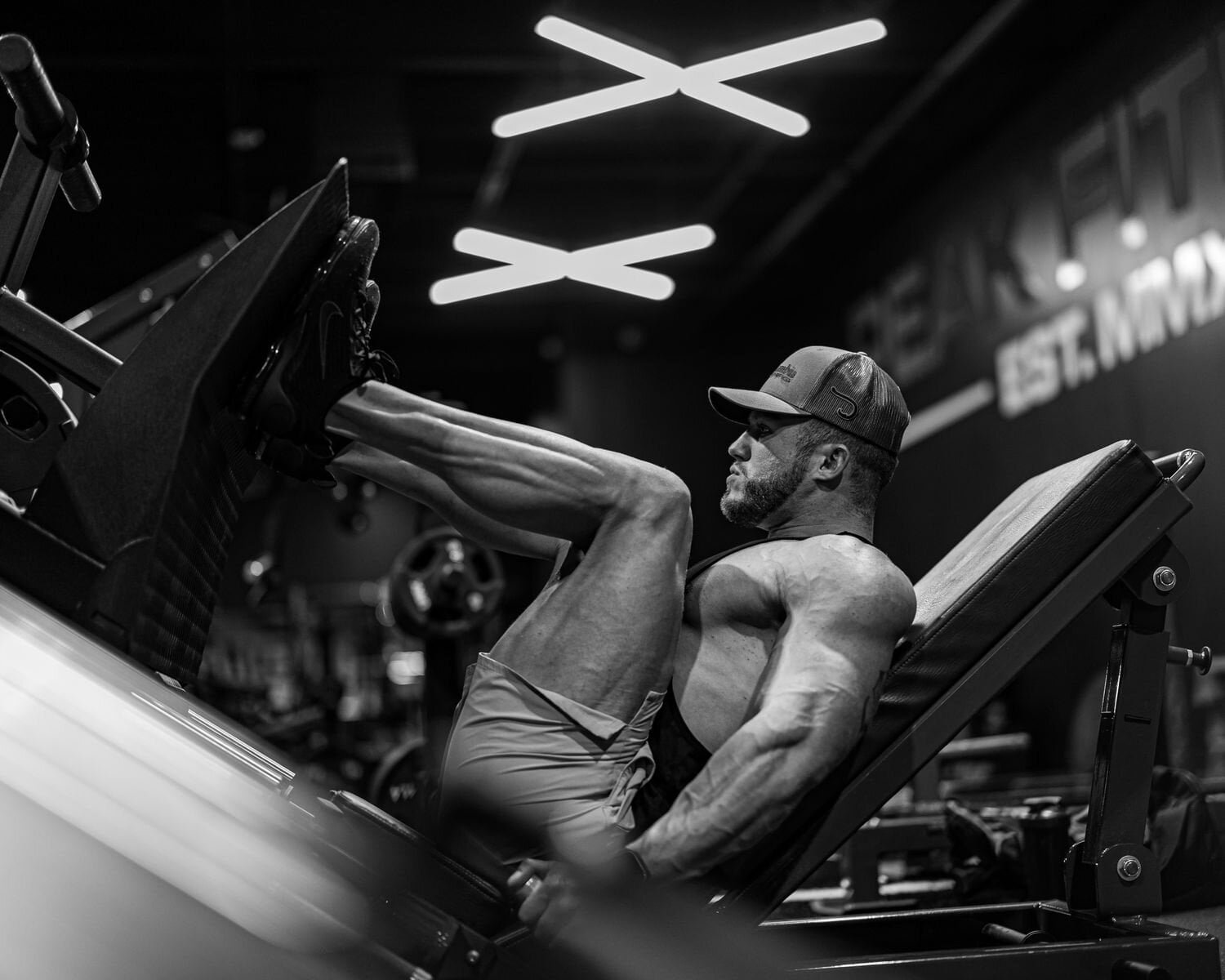
However, using more weight does not automatically produce better results. Proper leg press form requires a stable back and pelvis, flat feet, controlled movement, and knees that track in the same direction as your toes.
This guide explains how to use the leg press machine correctly, which muscles it works, how to adjust your foot position, and how to choose the right weight, sets, and repetitions.
What Is a Leg Press?
A leg press is a machine-based resistance exercise in which you push a platform, sled, seat, or lever away from your body by extending your hips and knees.
The most common types are:
- 45-degree leg press: You sit at an incline and push a weighted sled upward along rails.
- Horizontal leg press: You sit more upright and push a platform or move your seat backward.
- Vertical leg press: You lie on your back and press the platform upward.
- Iso-lateral leg press: Each leg moves a separate lever, allowing the sides to work independently.
The exact movement and resistance can differ significantly between machines. A 200-pound leg press on one model may not feel the same as 200 pounds on another because the sled angle, lever system, starting resistance, and friction can all change the actual demand.
For that reason, track your progress on the same machine whenever possible instead of comparing your leg press weight with someone using different equipment.
How to Do the Leg Press With Proper Form
The exact setup will depend on the machine, but the main technique principles remain similar.
The NASM leg press guide recommends supporting the back and head against the pad, using a stable foot position, bracing the body, and controlling both phases of the movement.
How to Set Up the Leg Press Machine
Before adding a challenging amount of weight:
- Sit with your head, upper back, lower back, and pelvis supported by the backrest.
- Adjust the seat so your knees are comfortably bent without being forced tightly against your chest.
- Place your feet approximately hip- to shoulder-width apart.
- Keep your heels and the balls of your feet in contact with the platform.
- Point your toes forward or slightly outward.
- Confirm that you can reach the handles and safety mechanism.
- Practice the movement with a light load before beginning your working sets.
A knee bend of approximately 90 degrees is a practical starting position on many seated machines. It is not a universal requirement, however. Your body proportions, mobility, comfort, and the machine’s design should determine the final setting.
Step-by-Step Leg Press Instructions
1. Establish Your Foot Position
Place both feet firmly on the platform. Your knees should point in roughly the same direction as your second and third toes.
Do not begin with an extremely wide, narrow, high, or low position. A comfortable stance near hip or shoulder width is the most reliable starting point.
2. Brace Your Body
Hold the handles and gently tighten your abdominal muscles. Keep your pelvis, lower back, and upper back against the support pad.
Release the machine’s safety handles only after you are stable.
3. Lower the Weight Slowly
Bend your hips and knees as the platform moves toward you. Use a smooth, controlled tempo rather than allowing the weight to drop.
Continue until you reach the deepest position you can control without:
- Lifting your heels
- Allowing your knees to collapse inward
- Rounding your lower back
- Letting your pelvis roll away from the seat
- Feeling sharp joint pain
- Losing control of the sled
The deepest possible leg press is not necessarily the best depth for your body.
4. Press Through Your Whole Foot
Push the platform away by extending your hips and knees. Maintain pressure through your heel, midfoot, and forefoot instead of pressing only through your toes.
Keep your knees aligned with your feet throughout the movement.
5. Finish Without Forcefully Locking Your Knees
Extend your legs until your knees are nearly straight, but do not rapidly snap them backward or rest the sled on hyperextended knees.
Maintain muscular control and begin the next repetition smoothly.
6. Secure the Machine
After your final repetition, return the safety mechanism to its fully secured position before moving your feet or leaving the machine.
The ACE seated leg press instructions similarly recommend keeping the back and pelvis against the pad, maintaining heel contact, avoiding knee hyperextension, and controlling the return phase.
How to Breathe During the Leg Press
Use a steady breathing pattern:
- Inhale as you lower the platform.
- Exhale as you press it away.
Avoid holding your breath through several repetitions, especially if you are a beginner or have blood-pressure concerns. The American Heart Association notes that breath-holding during exercise can raise blood pressure.
Experienced strength athletes sometimes use a brief breath-hold to brace during very heavy efforts. That technique is different from unintentionally holding your breath through an entire set and may not be appropriate for everyone.
Leg Press Muscles Worked
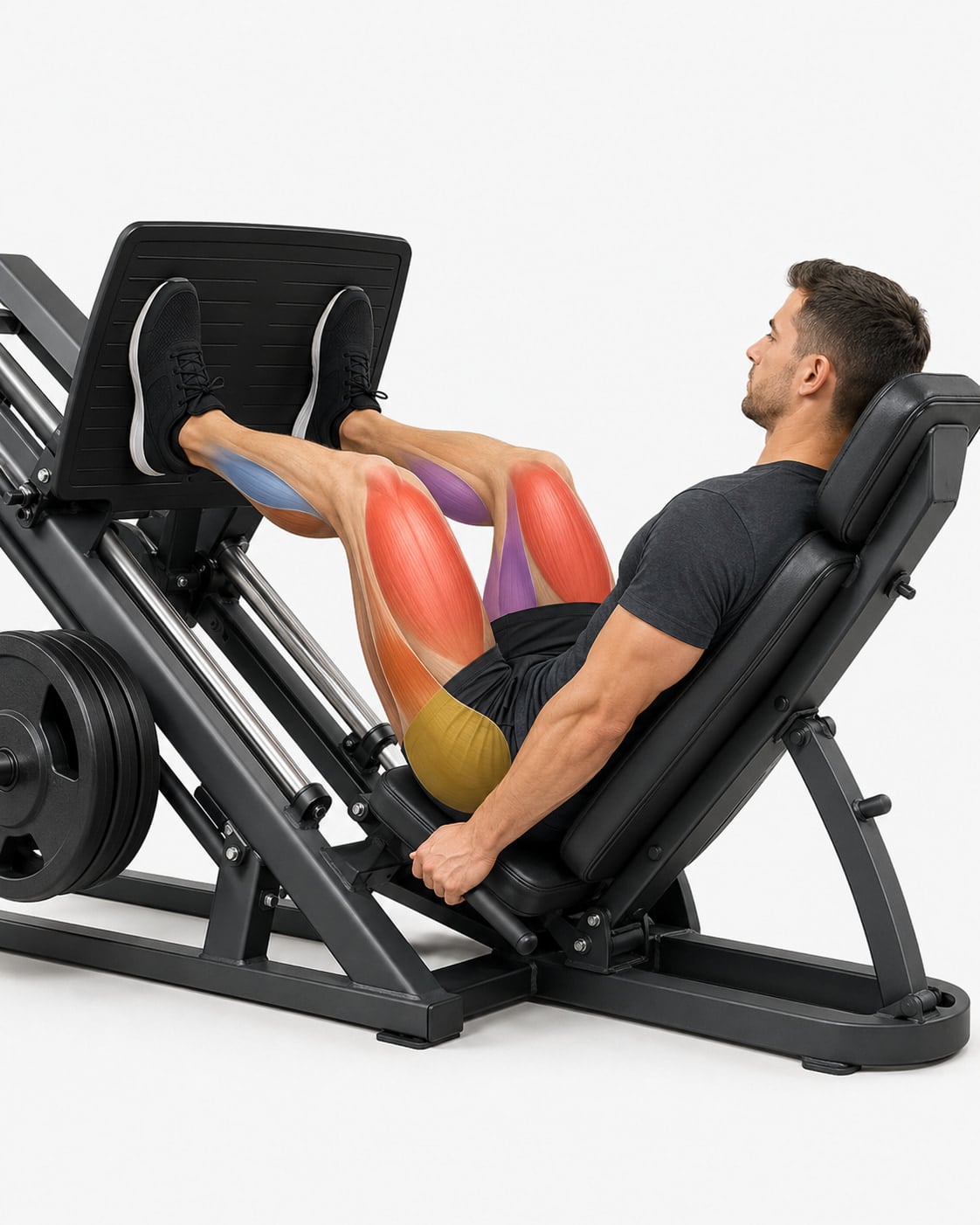
The leg press is a multi-joint exercise involving movement at both the knees and hips.
A systematic review of leg press muscle activation found that the quadriceps generally demonstrated the highest muscle activity during the exercise.
Primary Muscles Worked
Quadriceps
The quadriceps on the front of your thighs are the main muscles used during the leg press. Their primary job is to extend, or straighten, your knees as you push the platform away.
The quadriceps group includes:
- Vastus lateralis
- Vastus medialis
- Vastus intermedius
- Rectus femoris
The leg press can be especially useful for adding quadriceps training volume because the supported position reduces some of the balance and coordination demands found in standing exercises.
Gluteus Maximus
Your gluteus maximus contributes to hip extension as you press away from the bottom position.
Glute involvement generally becomes more noticeable when the movement includes greater hip flexion. However, you should not force extra depth if your pelvis begins lifting or your lower back rounds.
Secondary Muscles Worked
Hip Adductors
The inner-thigh muscles help control the hips and may assist with hip extension, particularly when pressing from a deeper position.
Hamstrings
The hamstrings contribute to hip movement and knee stability, but they are generally not the primary target of a standard leg press.
The exercise does not train the hamstrings through their main knee-flexion function. Include exercises such as leg curls, Romanian deadlifts, or other hip hinges when complete hamstring development is a goal.
Calves
The calf muscles help stabilize your ankles and maintain foot contact. They do not receive the same direct stimulus as they would during a calf raise.
Core and Trunk Muscles
Your abdominal and trunk muscles help stabilize your body, but the backrest reduces their demand compared with an unsupported squat or lunge.
Benefits of the Leg Press
Builds Lower-Body Strength
The leg press allows you to progressively challenge the muscles responsible for knee and hip extension.
As strength improves, you can gradually increase the resistance, repetitions, sets, or controlled range of motion. These progressive changes give your muscles a reason to adapt.
Supports Quadriceps and Glute Muscle Growth
The leg press can provide a strong training stimulus for the quadriceps and glutes when you use an appropriate load and perform enough challenging sets.
In March 2026, the American College of Sports Medicine published updated resistance-training recommendations based on 137 systematic reviews involving more than 30,000 participants. The 2026 resistance-training guidelines emphasize that consistency matters more than complicated programming and that approximately 10 weekly sets per muscle group may help optimize muscle growth.
Those weekly sets do not all need to come from the leg press. Squats, split squats, step-ups, lunges, and leg extensions can also contribute to your total quadriceps volume.
Provides a Stable Training Position
The machine guides the resistance and supports your torso. This can make it easier to focus on your legs without worrying as much about balance or holding a barbell.
That stability may benefit:
- Beginners learning resistance training
- People who do not feel confident with barbell squats
- Lifters adding leg volume after another compound exercise
- People whose grip or upper-body fatigue limits free-weight exercises
A stable machine is not automatically injury-proof. Poor setup, excessive loading, uncontrolled repetitions, and incorrect safety-bar use can still create problems.
Makes Progressive Overload Easy to Track
Most leg press machines allow small and measurable increases in resistance. You can also track repetitions and sets without needing to judge bar position or balance.
Keep in mind that numbers should only be compared on the same machine. Different leg press designs can produce different levels of effective resistance.
Allows Hard Leg Training With Less Balance Demand
Balance and torso control sometimes become the limiting factors in squats and lunges before the leg muscles are fully challenged.
Because the leg press reduces those demands, you may be able to train your quadriceps and glutes closer to their muscular limits while maintaining a stable position.
Can Be Performed One Leg at a Time
A single-leg press trains each side independently. This may help you identify and gradually address noticeable side-to-side differences.
Use considerably less resistance than you use for a two-leg press. Keep your pelvis level and supported rather than twisting toward the working side.
Leg Press Foot Placement Explained
Foot placement can change your comfort, range of motion, and the relative amount of movement at your hips and knees. However, it cannot completely isolate one lower-body muscle.
A study comparing different stance widths and toe angles found no significant differences in muscle activation among the tested foot positions. The researchers suggested that users could choose a comfortable stance while maintaining proper mechanics.
Standard Foot Placement
For most people, begin with:
- Feet hip- to shoulder-width apart
- Toes forward or slightly outward
- Heels flat
- Knees tracking over the toes
This position provides a stable baseline from which you can make small adjustments.
High Foot Placement
Moving your feet slightly higher usually reduces some knee travel and increases the amount of hip movement. This may shift some emphasis toward the glutes.
A high position does not turn the leg press into a complete hamstring exercise. Placing your feet too high can also shorten your effective range or make it harder to maintain stable contact with the platform.
Low Foot Placement
A slightly lower position may create more knee flexion and increase the demand on the quadriceps.
Do not place your feet so low that your heels rise, your ankles feel restricted, or you cannot control the bottom position.
Wide Foot Placement
A moderately wider stance may feel more comfortable for people with certain hip structures or mobility levels. It can also involve more hip movement.
Avoid forcing an extreme width. Your knees should continue tracking in the direction of your toes.
Narrow Foot Placement
A narrow stance may feel more quadriceps-focused, but it can reduce stability or create uncomfortable knee and hip positions for some people.
Keep enough space between your feet to maintain balance and prevent your knees from collapsing inward.
The Best Foot Position
The best position is the one that allows you to:
- Keep your entire foot on the platform
- Maintain knee-to-toe alignment
- Keep your pelvis and back supported
- Use a controlled, pain-free range
- Apply pressure evenly through both legs
Small changes are reasonable. Extreme positions are rarely necessary.
How Deep Should You Leg Press?
Lower the platform as far as you can while maintaining control and a stable pelvis.
End the downward phase when any of the following occurs:
- Your lower back begins rounding.
- Your pelvis lifts or rolls away from the pad.
- Your heels leave the platform.
- Your knees collapse inward.
- Your upper thighs compress heavily against your torso.
- You experience sharp pain.
- You cannot reverse the movement without bouncing.
A 2025 study involving 23 resistance-trained adults compared leg presses performed to approximately 100 degrees of knee flexion with a deeper individualized range averaging approximately 154 degrees. After eight weeks, both conditions produced similar quadriceps growth. Because the study was small and involved trained participants, it should not be interpreted as proof that depth never matters.
The practical goal is not to force the deepest possible repetition or deliberately shorten every repetition. Use the largest controlled range your body and machine allow.
Leg Press Sets, Reps, and Weight
The best number of sets and repetitions depends on your goal, experience, and total training program.
| Training goal | Practical leg press starting point |
|---|---|
| Beginner or general fitness | 2–3 sets of 8–12 repetitions |
| Muscle growth | 3–4 sets of 6–15 repetitions |
| Maximum strength | 2–3 sets of 3–6 repetitions with heavier resistance |
| Muscular endurance | 2–3 sets of 12–20 repetitions |
| Single-leg training | 2–3 sets of 8–15 repetitions per side |
These are flexible ranges, not strict rules. Muscle growth can occur across a wide range of repetitions when sets are sufficiently challenging and technique remains controlled.
How Much Weight Should You Use?
Choose a resistance that allows you to complete every repetition with similar form.
For most muscle-building sets, finish with approximately one to three good repetitions still possible. You should feel challenged, but you should not need to:
- Bounce the sled
- Shorten your range noticeably
- Push on your knees with your hands
- Lift your hips from the pad
- Lock your knees aggressively
- Let one side take over
The 2026 ACSM position stand reported that training to complete muscular failure is not required for the average healthy adult. It also found that heavier loads of approximately 80% of one-repetition maximum or more are most relevant when maximizing strength is the main goal.
Beginners do not need to test a one-repetition maximum on the leg press. A moderate weight that can be controlled for 8–12 repetitions is a more practical place to start.
How to Progress
Use a simple double-progression method:
- Select a repetition range, such as 8–12.
- Begin with a weight you can control for about eight repetitions.
- Gradually add repetitions over future workouts.
- Once you can complete 12 controlled repetitions in every set, increase the weight by the smallest available amount.
- Return to the lower end of the repetition range and build up again.
Increase only one variable at a time. Adding weight, sets, repetitions, and depth simultaneously can make it difficult to judge whether you are recovering properly.
Leg Press vs. Squat
The leg press and squat both train the lower body, but they are not identical exercises.
| Leg press | Squat |
|---|---|
| Machine guides the movement | Lifter controls the full movement |
| Back is supported | Trunk must stabilize the body |
| Lower balance demand | Higher balance and coordination demand |
| Easy to add quadriceps volume | Trains standing movement mechanics |
| Strength transfers strongly to leg pressing | Strength transfers strongly to squatting |
| Machine design affects resistance | External load is easier to standardize |
A 2023 systematic review and meta-analysis found no clear overall difference in muscle growth between machine-based and free-weight training. However, strength improvements were specific to the type of exercise practiced: machine training improved machine strength more, while free-weight training improved free-weight strength more.
Therefore:
- Choose the leg press when you want stability, accessible loading, and additional quadriceps-focused volume.
- Choose the squat when improving squat performance, balance, trunk control, or standing movement skills is important.
- Use both when they fit your goals, recovery, and available equipment.
The leg press can replace squats in some programs, but it does not reproduce every demand of a standing squat.
Common Leg Press Mistakes
Using Too Much Weight
Excessive resistance often leads to shallow repetitions, bouncing, knee collapse, or movement of the lower back.
Fix: Reduce the weight until you can control the entire repetition.
Lowering Until the Lower Back Rounds
When the platform comes too close, the pelvis may roll backward and pull the lower back away from the pad.
Fix: Stop the downward phase immediately before your pelvis begins moving.
Performing Only Very Shallow Repetitions
Some lifters shorten the movement simply to display more weight.
Fix: Use a meaningful individualized range rather than choosing the load first and allowing it to determine your depth.
Allowing the Knees to Collapse Inward
Knee collapse can signal that the load, stance, or level of control is inappropriate.
Fix: Reduce the resistance and keep your knees moving in the same direction as your toes.
Lifting the Heels
Heel lift reduces stability and may indicate that your feet are too low or your ankle mobility cannot support the chosen depth.
Fix: Move your feet slightly higher or shorten the range until the whole foot remains planted.
Bouncing Out of the Bottom
Using momentum reduces control and can expose the joints to a sudden increase in force.
Fix: Lower the platform slowly, pause briefly if needed, and press without rebounding.
Forcefully Locking the Knees
Snapping the knees backward shifts stress away from the muscles and onto the joint structures.
Fix: Finish with controlled knee extension without hyperextending.
Pressing Unevenly
One leg may contribute more than the other, especially as fatigue increases.
Fix: Use a lighter load, check that your feet are positioned evenly, and consider controlled single-leg work when appropriate.
Ignoring the Safety Mechanism
Entering, exiting, or adjusting your feet before the sled is secured can be dangerous.
Fix: Learn how the machine’s safety handles and stops work before loading it.
Leg Press Safety Tips
Warm up before your heavy sets. Start with five to ten minutes of general movement if needed, followed by one to three lighter leg press sets.
Additional safety practices include:
- Inspect the machine before using it.
- Load both sides evenly on plate-loaded machines.
- Use safety stops when available.
- Keep your head and back supported.
- Control every repetition.
- Wear shoes that provide stable platform contact.
- Avoid sudden, large increases in resistance.
- Breathe regularly.
- Secure the machine before changing your foot position.
- Ask a qualified trainer for help when using an unfamiliar machine.
Stop the exercise if you experience sharp or worsening pain, numbness, tingling, sudden weakness, dizziness, faintness, or chest discomfort.
People recovering from surgery or managing a significant knee, hip, spinal, blood-pressure, or cardiovascular condition should obtain individualized guidance from a qualified healthcare or exercise professional before performing heavy leg presses.
Frequently Asked Questions About the Leg Press
What muscles does the leg press work?
The leg press primarily works the quadriceps. It also trains the gluteus maximus, hip adductors, and hamstrings, while the calves and trunk muscles provide additional stabilization.
Does the leg press work the glutes?
Yes. Your glutes help extend your hips as you push the platform away. A controlled range that includes comfortable hip flexion may increase their contribution, but you should not lower so deeply that your pelvis lifts from the pad.
Is the leg press better than squats?
Neither exercise is universally better. The leg press provides more external stability and requires less balance, while the squat requires more trunk control and standing coordination. Your goals should determine which one you prioritize.
Is the leg press bad for your knees?
The leg press is not automatically bad for healthy knees. Problems are more likely when the load is excessive, the knees collapse inward, the heels lift, or the user forces a painful range.
People with an existing knee injury or persistent knee pain should seek individualized guidance instead of assuming one technique will be appropriate for every condition.
How deep should you go on the leg press?
Lower the platform as far as you can without pain, heel lift, knee collapse, loss of control, or movement of your pelvis and lower back away from the pad. The correct depth varies by person and machine.
Where should your feet be placed?
Begin with your feet approximately hip- to shoulder-width apart and your toes pointing forward or slightly outward. Keep your heels down and your knees aligned with your toes.
How much weight should a beginner leg press?
There is no universal starting weight because machines use different angles and resistance systems. Begin with a light load you can perform for 8–12 controlled repetitions while keeping your back supported, feet flat, and knees aligned.
Conclusion
The leg press is an effective exercise for building quadriceps, glute, and overall lower-body strength. Its supported position makes it accessible, but good results still depend on careful setup, controlled repetitions, an appropriate range of motion, and gradual progression.
Start with a moderate load, keep your whole foot on the platform, stop before your lower back rounds, and avoid chasing weight at the expense of technique. Record your sets, repetitions, and machine settings so you can make small, measurable improvements over time.
References
- American College of Sports Medicine — 2026 Resistance Training Guidelines
- National Academy of Sports Medicine — Leg Press Exercise Guide
- American Council on Exercise — Seated Leg Press Instructions
- PubMed — Systematic Review of Leg Press Muscle Activation
- PubMed — Foot Position and Muscle Activation During the Leg Press
- PubMed — Leg Press Range of Motion and Quadriceps Growth
- PubMed — Free-Weight vs. Machine-Based Strength Training
- American Heart Association — Exercise, Breathing, and Blood Pressure