

How many calories should a woman eat a day? The National Academies’ reference examples for adult women range from about 1,700 to 2,700 calories per day for weight maintenance, but your personal needs can be higher or lower. Your age, body size, activity, and life stage all matter.
The familiar 2,000-calorie number is not a prescription for every woman. According to the FDA’s nutrition-label guidance, it is a general reference used for nutrition advice.
Start with the age-and-activity chart below. Then use your own measurements to estimate your needs, keeping maintenance, weight-change goals, pregnancy, and breastfeeding separate.
How Many Calories Should a Woman Eat a Day by Age and Activity?
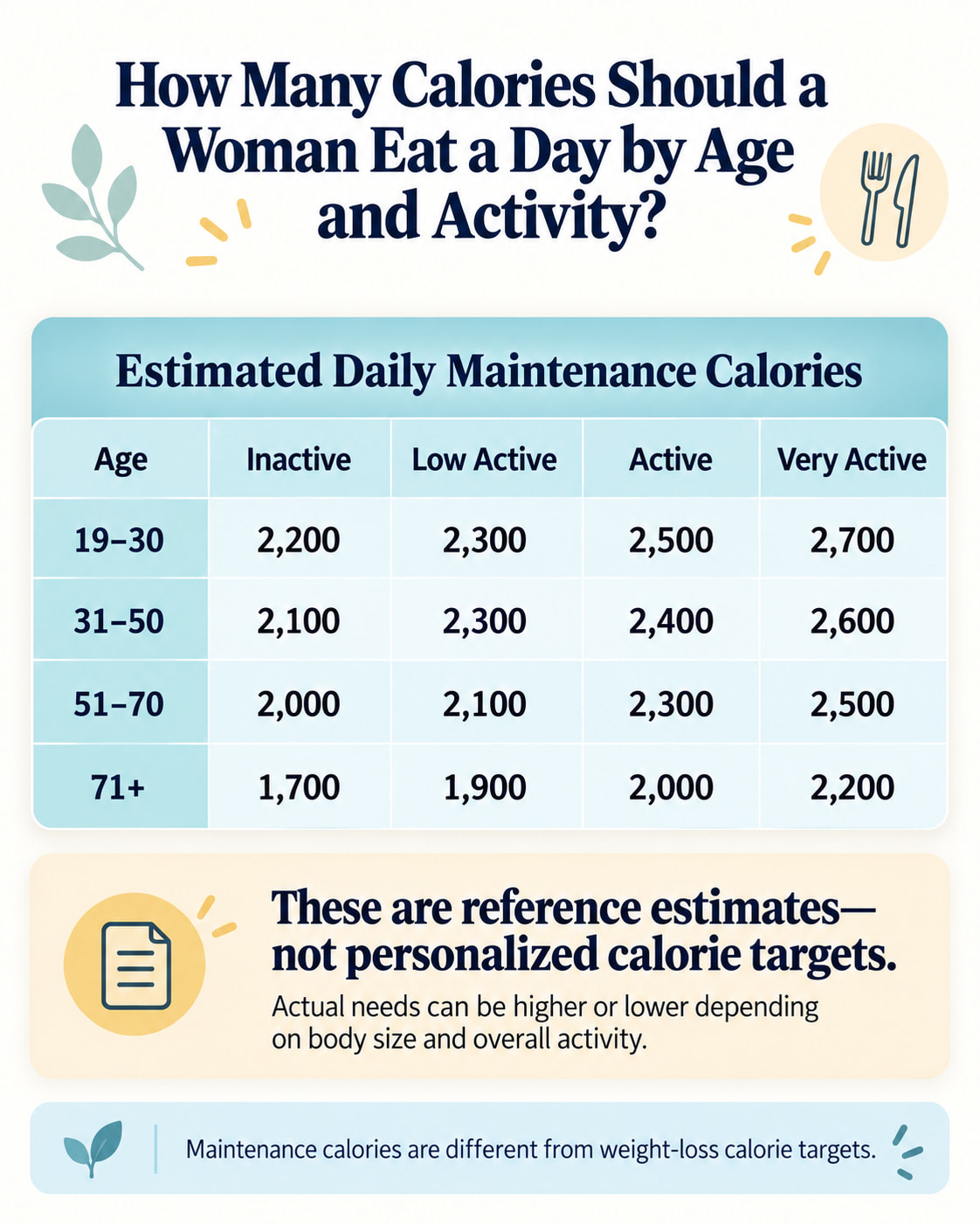
The following chart uses reference estimates from the National Academies’ 2023 Dietary Reference Intakes for Energy. Numbers are rounded to the nearest 100 calories.
Estimated Daily Maintenance Calories for Adult Women
| Age | Inactive | Low Active | Active | Very Active |
|---|---|---|---|---|
| 19–30 | 2,200 | 2,300 | 2,500 | 2,700 |
| 31–50 | 2,100 | 2,300 | 2,400 | 2,600 |
| 51–70 | 2,000 | 2,100 | 2,300 | 2,500 |
| 71+ | 1,700 | 1,900 | 2,000 | 2,200 |
Source: National Academies, Table 7-10. Calculations use median U.S. heights and weights from NHANES 2015–2018 and representative ages of 25, 40, 60, and 80 for the respective groups.
These are maintenance examples—not weight-loss targets, minimum intakes, or limits. They do not include pregnancy or breastfeeding adjustments.
Maintenance calories are the energy intake that supports a stable body weight over time. A reference chart cannot determine that amount precisely for you because actual requirements vary even among people with similar measurements and activity levels.
How to Choose Your Activity Level
Consider your whole day, including work, transportation, household tasks, and recreation—not only scheduled workouts.
The chart’s activity categories broadly describe increasing amounts of daily movement:
| Category | General Description |
|---|---|
| Inactive | Basic daily activities with little additional physical activity. |
| Low active | Regular additional movement through work or recreation beyond basic daily living. |
| Active | Substantial movement across the day, from occupational activity, exercise, or both. |
| Very active | A high overall activity load, such as strenuous work or prolonged vigorous activity. |
These descriptions are orientation tools, not precise tests. The National Academies notes that activity categories cannot reliably be assigned simply by whether someone meets weekly exercise recommendations.
For example, two women might attend the same three weekly exercise classes. One works at a desk, while the other spends much of her workday moving. Their workout schedules alone would not capture that difference.
When using a calculator, read its activity descriptions rather than assuming that “active” means the same thing across every tool.
How to Estimate Your Personal Calorie Needs
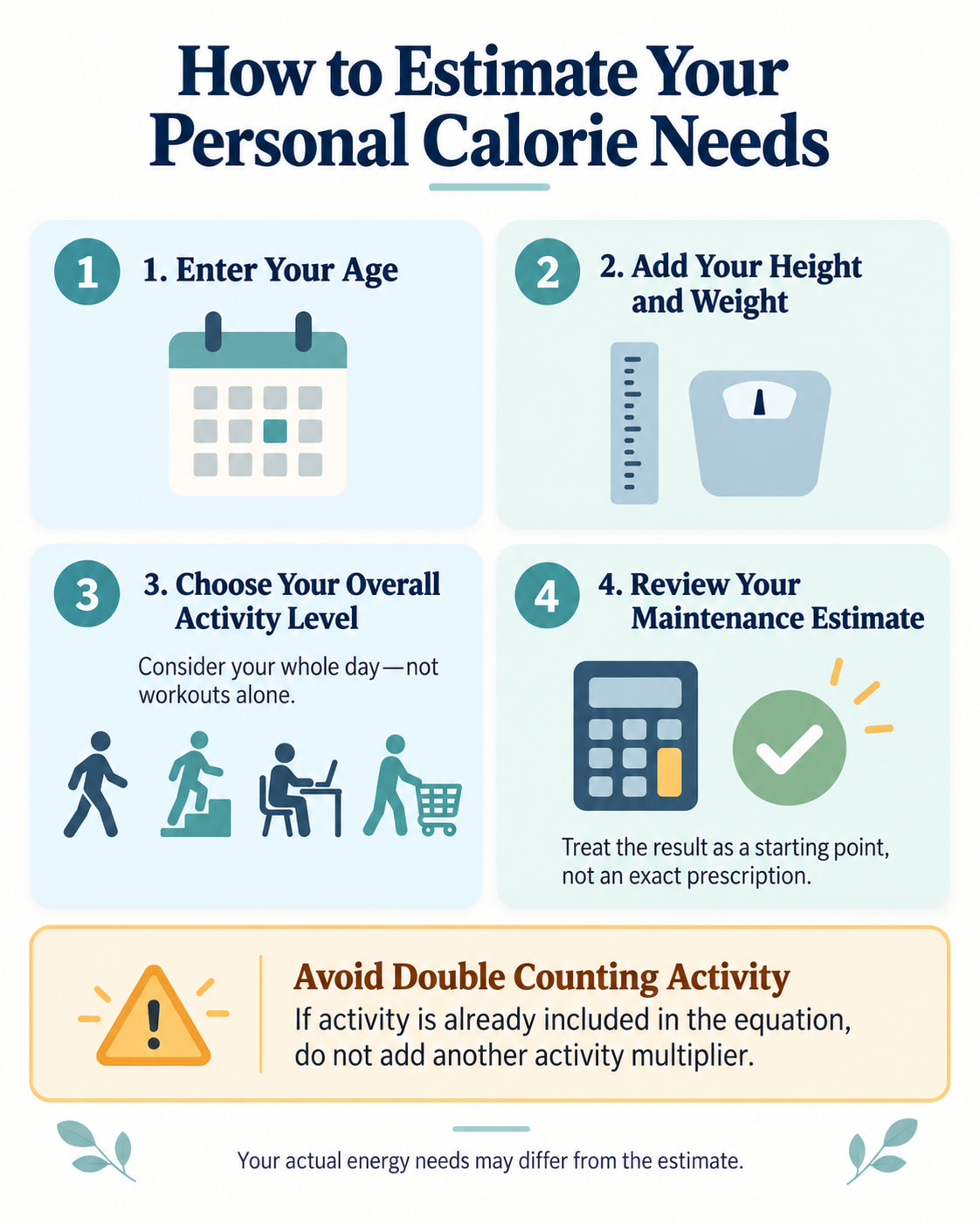
Start With Your Measurements and Daily Activity
The USDA DRI Calculator estimates daily calorie needs using age, sex, height, weight, and activity. It also includes pregnancy and breastfeeding options. USDA cautions that individual requirements may be above or below its estimates.
Enter your own measurements rather than using the reference chart’s body-size assumptions. Select the appropriate life-stage option, and check the units carefully.
Look for an estimate of total daily energy needs, not just resting metabolism. The adult Estimated Energy Requirement equations estimate whole-day maintenance needs, including the selected activity category.
Review a Worked Example
Consider a fictional woman who is:
- 35 years old
- 165 centimeters tall, approximately 5 feet 5 inches
- 65 kilograms, approximately 143 pounds
- Low active for this example
The National Academies’ low-active equation for adult women is:
Daily calories = 575.77 − (7.01 × age) + (6.60 × height in centimeters) + (12.14 × weight in kilograms)
Using the example measurements:
575.77 − (7.01 × 35) + (6.60 × 165) + (12.14 × 65) ≈ 2,200 calories per day
This is an estimated maintenance intake—not a guaranteed requirement or a weight-loss target.
Because the equation already accounts for an activity category, multiplying the result by another activity factor would double-count that adjustment.
Check the Estimate Over Time
The National Academies describes calorie planning as a two-step process: calculate an estimate, then monitor body weight over time and adjust intake when appropriate. An equation cannot fully capture individual variation.
For maintenance, review the longer-term pattern rather than treating one measurement as a verdict. Also consider whether your activity routine or circumstances have changed.
A stable weight does not prove that your diet supplies every nutrient you need. Nutritional deficiencies can occur at different body sizes, so calorie balance and nutritional adequacy should be considered separately.
Do Women Need Fewer Calories as They Age?
Calorie needs may decrease with age, particularly when daily activity decreases. However, that does not mean every woman should automatically cut her intake at a particular birthday. Body size and activity remain important when estimating needs.
Menopause also deserves a careful explanation. The Menopause Society distinguishes aging-related weight gain from menopause-related changes in fat distribution, including a greater tendency to store fat around the abdomen. Not every midlife weight change has the same cause.
The practical approach is to reassess your current routine and measurements—not adopt a universal “menopause calorie target.”
Older adults may also need fewer calories without needing fewer nutrients. That makes nutrient-rich food choices especially useful when appetite or energy requirements decrease.
What Changes for Weight Loss or Weight Gain?
The main chart estimates maintenance, so it should not be read as a ready-made weight-loss plan.
Weight loss generally requires an energy deficit over time, while weight gain requires an energy surplus. However, the National Academies’ maintenance equations do not directly prescribe an appropriate intake for either goal.
For intentional weight loss, choose an approach that accounts for your health, food preferences, and ability to maintain the eating pattern. NIDDK guidance recommends individualized, realistic plans rather than promises of rapid results.
Two useful checks before changing your intake are:
- Confirm what the calculator produced. A maintenance estimate and a weight-loss target are different outputs; do not subtract a deficit twice.
- Consider nutritional adequacy. A lower number is not automatically a more appropriate number.
The NIDDK Body Weight Planner provides personalized estimates for weight-change goals, but it is intended for adults and is not designed for pregnant or breastfeeding women.
How Do Calorie Needs Change During Pregnancy and Breastfeeding?
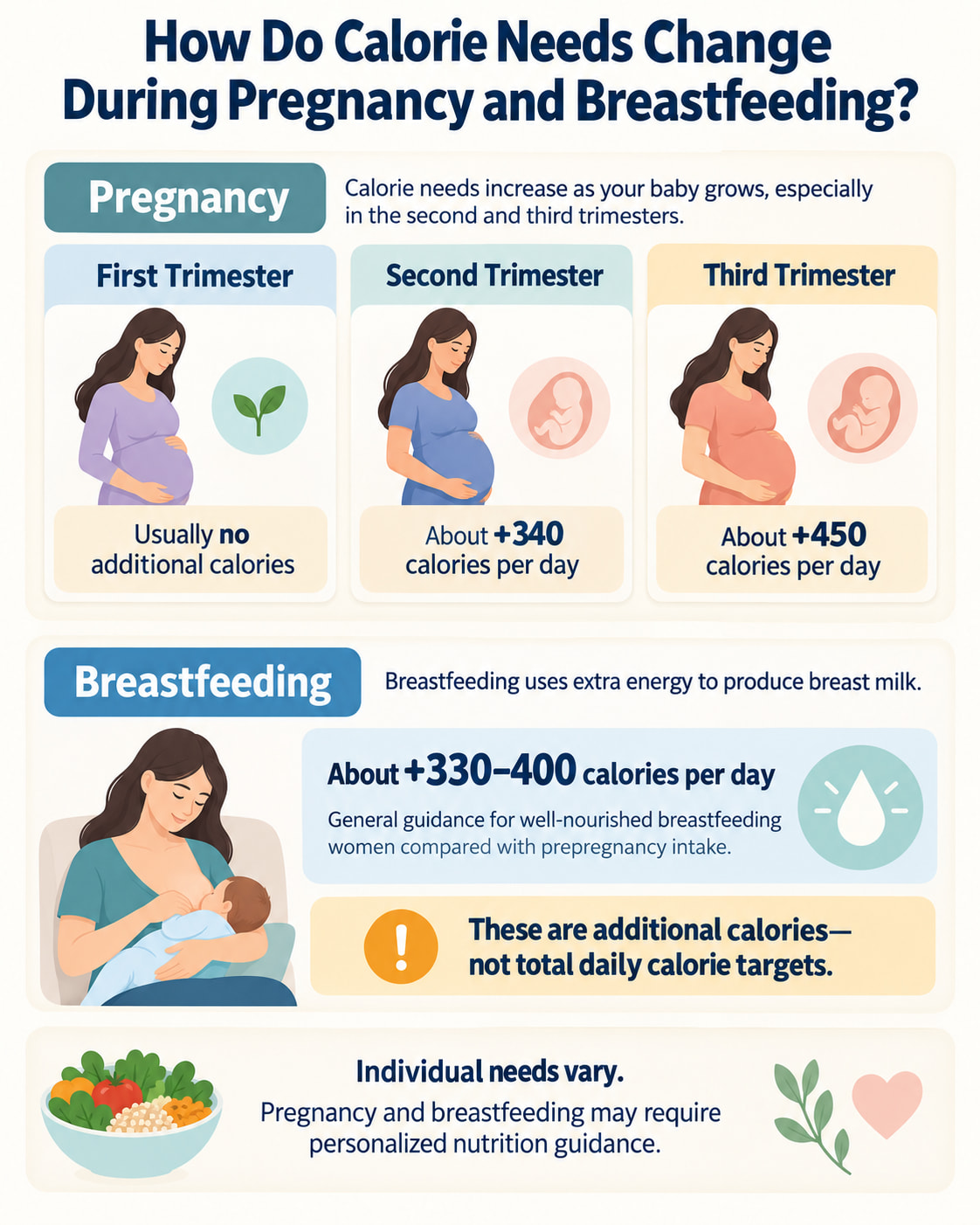
Pregnancy and breastfeeding require separate consideration. Do not use the ordinary maintenance chart alone to set an intake for these stages.
During Pregnancy
According to CDC pregnancy guidance, the general additional-energy recommendations are:
| Pregnancy Stage | General Additional Calories per Day |
|---|---|
| First trimester | Usually no additional calories |
| Second trimester | About 340 additional calories |
| Third trimester | About 450 additional calories |
These are additions to prepregnancy needs, not total daily calorie targets.
The CDC recommends working with your prenatal care professional to review your needs and pregnancy weight-gain pattern.
“No additional calories” in the first trimester does not mean eating less than you need. It means that pregnancy generally does not require an extra calorie allowance at that stage.
While Breastfeeding
According to the CDC’s breastfeeding nutrition guidance, well-nourished breastfeeding women generally need 330–400 additional calories per day compared with their intake before pregnancy.
The amount varies with factors including age, body size, activity, and whether breastfeeding is exclusive or combined with formula feeding.
These figures refer to the prepregnancy baseline—not the pregnancy intake plus another increase.
Why Food Quality Matters Alongside Calories
A calorie total tells you about energy, not whether your eating pattern supplies enough protein, fiber, vitamins, and minerals.
The FDA highlights fiber, vitamin D, calcium, iron, and potassium as nutrients to pay attention to on food labels. Looking beyond the calorie number can help you compare foods more meaningfully.
Build meals around a variety of foods, such as:
- Vegetables
- Fruit
- Whole grains
- Beans and lentils
- Eggs
- Fish
- Poultry or other protein sources
- Dairy or appropriately fortified alternatives
- Nuts and seeds
These foods provide different nutrients rather than interchangeable calories alone.
For example, a meal might combine beans, brown rice, vegetables, and yogurt. Another could include eggs, whole-grain toast, and fruit. These are meal ideas—not fixed portions or calorie prescriptions.
The goal is an eating pattern that fits your needs, not simply reaching a number by the end of the day.
When to Get Personalized Nutrition Advice
Contact a healthcare professional about unintentional weight loss, persistent weakness, ongoing tiredness, or reduced appetite. These symptoms can be associated with inadequate nutrition, but they do not establish the cause on their own.
New or persistent menstrual changes also deserve attention. Missed periods can have several causes, including pregnancy, stress, sudden weight loss, and excessive exercise. Do not assume that changing calories alone will address the problem.
If tracking food leads to intense anxiety, rigid restriction, or preoccupation with weight and eating, seek support rather than tightening the rules. The National Institute of Mental Health identifies excessive fixation on controlling food intake as a possible warning sign of an eating disorder.
A general chart should support—not replace—individualized care.
Frequently Asked Questions
Is 2,000 Calories a Day Enough for a Woman?
It may be, but it is not a universal target. Depending on your measurements and activity, 2,000 calories could be above, below, or close to your needs.
The FDA uses 2,000 calories as a general nutrition reference, not an individualized meal-planning recommendation.
Is 1,200 Calories a Day Enough for a Woman?
Do not assume that it is.
Neither 1,200 nor 1,500 calories is appropriate for every woman. Your energy requirements and nutritional needs must be considered together. A calorie number alone cannot establish whether an eating plan is adequate.
How Many Calories Should a Woman Over 50 Eat a Day?
In the reference chart, estimated maintenance needs are approximately:
- 2,000–2,500 calories per day for ages 51–70
- 1,700–2,200 calories per day for ages 71 and older
The exact estimate depends on activity.
These figures use reference body sizes, so they should not be treated as personalized calorie targets.
Can an Active Woman Need More Than 2,400 Calories a Day?
Yes.
Several National Academies reference estimates exceed 2,400 calories per day. The chart’s highest value is also not an upper limit.
Your individual requirements depend on your body size and overall activity.
Should a Woman Eat the Same Number of Calories Every Day?
Not necessarily.
An estimated daily calorie requirement represents average needs rather than an obligation to eat exactly the same amount every day.
Small day-to-day differences are normal. Your longer-term intake, activity, body-weight pattern, and nutritional adequacy are more useful than trying to hit an identical number every day.
Conclusion
Use the calorie chart as a starting point, not a rulebook.
Your daily calorie needs depend on your age, body size, activity, and life stage. A woman may need more or fewer calories than a general chart suggests, even when she falls into the same age group as someone else.
Start by estimating your maintenance needs using your current measurements and whole-day activity. Then consider your health, goals, and eating pattern before making substantial changes.
If you are pregnant, breastfeeding, experiencing unexplained weight changes, or concerned that your intake may be too low, consider getting personalized guidance from a qualified healthcare professional or registered dietitian.
References
- National Academies — Estimated Energy Requirements for U.S. Females by Age and Physical Activity Level
- National Academies — Adult Estimated Energy Requirement Equations
- National Academies — Applications of the Dietary Reference Intakes for Energy
- National Academies — Dietary Reference Intakes for Energy Summary
- USDA — DRI Calculator for Healthcare Professionals
- FDA — How to Understand and Use the Nutrition Facts Label
- CDC — Weight Gain During Pregnancy
- CDC — Maternal Diet and Breastfeeding
- The Menopause Society — MenoNotes
- NIDDK — Health Tips for Older Adults
- NIDDK — Choosing a Safe and Successful Weight-Loss Program
- NIDDK — Body Weight Planner
- NHS — Malnutrition
- NHS — Missed or Late Periods
- NIMH — Eating Disorders
This content is for informational purposes only and not medical advice.