

How many calories do you burn running a mile? A 150-pound person burns an estimated 110 total calories running one mile at a 10-minute pace on level ground. Using the same calculation, a 120-pound person burns about 90 calories, while a 200-pound person burns about 150. These are estimates, not exact measurements.
Understanding what the number includes is just as important as knowing the number itself. Total calories include the energy you would have used at rest during those minutes. Active calories estimate the additional energy used through activity. The chart and examples below explain both.
Calories Burned Running a Mile by Weight
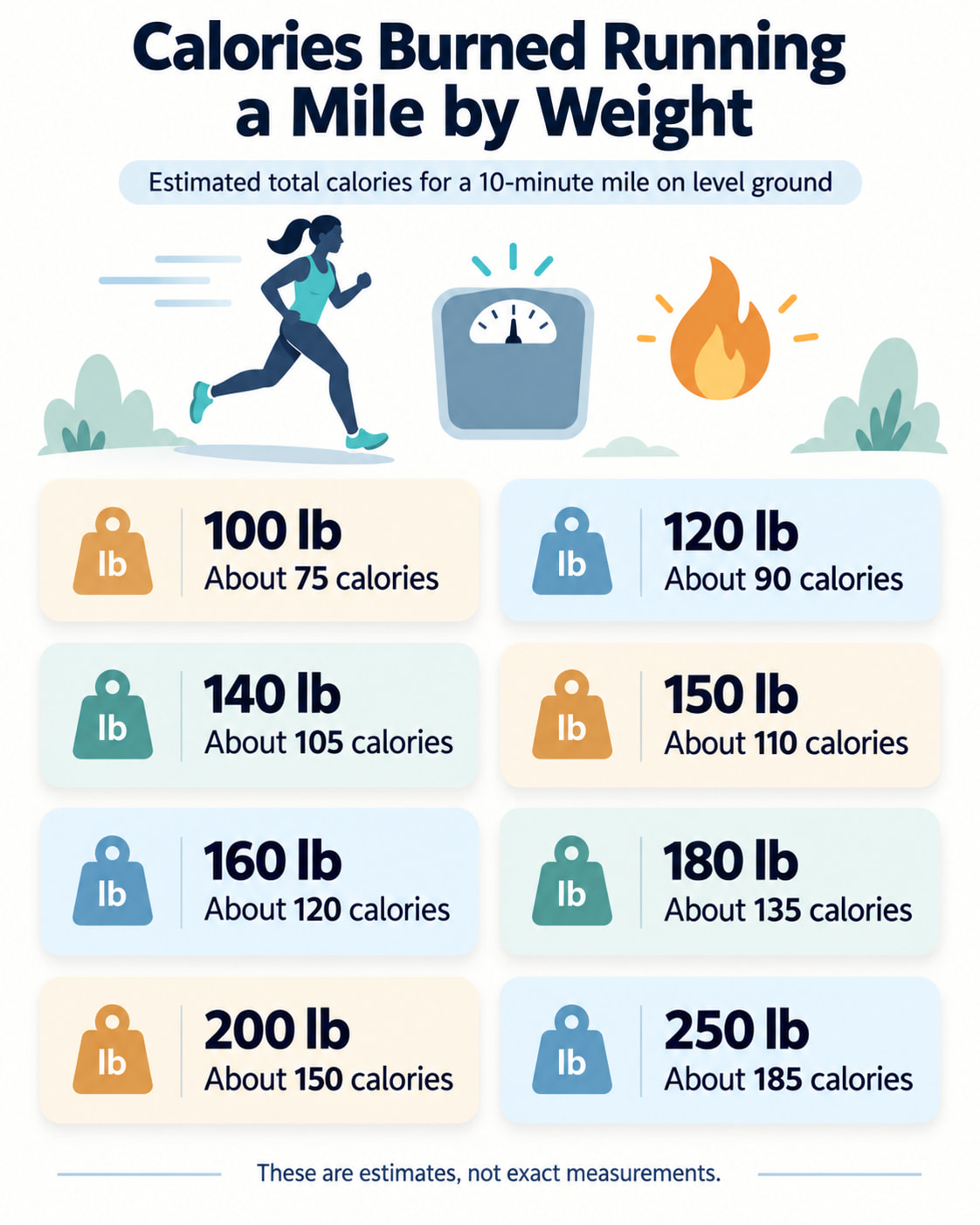
The 2024 Adult Compendium of Physical Activities assigns running at 6–6.3 miles per hour an intensity of 9.3 METs. METs are a standardized way to describe an activity’s energy demand. For this chart, the calculation uses exactly 6 mph, which means completing one mile in 10 minutes.
| Body weight | Approximate weight in kilograms | Estimated total calories per mile |
|---|---|---|
| 100 lb | 45.4 kg | 75 |
| 120 lb | 54.4 kg | 90 |
| 140 lb | 63.5 kg | 105 |
| 150 lb | 68.0 kg | 110 |
| 160 lb | 72.6 kg | 120 |
| 180 lb | 81.6 kg | 135 |
| 200 lb | 90.7 kg | 150 |
| 220 lb | 99.8 kg | 160 |
| 250 lb | 113.4 kg | 185 |
These are calculated estimates for continuous running without an added incline. Results are rounded to the nearest 5 calories using the Compendium’s MET value and calorie-conversion formula. They do not include a separate warm-up, cooldown, or recovery period.
Use the row nearest your weight as a starting point. A result of 110 calories does not mean your body used exactly 110 calories—or that a tracker showing a different number is necessarily correct.
How to Calculate Calories Burned Running a Mile
The Compendium’s calorie-conversion formula estimates calories per minute from activity intensity and body weight. Multiplying that result by your running time gives an estimated session total.
Estimated total calories = MET value × 3.5 × body weight in kilograms ÷ 200 × minutes
For a 150-pound runner, using approximately 68 kilograms and a 10-minute mile:
9.3 × 3.5 × 68 ÷ 200 × 10 = approximately 111 calories
That becomes 110 calories when rounded to the nearest 5, as shown in the chart.
For this specific 10-minute-mile model, a convenient shortcut is:
Estimated total calories per mile ≈ body weight in pounds × 0.74
The shortcut reproduces this chart’s assumptions. It is not a universal formula for every pace, incline, or running condition.
Total Calories vs. Active Calories
Total calories, sometimes called gross calories, include all the energy used during your run. Active calories, or calories above rest, exclude the estimated energy you would have used while resting during the same period.
The standard MET model represents resting expenditure as 1 MET. To estimate energy above rest, subtract 1 from the activity’s MET value before applying the formula. Actual resting energy use varies between individuals.
For the 150-pound runner’s 10-minute mile, the model gives approximately:
- 110 total calories during the run.
- 100 active calories above resting expenditure.
These describe the same run. Do not add them together.
When comparing a watch, treadmill, and online calculator, first check whether each number represents total or active calories.
Does Running Faster Burn More Calories per Mile?
Running faster generally increases calorie burn per minute, but it does not necessarily increase calories per mile by the same proportion. You are working at a higher rate, but you also finish the distance sooner.
For example, using Compendium values for a 150-pound runner:
| Pace | Estimated total calories for one mile |
|---|---|
| 10-minute mile at 6 mph | About 110 |
| 8-minute mile at 7.5 mph | About 110 |
The unrounded modeled estimates are approximately 111 and 112 calories, respectively. These calculations use 9.3 and 11.8 METs and are rounded to the nearest 5 calories.
This illustrates why calories per minute and calories per mile are different questions. It does not prove that every runner burns the same amount at both speeds.
Avoid choosing a harder pace solely because you expect a much larger calorie number for one mile.
What Else Affects Calories Burned Running a Mile?
Hills and Incline
Running uphill increases the energy required compared with level running at a similar speed. The Compendium lists higher MET values for uphill running than for its corresponding standard running categories.
Treat the weight chart as a level-running reference. It should not be interpreted as an accurate calculation for a steep treadmill session or a route with substantial climbing.
Running Economy
Two people of the same weight can use different amounts of energy at the same pace.
A 2015 review of running economy explains that the energy demand of running reflects several interacting factors, including physiology, movement mechanics, and neuromuscular characteristics. Running economy describes how much energy or oxygen a runner needs at a given submaximal speed.
That is why a weight-based calculator cannot fully personalize your result. Body weight is useful, but it does not capture everything about how you run.
Treadmill vs. Outdoor Running
Treadmill and overground running can have similar energy demands under controlled conditions. However, outdoor wind resistance and other environmental differences limit how directly laboratory estimates transfer to an outdoor route.
For practical tracking, record the treadmill incline or note whether your route was flat or hilly. Do not assume every treadmill mile is automatically easier—or that every outdoor mile burns a fixed percentage more.
Running vs. Walking a Mile: Which Burns More Calories?
Running generally burns more calories than ordinary walking over the same distance under comparable conditions. In a 2004 study comparing walking and running, researchers measured energy expenditure in 24 participants during treadmill exercise. A subgroup also completed track testing. Running 1,600 meters required more energy than walking that distance in both settings.
The study’s distance was slightly shorter than one mile, and its results do not establish a fixed difference for every person or walking speed.
The key is to compare like with like. A one-mile run versus a one-mile walk is a distance comparison. A 10-minute run versus a 30-minute walk is a different question.
How Accurate Are Running Calorie Estimates?
Calorie charts provide a useful reference, but they are not individual metabolic measurements. The Compendium explicitly states that it was not developed to determine a person’s precise energy expenditure.
Its 2024 adult estimates are intended for adults ages 19–59 without significant conditions affecting energy expenditure or metabolism. They should not be treated as equally validated estimates for children, pregnancy, every older adult, or people with relevant medical conditions. This is a limitation of the calculation, not a statement about who can run.
What About Smartwatches and Treadmill Displays?
An on-screen calorie number should also be treated as an estimate rather than an exact measurement.
A 2026 systematic review and meta-analysis of Apple Watch measurements found that energy-expenditure errors were variable and often substantial. Its calorie findings came from eight studies, and most evaluated older watch models. The results therefore do not establish one error percentage for every current device or every run.
Before comparing calorie estimates, check three things:
- The inputs: Use your current body weight and the correct activity and duration.
- The calorie category: Compare total calories with total calories, or active calories with active calories.
- The recording window: Make sure one estimate is not including a warm-up or cooldown that the other excludes.
Do not interpret a small difference between devices as proof that one has measured your run precisely.
How to Use Your Estimate Without Double Counting
A calorie estimate is best used as context, not as a score your workout must reach.
For example, suppose an app estimates your total daily expenditure and already includes your recorded run. Adding another 110 calories for that same run would count the activity twice.
Likewise, an estimate of 110 total calories does not mean you used 110 additional calories above your resting needs. Keep the distinction consistent with whatever tracking method you use.
Record your distance, time, and how the run felt alongside any calorie estimate. This gives you more information about the session than a calorie number alone.
Frequently Asked Questions
Does Jogging a Mile Burn 100 Calories?
It can, but 100 calories is not a universal result. In this article’s model, a 150-pound person running a 10-minute mile uses approximately 110 total calories, including about 100 calories above rest. A different weight or jogging pace changes the estimate.
How Many Calories Does a 200-Pound Person Burn Running a Mile?
Using the chart’s assumptions, a 200-pound person burns approximately 150 total calories during a 10-minute mile on level ground. That is a rounded calculation, not a measured individual result.
Can I Multiply the One-Mile Estimate for a Longer Run?
For a rough estimate, yes—provided you keep the same pace, incline, and calorie definition. Using the chart’s rounded figure, two similar miles for a 150-pound runner would be approximately 220 total calories.
For a more consistent calculation, use the full session duration in the formula and round only the final result.
What Changes When I Alternate Walking and Running?
Calculate the walking and running portions separately using an appropriate MET value and the time spent in each, then add the estimates. Applying a continuous-running value to the entire session does not account for the walking portions.
Do Age and Sex Change Calories Burned Running a Mile?
They can contribute to individual differences, but there is no single adjustment that makes this basic chart precise for everyone. Standard MET values do not individually correct for age, sex, or resting metabolism. A weight-based estimate should not be mistaken for a fully personalized assessment.
Does the Chart Include Calories Burned After the Run?
No. The calculation covers only the stated running time. It does not estimate any additional energy expenditure during recovery, nor does it include a separate warm-up or cooldown.
Conclusion
For a practical starting point, a 150-pound runner burns about 110 total calories during a 10-minute mile under this model. Your weight, pace, terrain, and running economy affect how closely that estimate matches your session.
Find your weight in the chart, check whether your tracker reports total or active calories, and use the result as a guide—not an exact target to chase.
References
- Compendium of Physical Activities. 2024 Adult Compendium: Running.
- Compendium of Physical Activities. Unit Conversions and Calorie-Calculation Formula.
- Compendium of Physical Activities. Corrected METs—Adults.
- Herrmann SD, et al. (2024). 2024 Adult Compendium of Physical Activities: A Third Update of the Energy Costs of Human Activities. Journal of Sport and Health Science.
- Barnes KR, Kilding AE. (2015). Running Economy: Measurement, Norms, and Determining Factors. Sports Medicine—Open.
- Hall C, et al. (2004). Energy Expenditure of Walking and Running: Comparison With Prediction Equations. Medicine & Science in Sports & Exercise.
- Lambe R, et al. (2026). The Accuracy of Apple Watch Measurements: A Living Systematic Review and Meta-Analysis. npj Digital Medicine.
This content is for informational purposes only and not medical advice.