
The benefits of Pilates for women may include better core strength, muscular endurance, flexibility, balance, and everyday movement. Pilates may also support posture, mental well-being, and sleep, although the evidence varies across these outcomes.
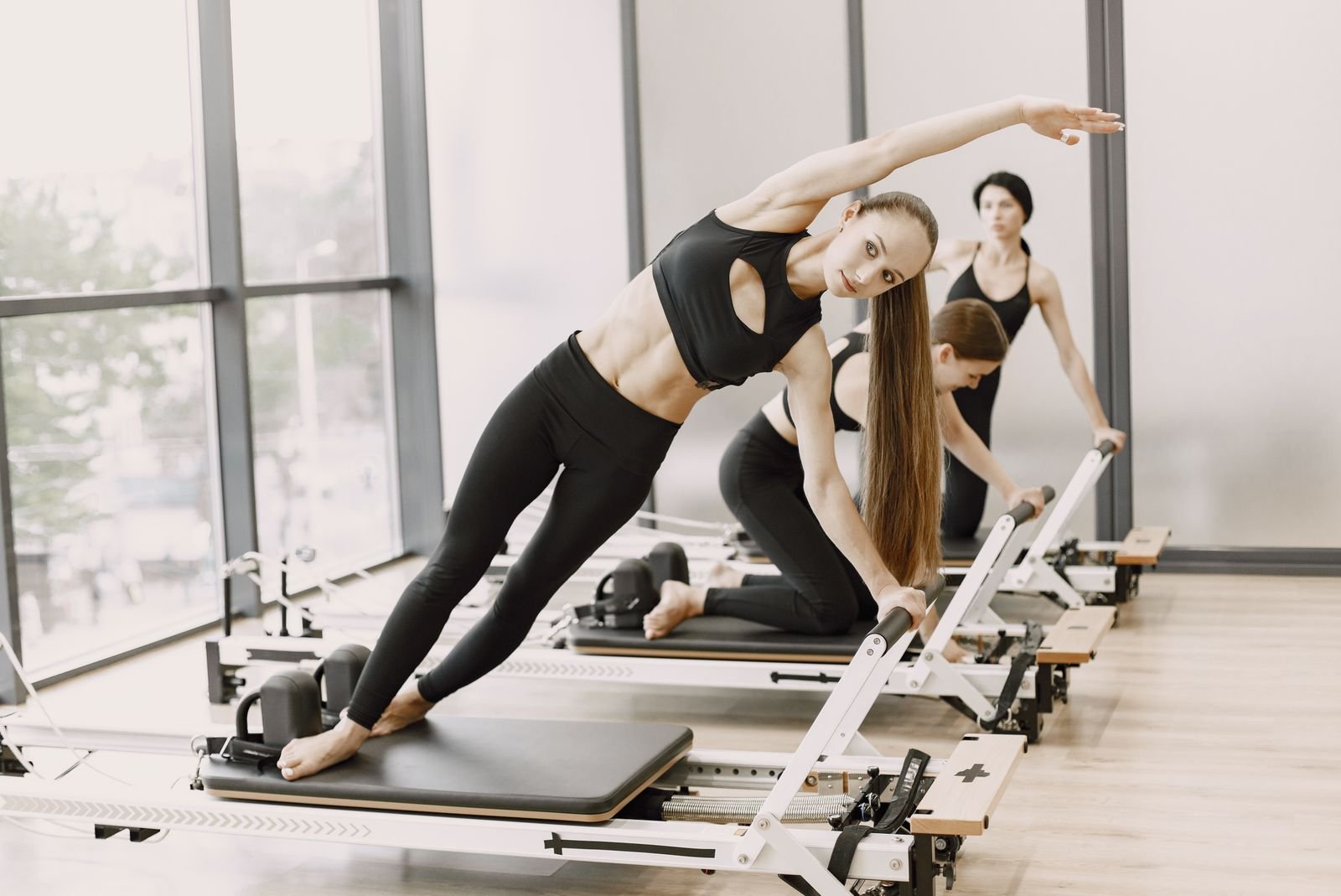
Understanding these differences helps you choose a routine with realistic expectations. You can start with beginner exercises, select a mat or reformer class that suits your needs, and build consistency gradually.
What Is Pilates?
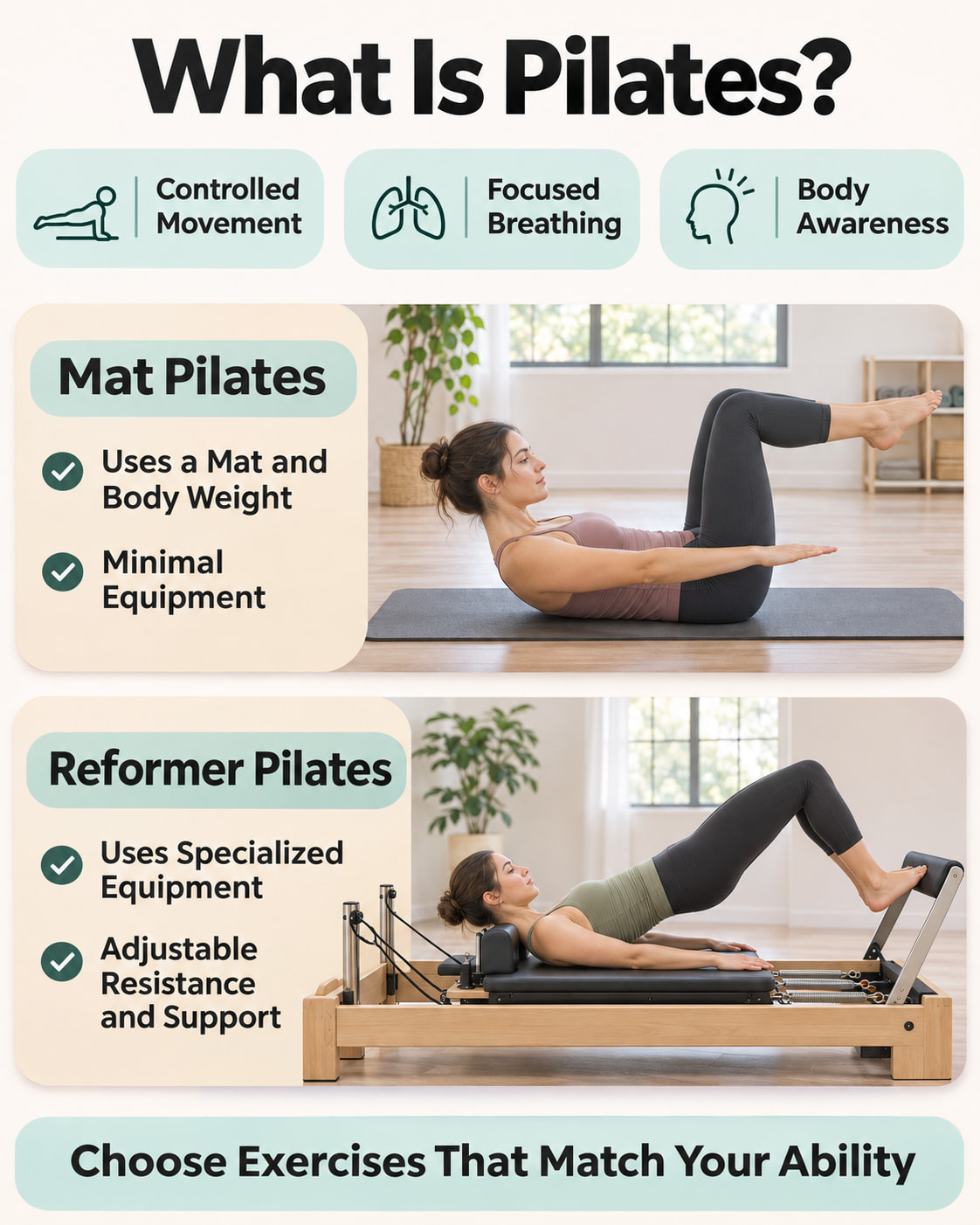
Pilates combines controlled movements, focused breathing, and attention to body position. Exercises often challenge the muscles around your trunk while your arms or legs move.
Pilates can be practiced on a mat or with equipment such as a reformer.
Most traditional Pilates exercises involve little impact from jumping or landing. However, a low-impact session can still require considerable muscular effort.
9 Benefits of Pilates for Women
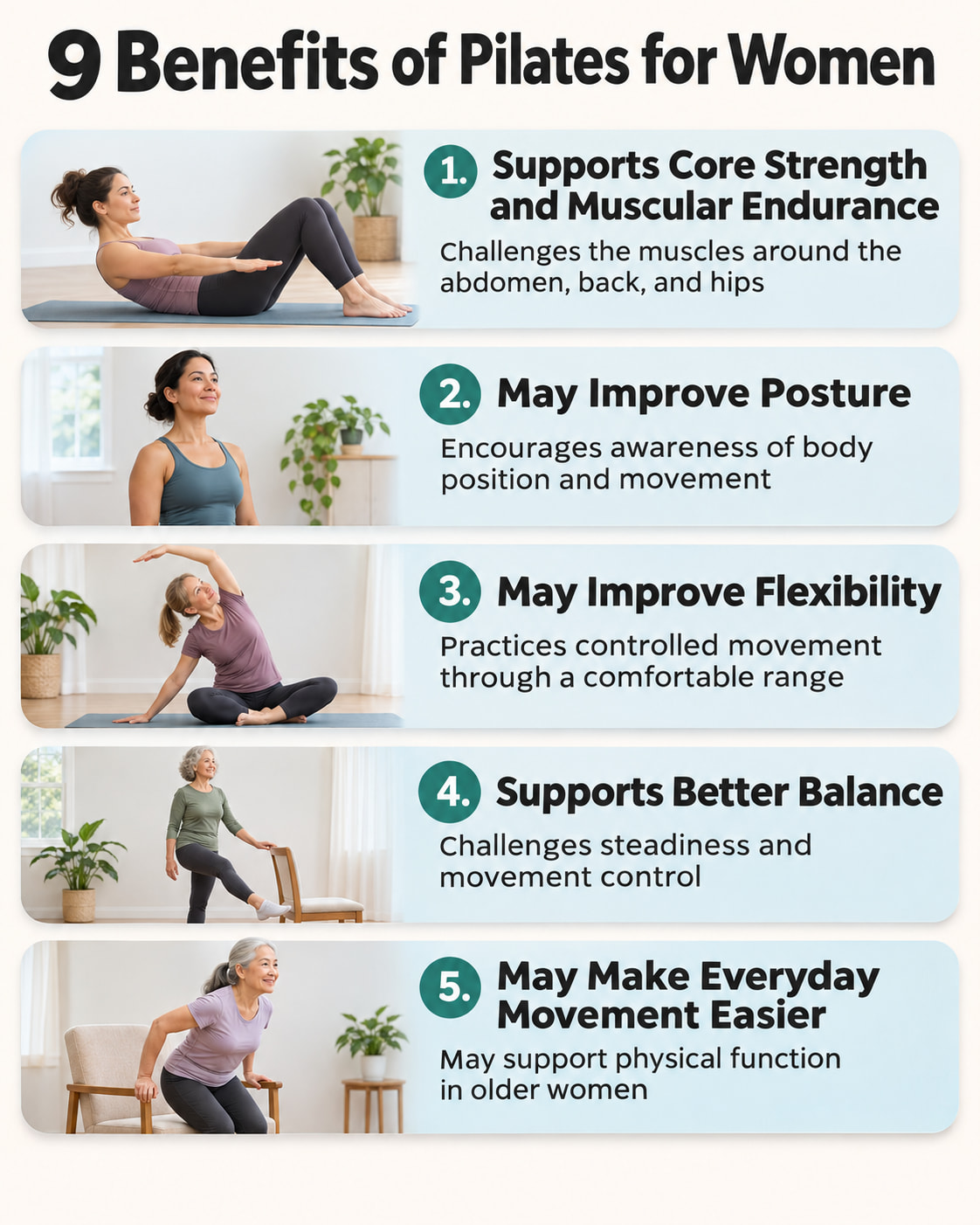
The benefits below are relevant to women at different ages and fitness levels. Research often involves specific groups, such as older adults or women with a particular health concern, so individual results will vary.
1. Supports Core Strength and Muscular Endurance
Your core includes muscles around your abdomen, back, and hips. Pilates challenges these muscles as you hold positions or move your limbs with control.
Muscular endurance means sustaining effort over time. In Pilates, that might involve completing a sequence while keeping your trunk steady and your breathing comfortable.
A 2025 randomized trial in Scientific Reports involving 47 women with overweight or obesity reported improvements in strength and muscular endurance after eight weeks of reformer Pilates.
This supports Pilates as one option for developing muscular fitness. Results depend on the exercises, difficulty, and starting ability; the study does not establish the same gains for every woman.
2. May Improve Posture
Pilates asks you to notice how you position and move your head, shoulders, rib cage, and pelvis. Practicing this attention may help you develop more controlled, comfortable movement.
A 2024 systematic review in Musculoskeletal Care examined 18 studies and found improvements in some measures of postural alignment. However, evidence for adults was rated very low to low certainty.
Keep expectations practical. You might work toward maintaining a position comfortably or noticing when you need to change position. Permanent spinal realignment or a guaranteed “perfect posture” would overstate the research.
3. May Improve Flexibility
Pilates includes movements that take your body through a controlled range. Regular practice may improve flexibility, particularly when your routine consistently includes exercises that challenge your current range comfortably.
A September 2026 review in Sports found favorable results for sit-and-reach flexibility in adult women. Study programs and results varied, so the finding does not establish an equal improvement at every joint.
Focus on smooth movement within a manageable range. Reaching farther is useful only when you can maintain control and avoid painful stretching.
4. Supports Better Balance
Balance involves staying steady while standing or moving. Pilates exercises can challenge this skill through changes in position, controlled limb movements, and shifts in support.
A 2024 systematic review involving 1,770 older adults found improvements in several balance measures compared with control groups. Pilates performed similarly to other forms of exercise.
These findings are especially relevant to women interested in staying active as they age. However, better performance on balance tests does not establish that Pilates prevents falls; the review did not demonstrate fewer falls.
5. May Make Everyday Movement Easier
Everyday physical function includes tasks such as getting up from a chair, walking, and turning. These are useful goals when deciding what you want from an exercise routine.
A randomized trial published in a 2022 issue of the Journal of Strength and Conditioning Research studied 109 women age 60 and older. After 12 weeks, the Pilates group showed improvements in handgrip strength and physical-performance measures compared with the control group.
The findings suggest potential benefits for physical function in older women. They do not prove that Pilates prevents long-term disability, but they support looking beyond appearance when judging progress.
6. May Help With Chronic Lower Back Discomfort
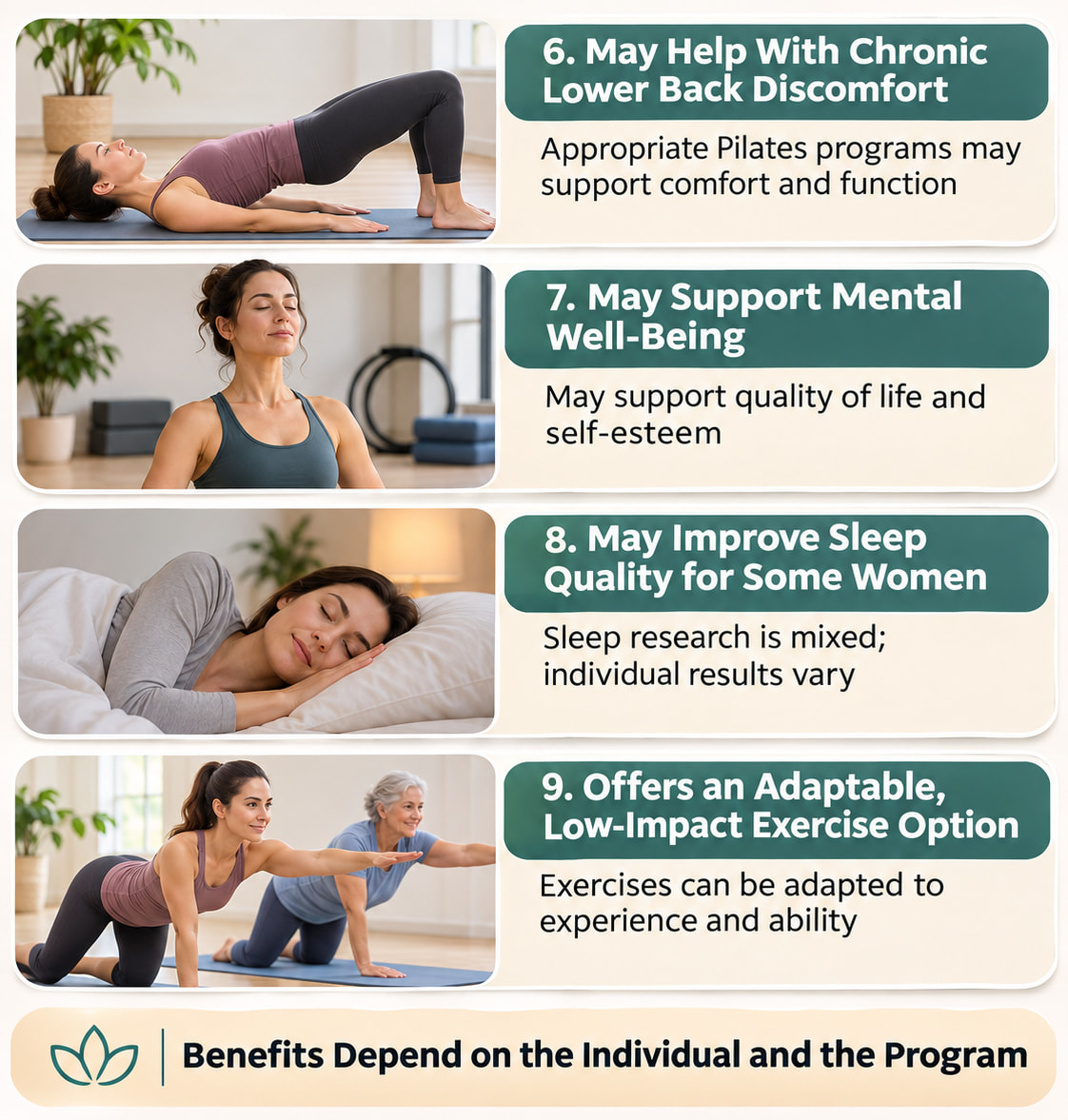
Some women with chronic lower back pain may experience less discomfort and better function with an appropriate Pilates program.
An August 2026 systematic review reported improvements in these outcomes among women with chronic lower back pain, including postmenopausal women.
The exercises and supervision used in research may differ from a general studio class. If you have ongoing back pain, seek advice about suitable movements and modifications. New or worsening pain also deserves attention before you increase exercise difficulty.
7. May Support Mental Well-Being
The focus on breathing and controlled movement gives Pilates an attentive, structured quality. Some women may enjoy that experience as much as the physical challenge.
A 2026 review in Sports found more encouraging results for quality of life and self-esteem than for depression or anxiety. The studies varied widely, and the overall unadjusted result was inconclusive.
Pilates can be part of a broader well-being routine. Choose a class you enjoy and feel comfortable attending, while continuing any mental-health support you need.
8. May Improve Sleep Quality for Some Women
Sleep is a possible benefit, but the research is mixed.
An October 2026 review in BMC Pregnancy and Childbirth found possible sleep improvements during pregnancy, although the evidence was rated low certainty. A separate 2026 trial in postmenopausal women found no specific sleep advantage for Pilates over lifestyle education.
These results leave room for individual benefit without supporting a dependable sleep promise. Consider any improvement a possible additional benefit of a routine you already find useful and enjoyable.
9. Offers an Adaptable, Low-Impact Exercise Option
Pilates offers different ways to practice, including mat classes and sessions using specialized equipment. An instructor can adjust exercise selection, range of movement, and difficulty to suit the participant.
This flexibility can make it easier to find an appropriate starting point. You do not need to begin with advanced positions or keep pace with the most experienced person in a class.
Adaptability is a practical advantage of Pilates. The right modifications still depend on your health, comfort, and ability.
Mat vs. Reformer Pilates: Which Should You Choose?
Both formats can offer worthwhile practice. The most useful choice is one that gives you appropriate instruction and a manageable challenge.
| Consideration | Mat Pilates | Reformer Pilates |
|---|---|---|
| Equipment | A mat, sometimes with small props | A dedicated machine with a moving carriage and springs |
| Exercise challenge | Often uses body weight and changes in position | Uses adjustable spring resistance and support |
| Where you can practice | At home or in a class | Usually where a reformer is available |
| Beginner priority | Learn positioning, breathing, and movement control | Learn the equipment and suitable settings with instruction |
Mat exercises can be demanding, and a reformer can provide assistance as well as resistance. The format alone does not determine how difficult a session will be.
If you are new, look for a beginner class with time for questions and individual adjustments.
How Often Should Women Do Pilates?
There is no single Pilates schedule proven best for every woman. Many research programs use two or three sessions per week, but that does not establish a universal requirement.
For a generally healthy beginner, two manageable sessions per week can be a practical starting example. Choose a duration and difficulty you can repeat comfortably, and adjust according to recovery and your other activities.
To make the routine easier to maintain:
- Choose specific days that fit your schedule.
- Begin at a level where you can follow instructions without rushing.
- Increase one element at a time, such as session length or exercise difficulty.
- Allow recovery when a challenging session leaves you sore or fatigued.
Include Aerobic Activity and Enough Strength Work
Current CDC physical activity guidance recommends at least 150 minutes of moderate-intensity aerobic activity per week, or 75 minutes of vigorous activity, or an equivalent combination. Adults also need muscle-strengthening activity on at least two days per week that works all major muscle groups.
Pilates can contribute to strengthening when the exercises sufficiently challenge the muscles involved. Whether a session contributes to your aerobic target depends on its actual intensity.
Build your week around those broader goals. For example, Pilates may fit alongside brisk walking and additional resistance exercises for muscle groups your classes do not challenge sufficiently.
How Long Does It Take to Notice Pilates Benefits?
There is no guaranteed number of sessions after which everyone will notice a change.
Studies commonly evaluate outcomes after several weeks. The reformer trial discussed above lasted eight weeks, while the trial in older women lasted 12 weeks. Those are study periods, not deadlines for your results.
Track progress using practical questions:
- Can I follow the movements with less confusion?
- Can I maintain control through a comfortable range?
- Can I complete an appropriate sequence with less fatigue?
- Are everyday activities becoming easier?
Avoid judging the routine only by the scale or expecting a particular body shape. Progress also includes learning, consistency, and improved physical performance.
How to Start Pilates Safely
Choose a beginner session and tell the instructor about relevant health conditions, injuries, or recent surgery. Ask for guidance when you are unsure whether an exercise suits you, and stop if it causes pain or makes you feel unwell.
During Pregnancy
ACOG guidance includes modified Pilates among suitable activities for women without a medical reason to avoid exercise.
Discuss your plans during prenatal care and choose instruction that accommodates pregnancy. Avoid hot Pilates and positions that require prolonged stillness or lying flat on your back.
After Childbirth
Return gradually according to your recovery. After a cesarean birth or complications, ask your obstetric clinician when and how to resume exercise.
Readiness for gentle activity does not automatically mean readiness for a demanding Pilates class. The timing and modifications should reflect your symptoms, delivery, and recovery.
With Osteoporosis or a Previous Spinal Fracture
The Bone Health & Osteoporosis Foundation advises that some Pilates movements may need modification, particularly those involving forward spinal bending or twisting.
Seek individual guidance about appropriate movements and tell your instructor about your bone-health history.
Frequently Asked Questions
How Many Times a Week Should Women Do Pilates?
Two manageable sessions per week can be a reasonable beginner example, with adjustments for recovery and other exercise. Research often uses two or three weekly sessions, but no single frequency guarantees results.
Can Pilates Help With Weight Loss or Belly Fat?
Pilates can contribute to an active routine, but research on body composition is inconsistent. It does not justify promising a particular amount of weight loss or a targeted reduction in belly fat. Consider strength, movement, and consistency among your measures of progress.
Is Mat Pilates or Reformer Pilates Better for Beginners?
Either can work when the exercises and instruction suit your needs. Mat Pilates requires little equipment. Reformer Pilates offers adjustable resistance and support, but beginners need instruction in using the machine. Start with a class designed for your experience level.
Is Pilates Enough Exercise on Its Own?
It depends on your sessions and wider routine. You still need sufficient aerobic activity and strengthening for all major muscle groups. Review whether your Pilates classes provide those challenges, then add activities that help cover the remaining needs.
Does Pilates Strengthen the Pelvic Floor?
Pelvic-floor work should be considered separately from general core exercise. An October 2026 randomized trial found that targeted pelvic-floor muscle training produced better results for urinary-incontinence impact and pelvic-floor function than Pilates, with or without deliberate pelvic-floor contractions. If leakage is a concern, seek individual guidance rather than relying on a general class.
Is Pilates Suitable for Women Over 50?
Pilates can be adapted for many women over 50. Studies in older adults suggest potential benefits for balance and physical function. Exercise selection should reflect your ability, existing symptoms, and any conditions that require modifications.
How Long Does It Take to Notice Results From Pilates?
There is no fixed timeline. Several studies assess changes after roughly eight to 12 weeks, but your experience may differ. Look for gradual improvements in control, endurance, comfort, and everyday movement rather than a guaranteed transformation.
Conclusion
The benefits of Pilates for women are most useful when connected to practical goals: moving with control, building muscular endurance, improving flexibility, and supporting everyday activity.
Start with a manageable beginner class, choose appropriate modifications, and give yourself time to build consistency. Combine Pilates with the other activity your body needs, and use how you move and function to judge your progress.
This content is for informational purposes only and not medical advice.
References
- Cleveland Clinic, 2023: Pilates overview and getting-started guidance.
- Scientific Reports, 2025: Reformer Pilates trial in women with overweight or obesity.
- Musculoskeletal Care, 2024: Systematic review of Pilates and postural alignment.
- Sports, 2026: Review of Pilates and physical fitness in adult women.
- Complementary Therapies in Clinical Practice, 2024: Review of Pilates and balance in older adults.
- Journal of Strength and Conditioning Research, 2022; first online 2020: Pilates and physical performance in older women.
- Journal of Back and Musculoskeletal Rehabilitation, 2026: Review of Pilates for chronic lower back pain in women.