
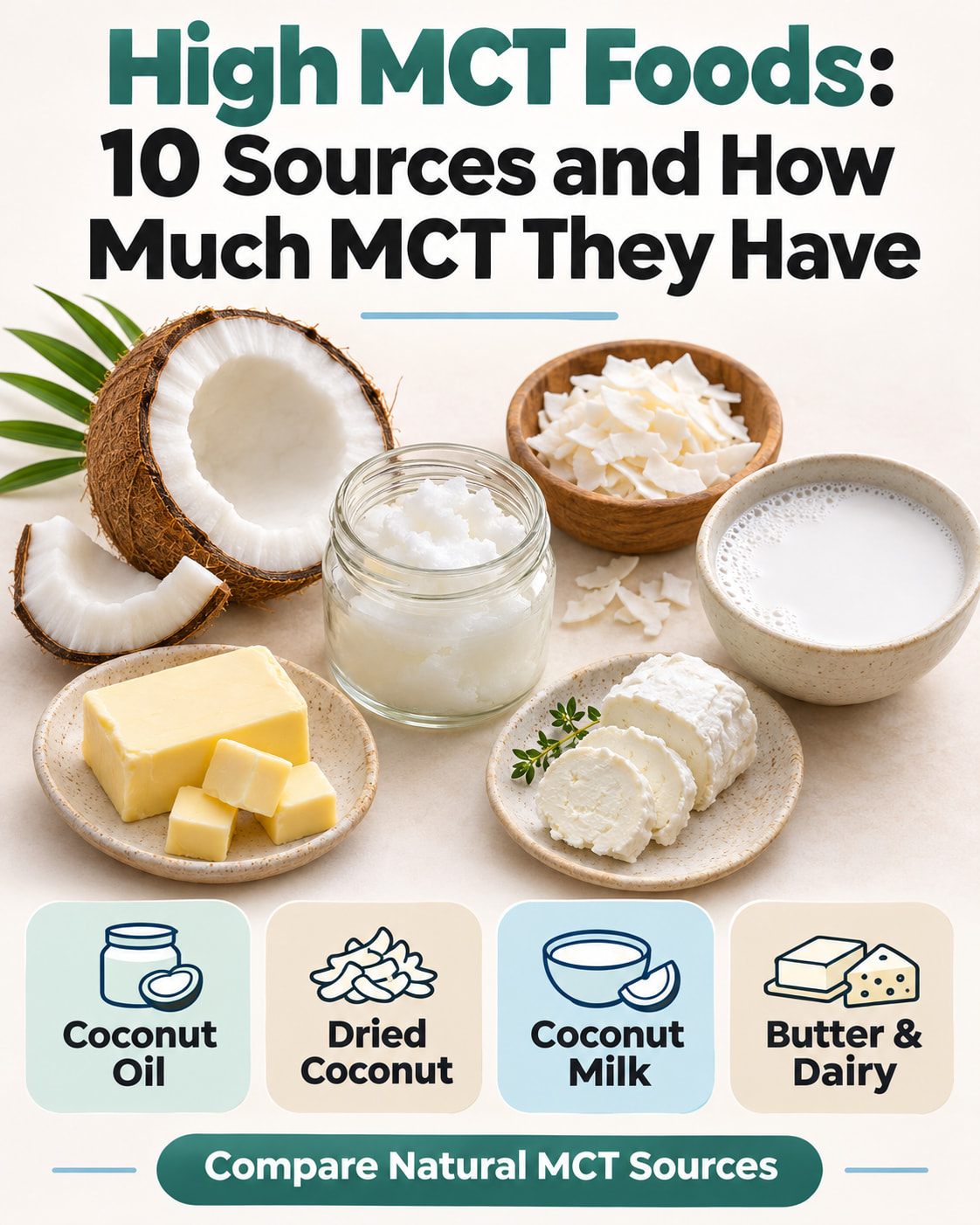
High MCT foods include coconut oil, dried coconut, palm kernel oil, coconut cream, coconut milk, and certain full-fat dairy products. Coconut oil is one of the most concentrated natural sources, but the amount of MCT-related fatty acids varies significantly between foods.
MCTs, or medium-chain triglycerides, are fats that your body processes differently from many longer-chain fats. However, not all medium-chain fatty acids behave the same way. That distinction matters when comparing natural foods with commercial MCT oil.
This guide covers 10 food sources, their estimated medium-chain fatty-acid content, practical serving sizes, and what current research says about their benefits and potential drawbacks.
What Are MCTs?
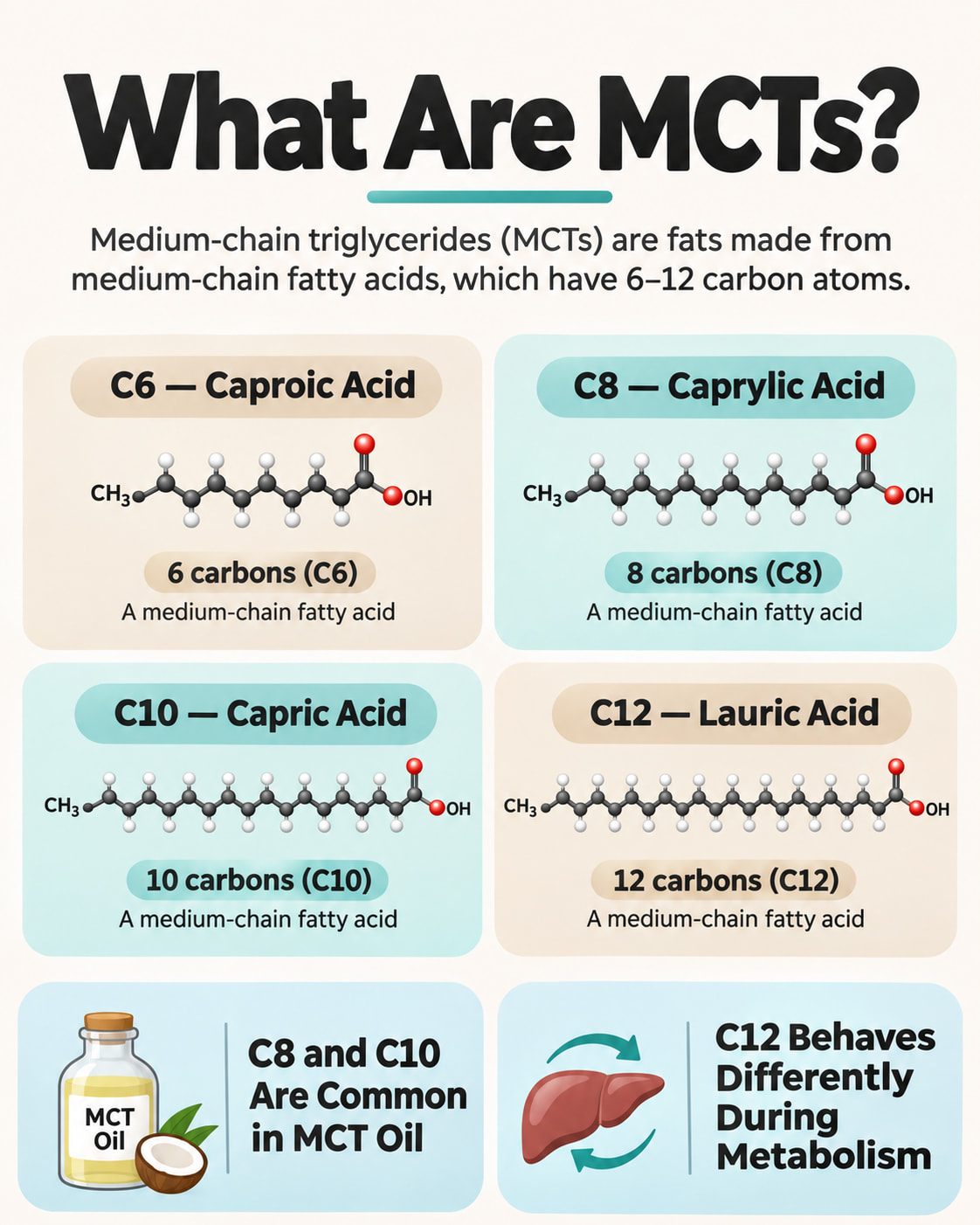
Medium-chain triglycerides (MCTs) are fats containing medium-length fatty acid chains. They are commonly discussed because certain medium-chain fats are absorbed and processed differently from long-chain fats.
The four fatty acids commonly included in the broader medium-chain category are:
- Caproic acid (C6): Contains six carbon atoms.
- Caprylic acid (C8): Contains eight carbon atoms.
- Capric acid (C10): Contains ten carbon atoms.
- Lauric acid (C12): Contains twelve carbon atoms.
C8 and C10 are especially important because commercial MCT oils usually concentrate these two fatty acids.
Lauric acid, or C12, is more complicated. Although commonly classified as medium-chain by its chemical structure, it behaves partly like longer-chain fats during digestion and metabolism.
This explains why coconut oil can have a high overall medium-chain fatty-acid content without providing the same concentration of C8 and C10 as specialized MCT oil.
Important: Food-composition databases measure individual fatty acids. Adding those values provides an estimate of medium-chain fatty-acid content, not a direct measurement of intact MCT molecules.
High MCT Foods: 10 Sources and Their Amounts
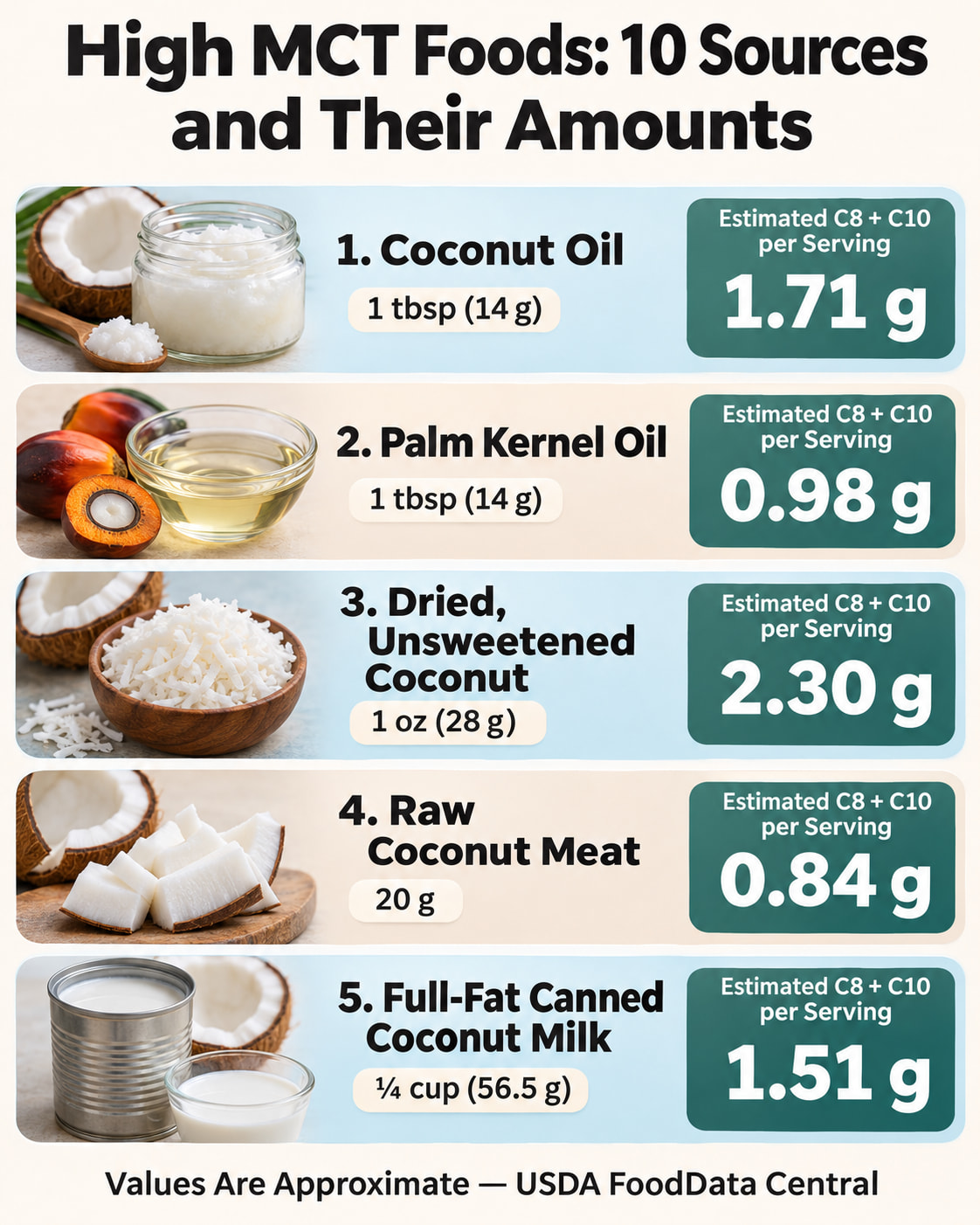
The following comparison uses data from USDA FoodData Central.
It separates the two measurements most useful for understanding MCT content:
- C8 + C10: Caprylic and capric acids, the fatty acids most commonly concentrated in MCT oil.
- C6–C12: A broader total that also includes caproic and lauric acids.
High MCT Foods Comparison Chart
| Food | C8 + C10 per 100 g | C6–C12 per 100 g | C8 + C10 per Example Serving |
|---|---|---|---|
| 1. Coconut oil | 12.19 g | 54.47 g | 1.71 g per tbsp (14 g) |
| 2. Palm kernel oil | 7.00 g | 54.20 g | 0.98 g per tbsp (14 g) |
| 3. Dried, unsweetened coconut | 8.11 g | 37.10 g | 2.30 g per oz (28 g) |
| 4. Raw coconut meat | 4.21 g | 19.26 g | 0.84 g per 20 g |
| 5. Full-fat canned coconut milk | 2.68 g | 12.27 g | 1.51 g per ¼ cup (56.5 g) |
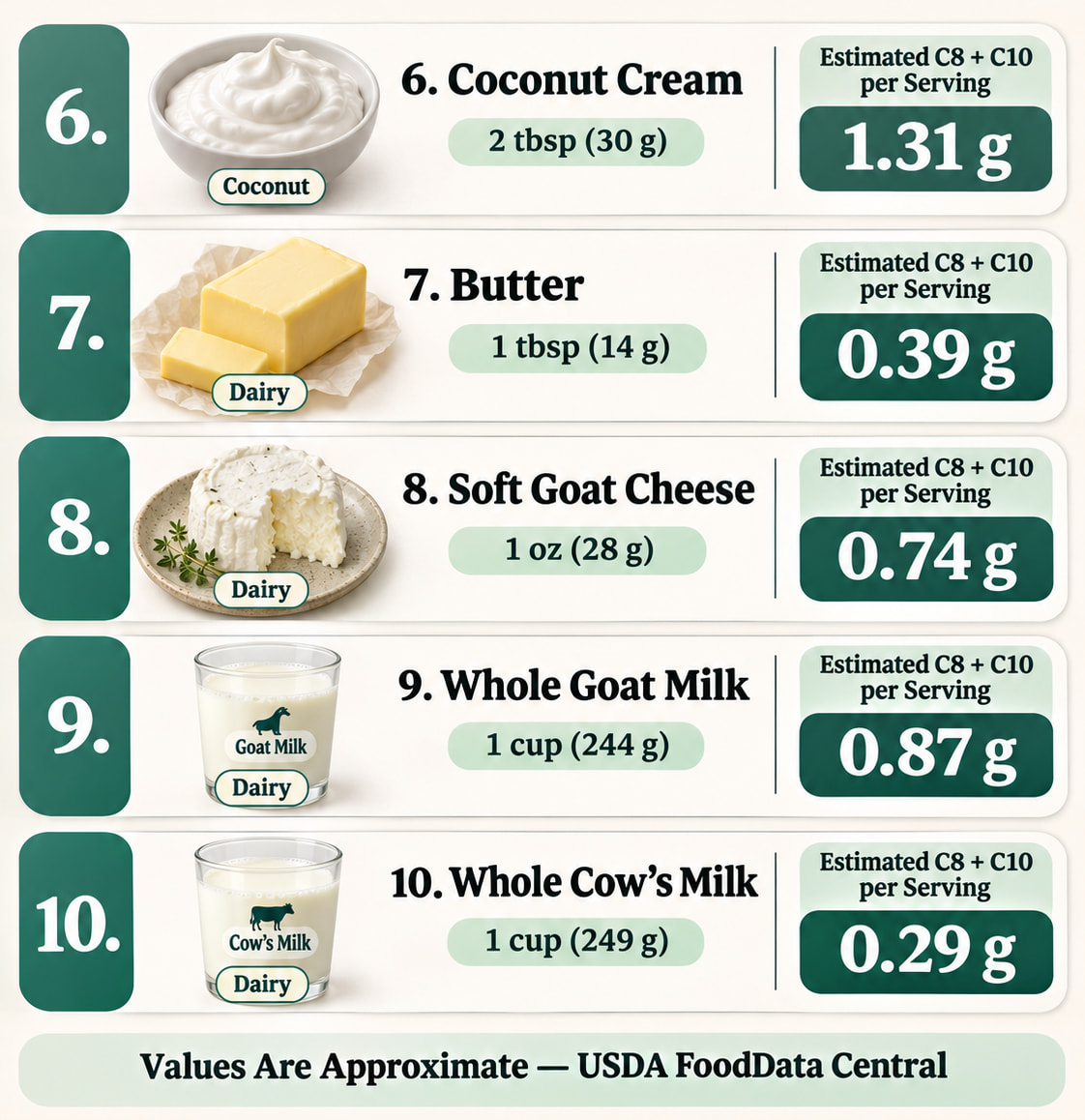
| 6. Raw coconut cream | 4.36 g | 19.94 g | 1.31 g per 2 tbsp (30 g) |
| 7. Salted butter | 2.76 g | 6.40 g | 0.39 g per tbsp (14 g) |
| 8. Soft goat cheese | 2.60 g | 4.00 g | 0.74 g per oz (28 g) |
| 9. Whole goat milk | 0.36 g | 0.57 g | 0.87 g per cup (244 g) |
| 10. Whole cow’s milk | 0.12 g | 0.27 g | 0.29 g per cup (249 g) |
Source: Calculations based on USDA FoodData Central fatty-acid records. Values are approximate, rounded, and represent the specific food entries analyzed. The serving amounts are examples rather than recommended MCT doses. Actual values vary by product and preparation.
The USDA food records used for this comparison were published in 2019–2020. USDA’s Foundation Foods documentation explains how individual fatty-acid values are reported.
Key takeaway: Coconut oil, palm kernel oil, and dried coconut contain substantial amounts of medium-chain fatty acids. Dairy foods also contribute, but generally in much smaller quantities per serving.
1. Coconut Oil
Estimated C8 + C10: 12.19 g per 100 g
Coconut oil is among the richest natural dietary sources of medium-chain fatty acids.
A tablespoon weighing approximately 14 grams provides:
- About 1.71 grams of C8 and C10 combined.
- About 7.63 grams of C6 through C12 combined.
Most of the broader medium-chain total comes from lauric acid.
Coconut oil works in certain baked goods, curries, and other cooked dishes. However, it is also high in saturated fat.
Practical tip: Use coconut oil according to your cooking needs rather than adding extra tablespoons solely for their MCT content.
2. Palm Kernel Oil
Estimated C8 + C10: 7.00 g per 100 g
Palm kernel oil comes from the seed of the oil palm fruit. It differs from regular palm oil, which is extracted from the fruit’s flesh.
Like coconut oil, palm kernel oil contains a substantial amount of lauric acid.
One tablespoon provides approximately 0.98 grams of C8 and C10 combined.
Palm kernel oil is commonly used in commercially prepared foods, confectionery coatings, and certain baked products.
Because it is rich in saturated fat, its medium-chain content does not automatically make it a healthier choice than other cooking oils.
Practical tip: Check ingredient labels if you want to identify palm kernel oil in packaged foods. There is no need to seek it out specifically for MCT intake.
3. Dried, Unsweetened Coconut
Estimated C8 + C10: 8.11 g per 100 g
Dried coconut is another concentrated source of medium-chain fatty acids.
A 1-ounce serving provides approximately 2.30 grams of C8 and C10 combined.
Unlike coconut oil, dried coconut also contains dietary fiber.
You can use unsweetened shredded or desiccated coconut in oatmeal, yogurt, homemade granola, or baked goods.
However, drying removes much of the water, making dried coconut relatively calorie-dense.
Practical tip: Choose unsweetened coconut and use portions that fit your overall nutritional needs.
4. Raw Coconut Meat
Estimated C8 + C10: 4.21 g per 100 g
Fresh coconut meat naturally contains medium-chain fatty acids, along with fiber and several minerals.
A 20-gram portion provides approximately 0.84 grams of C8 and C10.
Raw coconut contains considerably more water than dried coconut. Therefore, its medium-chain fatty-acid concentration is lower when both are compared by weight.
You can eat coconut meat fresh, add small pieces to fruit bowls, or use shredded coconut in recipes.
Practical tip: Fresh coconut is a reasonable choice when you want a whole-food option that provides both fat and fiber.
5. Full-Fat Canned Coconut Milk
Estimated C8 + C10: 2.68 g per 100 g
Full-fat canned coconut milk contains fat extracted from coconut meat.
A quarter-cup serving, weighing approximately 56.5 grams, provides about 1.51 grams of C8 and C10.
Coconut milk can add creaminess to soups, curries, sauces, and other recipes.
Its fat content depends heavily on the product.
For example, refrigerated coconut beverages are often diluted and may contain substantially less coconut fat than full-fat canned coconut milk.
Practical tip: Check the nutrition label and choose a product appropriate for the recipe. Do not assume all coconut milk products have the same MCT content.
6. Coconut Cream
Estimated C8 + C10: 4.36 g per 100 g
Coconut cream is a rich coconut product containing more fat than many coconut milk preparations.
The USDA raw coconut cream entry provides approximately 1.31 grams of C8 and C10 in a 30-gram portion.
Its creamy texture works well in sauces, curries, and desserts.
However, coconut cream products vary. The USDA values above describe raw cream expressed from coconut meat and should not be applied automatically to every canned or packaged version.
Also, coconut cream is different from sweetened cream of coconut, which commonly contains added sugar.
Practical tip: Choose unsweetened coconut cream when you want control over the sweetness of your recipe.
7. Butter
Estimated C8 + C10: 2.76 g per 100 g
Butter contains small amounts of several medium-chain fatty acids because these fats naturally occur in milk fat.
A tablespoon of salted butter provides approximately 0.39 grams of C8 and C10.
Butter also provides fat-soluble nutrients, although the amounts depend on the product and serving size.
Its main nutritional consideration is its substantial saturated-fat content.
Practical tip: Butter can be used occasionally for flavor, but increasing butter consumption is not a practical way to obtain large amounts of C8 and C10.
8. Soft Goat Cheese
Estimated C8 + C10: 2.60 g per 100 g
Soft goat cheese contains medium-chain fatty acids naturally present in goat milk fat.
A 1-ounce serving provides approximately 0.74 grams of C8 and C10.
It also supplies protein and calcium.
However, the amount of fat varies among soft, semisoft, and aged goat cheeses. The values in this guide apply specifically to the USDA soft goat cheese entry.
You can add a small portion to salads, roasted vegetables, or whole-grain toast.
Practical tip: Choose goat cheese for its flavor and overall nutritional contribution, not only for its MCT content.
9. Whole Goat Milk
Estimated C8 + C10: 0.36 g per 100 g
Goat milk contains naturally occurring medium-chain fatty acids, particularly caprylic and capric acids.
One cup, weighing approximately 244 grams, provides about 0.87 grams of C8 and C10.
Whole goat milk also supplies protein, calcium, and other nutrients.
Although its fat composition differs from cow’s milk, goat milk still contains lactose and milk proteins. It is not automatically suitable for people with lactose intolerance or a cow’s milk allergy.
Practical tip: Choose pasteurized goat milk if you enjoy it and tolerate dairy. Its MCT content alone is not a reason to replace other nutritious milk options.
10. Whole Cow’s Milk
Estimated C8 + C10: 0.12 g per 100 g
Whole cow’s milk contains smaller amounts of C8 and C10 than the other foods highlighted in this guide.
One cup, weighing approximately 249 grams, provides about 0.29 grams of these fatty acids.
Whole milk also provides protein, calcium, and several vitamins and minerals.
However, it is not a concentrated MCT source.
Reduced-fat and fat-free milk generally contain less of these fatty acids because they contain less milk fat.
Practical tip: Choose milk based on your overall dietary preferences, nutritional needs, and tolerance rather than MCT content alone.
Why Do MCT Amounts Differ Between Foods?
Not every fat-containing food has the same fatty-acid composition.
Coconut products contain substantial amounts of lauric acid, along with smaller quantities of caprylic and capric acids.
Dairy products contain a wider mixture of fatty acids, including small amounts of medium-chain fats.
Processing and water content also influence the amount of fat found in a given weight of food.
For example, dried coconut contains more concentrated fat per 100 grams than fresh coconut meat.
The way researchers define medium-chain fatty acids makes another important difference.
C8 and C10 vs. C12: Why the Distinction Matters
C8 and C10 are commonly associated with commercial MCT oil because they are metabolized differently from many long-chain fats.
C12, or lauric acid, behaves partly like a long-chain fatty acid.
Consider coconut oil:
- Approximately 12.19 grams per 100 grams come from C8 and C10.
- Approximately 54.47 grams per 100 grams come from C6 through C12.
Both figures describe medium-chain fatty-acid categories, but they are not interchangeable.
That is why nutrition articles that describe coconut oil as containing more than 50% MCTs can be misleading if they do not explain that most of the total comes from lauric acid.
MCT Oil vs. Coconut Oil: What’s the Difference?
MCT oil and coconut oil are not identical.
Coconut oil is a natural oil containing a mixture of fatty acids, including substantial amounts of lauric acid.
Commercial MCT oil is specially processed to concentrate medium-chain triglycerides, typically those containing C8 and C10.
| Feature | Coconut Oil | Commercial MCT Oil |
|---|---|---|
| Main fatty-acid profile | High in C12, with some C8 and C10 | Usually concentrated C8 and C10 |
| Processing | Extracted from coconut | Fractionated and processed |
| Cooking | Commonly used in cooking and baking | Usually added to foods or drinks |
| Concentration of C8 and C10 | Lower | Much higher |
| Saturated fat | High | Also predominantly saturated fat |
Some commercial products are made entirely or predominantly from C8 triglycerides. Others combine C8 and C10.
For example, certain concentrated C8 oil labels list approximately 14 grams of C8 triglycerides per tablespoon.
This label figure refers to triglycerides, while the USDA comparison table reports individual fatty acids. The two measurements should not be treated as identical.
Bottom line: MCT oil is more concentrated in C8 and C10 than coconut oil, but concentrated MCT oil is not necessarily something everyone needs to add to their diet.
Do High MCT Foods Have Health Benefits?
The potential effects of MCTs depend on the specific fatty acids, the amount consumed, and the overall diet.
1. They Provide a Source of Energy
Fat is an important source of dietary energy.
Certain medium-chain fats, especially C8 and C10, are absorbed and metabolized differently from longer-chain fatty acids.
They can reach the liver relatively quickly, where they may be used for energy or converted into ketones.
However, faster metabolism does not mean the calories disappear or that consuming more MCTs automatically improves physical performance.
2. They May Influence Body Composition
Researchers have investigated whether replacing some long-chain fats with MCTs influences body weight and fat mass.
A September 2026 systematic review and meta-analysis examined seven randomized controlled trials involving 346 participants with overweight or obesity.
The researchers found reductions in body weight, fat mass, and waist circumference compared with control groups.
However, the certainty of the evidence was rated low.
These findings are promising but limited. They do not establish that eating more coconut oil, butter, or other high MCT foods independently produces weight loss.
MCTs still provide calories, so adding extra fat without accounting for overall energy intake may work against weight-management goals.
3. They May Support Ketone Production
Certain MCTs can increase the production of ketones, which the body can use as an alternative energy source.
This effect is particularly associated with caprylic acid, or C8.
However, the ketone response from concentrated MCT oil may differ considerably from that produced by ordinary coconut foods.
Research into ketone production does not prove that high MCT foods improve memory, focus, or athletic performance in everyone.
How to Include High MCT Foods in a Balanced Diet
You do not need a special MCT-focused diet to include foods containing medium-chain fatty acids.
A practical approach is to use these foods as part of meals you already enjoy.
Choose Foods Based on Your Overall Nutrition
Dried coconut provides fiber along with its fats. Milk and goat cheese contribute protein and calcium.
Oils, meanwhile, primarily provide fat and energy.
The best choice depends on what else the food adds to your diet.
Use Reasonable Portions
Medium-chain fatty acids do not make a food calorie-free.
Coconut oil, coconut cream, and dried coconut are relatively energy-dense.
Small portions can contribute flavor and texture without requiring large amounts.
Replace Rather Than Simply Add Fat
If you decide to use coconut oil occasionally, consider how it fits into your existing fat intake.
Replacing another cooking fat is different from adding several tablespoons of oil on top of your regular meals.
Also, remember that MCT content is only one consideration when choosing dietary fats.
The overall balance of saturated and unsaturated fats matters.
Possible Side Effects and Safety Considerations
Most people can include moderate portions of coconut and dairy foods in a varied diet, provided they tolerate those foods.
Concentrated MCT oil requires additional consideration.
Digestive Discomfort
Consuming MCT oil, particularly in larger amounts, can cause gastrointestinal symptoms.
An August 2026 systematic review of MCT side effects examined 33 studies involving 1,100 participants.
The most frequently reported problems included diarrhea, abdominal pain, digestive discomfort, and nausea.
Higher intakes were associated with more noticeable symptoms in some studies.
If you choose to use MCT oil, avoid starting with a large amount. There is no universally established dose that guarantees good tolerance.
People using MCT products for a medical nutrition plan should follow individualized professional guidance.
Saturated Fat Intake
Coconut oil, palm kernel oil, butter, and full-fat dairy products contribute saturated fat.
According to the World Health Organization’s January 2026 healthy-diet guidance, saturated fat should provide no more than 10% of total daily energy intake.
For a 2,000-calorie diet, that equals approximately 22 grams of saturated fat.
WHO also recommends favoring unsaturated fat sources such as olive oil, canola oil, nuts, and other plant foods.
Remember: A food can contain MCTs and still be high in saturated fat. MCT content alone does not determine whether it is a healthy choice.
Frequently Asked Questions About High MCT Foods
1. Which Food Has the Most MCTs?
Coconut oil and palm kernel oil are among the most concentrated natural sources when a broad definition that includes lauric acid is used.
For C8 and C10 specifically, the USDA coconut oil entry provides approximately 12.19 grams per 100 grams, compared with 7 grams in palm kernel oil.
Commercial MCT oil is generally much more concentrated in C8 and C10 than either natural oil.
2. Is Coconut Oil the Same as MCT Oil?
No. Coconut oil contains a mixture of fatty acids, with lauric acid making up a large proportion.
Commercial MCT oil is processed to concentrate C8, C10, or both.
They have different fatty-acid profiles and should not be considered interchangeable in nutrition research.
3. How Much MCT Is in Coconut Milk?
The USDA entry for full-fat canned coconut milk contains approximately 2.68 grams of C8 and C10 per 100 grams.
That equals about 1.51 grams in a quarter-cup serving weighing 56.5 grams.
Actual amounts vary depending on the brand and coconut fat concentration.
4. Does Butter Contain MCTs?
Yes. Butter contains small quantities of medium-chain fatty acids naturally found in milk fat.
A tablespoon of salted butter provides approximately 0.39 grams of C8 and C10.
However, butter contains substantial saturated fat and should not be considered a concentrated MCT supplement.
5. Does Goat Milk Have More MCTs Than Cow’s Milk?
The USDA entries used in this comparison show more C8 and C10 in whole goat milk than in whole cow’s milk.
A cup of goat milk provides approximately 0.87 grams, compared with about 0.29 grams in a cup of whole cow’s milk.
These figures are estimates for specific USDA food entries. Actual concentrations vary.
6. Can High MCT Foods Help With Weight Loss?
Research suggests that replacing certain dietary fats with MCTs may modestly influence body composition in some circumstances.
However, the current evidence has limitations.
There is insufficient evidence to conclude that simply increasing coconut oil, butter, or other natural MCT-containing foods causes meaningful weight loss.
Overall calorie intake, food quality, physical activity, and long-term dietary habits remain important.
7. Can MCT Oil Cause Diarrhea or Stomach Discomfort?
Yes. Diarrhea, nausea, and abdominal discomfort are among the gastrointestinal side effects reported with concentrated MCT consumption.
The likelihood and severity can depend on the amount consumed and individual tolerance.
If symptoms occur, stop or reduce the product and seek professional guidance if symptoms are persistent, severe, or concerning.
Conclusion
The best-known high MCT foods are coconut oil, palm kernel oil, dried coconut, coconut cream, and coconut milk. Full-fat dairy products also contain medium-chain fatty acids, although usually in smaller quantities.
The most important distinction is between C8 and C10, which are commonly concentrated in MCT oil, and C12, which makes up much of the medium-chain fatty-acid content of coconut products.
If you want to include these foods in your diet, choose options you enjoy, pay attention to serving sizes, and consider the overall balance of dietary fats.
Start with nutritious meals rather than chasing higher MCT numbers. A varied, balanced eating pattern matters more than maximizing any single type of fat.
This content is for informational purposes only and not medical advice.
References
- USDA FoodData Central. Food and Nutrient Database. Primary source for the fatty-acid comparison. FoodData Central records used: 330458, 171422, 170170, 170169, 170173, 170580, 790508, 173435, 171278, and 746782.
- USDA FoodData Central. Foundation Foods Documentation. Guidance on food composition and fatty-acid reporting.
- Minamida M, et al. (September, 2026). Effect of Medium Chain Fatty Acids on Body Composition in Individuals with Overweight and Obesity: A Systematic Review and Meta-Analysis. Obesity Reviews.
- Scheller M, et al. (August, 2026). Gastrointestinal Issues Predominate Among Side Effects of Medium-Chain Triglyceride Consumption in Humans. Frontiers in Nutrition.
- World Health Organization (January, 2026). Healthy Diet. Recommendations on dietary fat and balanced eating.