
Cool down exercises for seniors are gentle, low-intensity movements and stretches that help your body gradually return to a resting state after activity. A proper cool-down can help you feel less stiff, move more comfortably, and finish workouts (or walks) feeling steady instead of rushed.
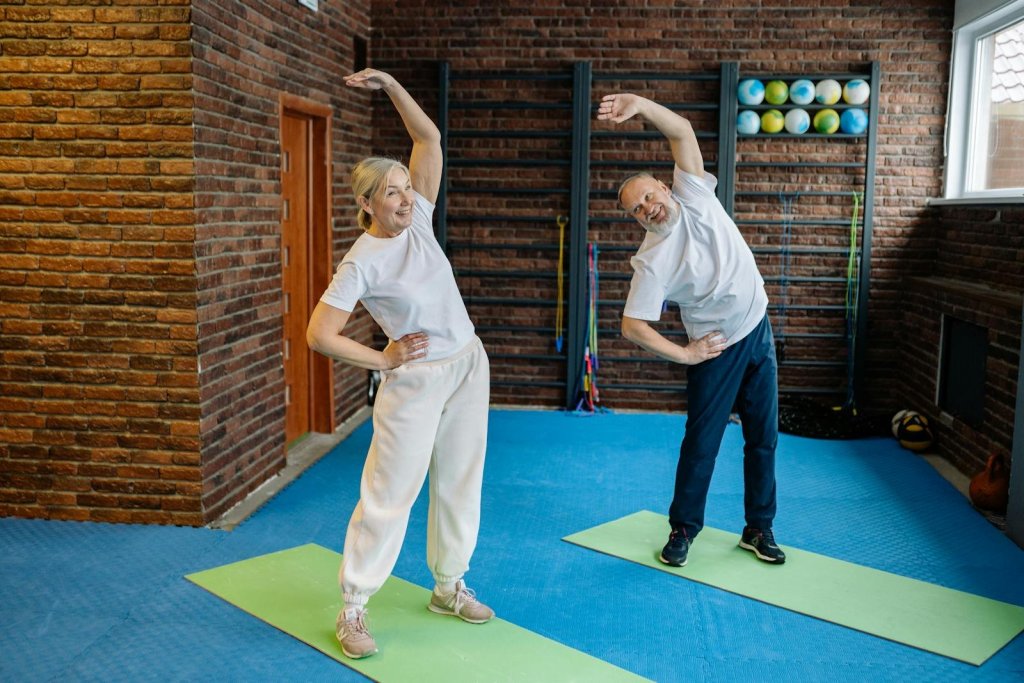
Most cool-downs follow a simple pattern: slow your pace for a few minutes, then do a handful of gentle stretches for the muscles you used most. The American Heart Association notes that stopping suddenly can make some people feel lightheaded, which is why a gradual cool-down matters.
What counts as a good cool down for seniors
A senior-friendly cool-down usually includes:
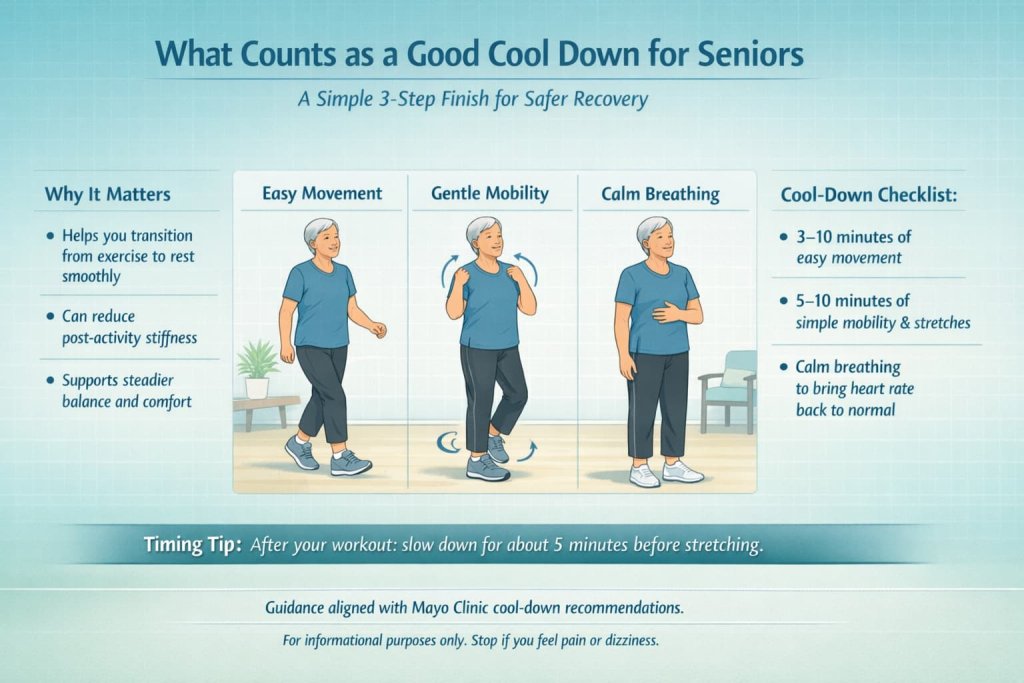
- 3–10 minutes of easy movement (slower walking, gentle marching, easy cycling)
- 5–10 minutes of simple mobility and comfortable, non-bouncy stretching
- Calm breathing to bring your heart rate and breathing back toward normal
The Mayo Clinic recommends continuing the activity at a lower intensity for about five minutes (for example, slowing down after a brisk walk).
Benefits of cool down exercises for seniors
A consistent cool-down can support:
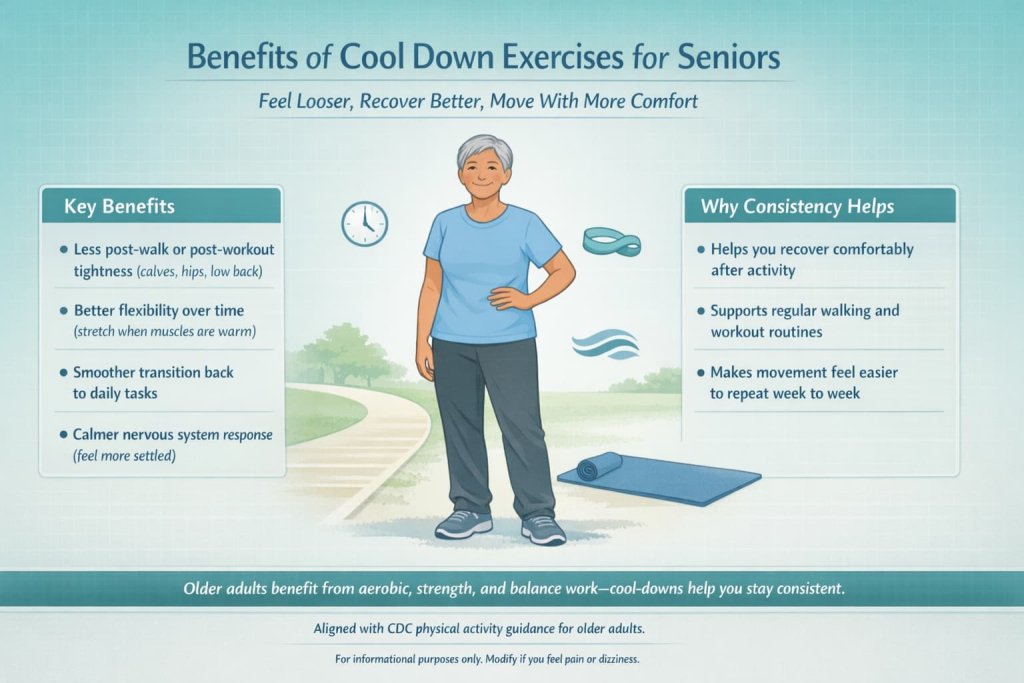
- Less “post-walk” or “post-workout” tightness in calves, hips, and low back
- Better flexibility over time (especially when stretching warm muscles)
- A smoother transition from exercise to everyday tasks
- A calmer nervous system response (you feel more settled after movement)
For weekly movement goals, the CDC recommends older adults include aerobic activity, muscle strengthening, and balance work—cool-downs help you do those sessions more comfortably and consistently.
Quick safety checklist before you start
Use these guidelines to keep your cool-down comfortable and joint-friendly:
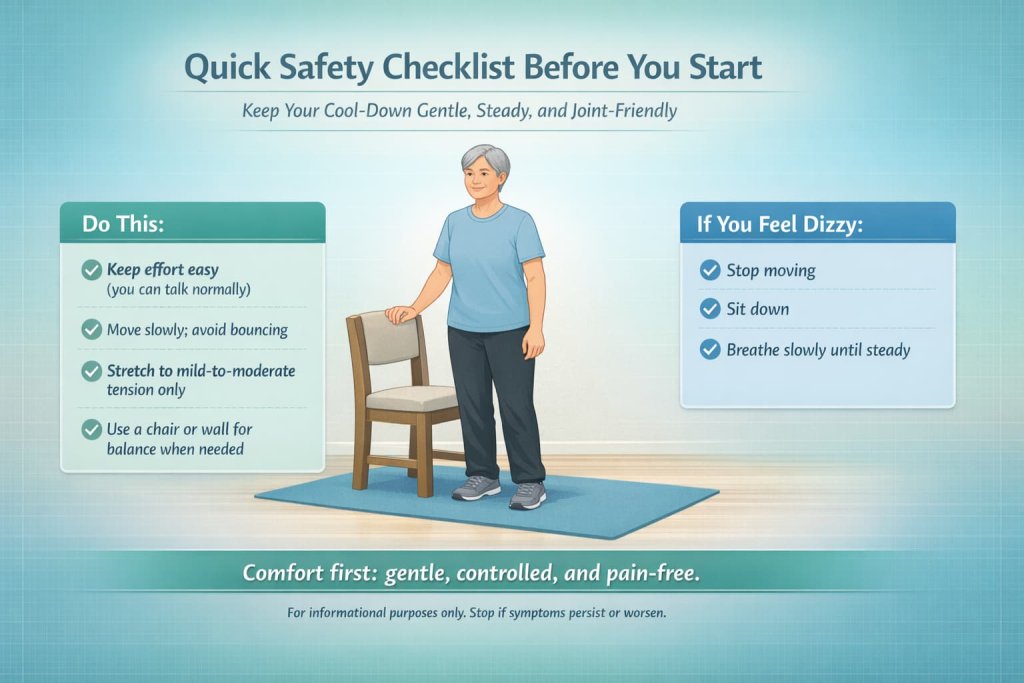
- Keep the effort easy: you should be able to talk normally.
- Move slowly and avoid bouncing into stretches.
- Aim for a mild-to-moderate stretch sensation, not sharp pain.
- Hold a sturdy chair or wall for balance when needed.
- If you feel dizzy, stop, sit down, and breathe until steady.
How long should seniors cool down
Most seniors do well with:
- 5 minutes of easy movement after activity (longer after harder workouts)
- 20–30 seconds per stretch, repeated 1–2 times per side
If you’re older, tighter, or just starting, longer holds may feel better as long as they stay comfortable and pain-free.
10 Best Cool Down Exercises for Seniors
Below are simple options you can mix and match. Do 5 minutes of slow movement first (like an easy walk), then pick 5–8 of these.
1) Slow walk and arm swing reset
How to do it:
- Walk slowly for 2–5 minutes, gradually reducing your pace.
- Let your arms swing naturally at your sides.
- Keep posture tall: ribs stacked over hips, shoulders relaxed.
Why it works: This gently lowers heart rate while keeping blood moving, which can help you feel steady after activity.
Muscles worked: Calves, quads, glutes (light), shoulders (light).
Trainer Tip: If you feel “amped up” after exercise, exhale longer than you inhale for 5–6 breaths to settle faster.
2) Supported calf stretch (wall or chair)
How to do it:
- Face a wall and place hands on it for support.
- Step one leg back, heel down, toes forward.
- Bend the front knee slightly until you feel a gentle calf stretch in the back leg.
Why it works: Calves get tight after walking and can affect ankle mobility and balance.
Muscles worked: Gastrocnemius and soleus (calves).
Trainer Tip: Keep the back heel heavy and don’t let the back foot turn outward.
3) Seated hamstring stretch (chair)
How to do it:
- Sit tall near the edge of a sturdy chair.
- Extend one leg straight with heel on the floor, toes up.
- Hinge forward from the hips (not rounding the back) until you feel a mild stretch.
Why it works: Hamstrings commonly tighten after walking, cycling, and many lower-body workouts.
Muscles worked: Hamstrings, calves (secondary).
Trainer Tip: Think “proud chest” and stop before you feel pulling behind the knee.
4) Standing quad stretch (supported)
How to do it:
- Hold a chair or counter with one hand.
- Bend one knee and bring the heel toward your glute.
- Hold the ankle or pant leg gently; keep knees close together.
Why it works: Quads can tighten after stairs, sit-to-stands, and brisk walking.
Muscles worked: Quadriceps, hip flexors (secondary).
Trainer Tip: If grabbing your ankle is hard, loop a towel around your ankle and hold the towel ends.
5) Hip flexor stretch (supported split stance)
How to do it:
- Stand in a staggered stance and hold a chair for support.
- Slightly bend the back knee and tuck the pelvis gently (avoid arching low back).
- Shift your weight forward until you feel a stretch at the front of the back hip.
Why it works: Hip flexors can shorten from sitting and may feel tighter after walking hills or biking.
Muscles worked: Hip flexors (iliopsoas/rectus femoris), quads (secondary).
Trainer Tip: Small movement is enough—avoid “pushing through” the low back.
6) Figure-4 glute stretch (seated)
How to do it:
- Sit tall on a chair.
- Cross one ankle over the opposite thigh (like a “4” shape).
- Keep your back straight and gently hinge forward until you feel a stretch in the hip.
Why it works: This targets glutes and deep hip muscles that can feel tight after walking or strength work.
Muscles worked: Glutes, deep hip rotators.
Trainer Tip: If crossing the ankle is uncomfortable, do a gentle seated glute squeeze hold instead.
7) Side bend stretch (standing or seated)
How to do it:
- Stand tall (or sit tall) and raise one arm overhead.
- Gently lean to the opposite side without twisting.
- Keep shoulders relaxed and breathe slowly.
Why it works: Helps relax the sides of the body after arm movement, breathing work, or long walks.
Muscles worked: Obliques, lats (light).
Trainer Tip: Think “lengthen” more than “bend.” You should feel opening, not pinching.
8) Chest opener (doorway or clasped hands)
How to do it:
- Stand tall and clasp hands behind your back (or hold a towel).
- Gently straighten your arms and lift your hands slightly as you open the chest.
- Keep chin tucked slightly and ribs down.
Why it works: Many seniors carry tension forward through the chest and shoulders, especially after walking with a slight hunch.
Muscles worked: Chest (pectorals), front shoulders.
Trainer Tip: If shoulders are sensitive, do a doorway stretch with the arm lower (below shoulder height).
9) Upper back stretch (hug stretch)
How to do it:
- Cross your arms to “hug” yourself, hands on shoulder blades.
- Gently round the upper back as you reach elbows forward.
- Breathe into your upper back for 3–5 slow breaths.
Why it works: Relieves upper-back tightness and improves comfort in your shoulder blades.
Muscles worked: Upper back (rhomboids/traps), rear shoulders (light).
Trainer Tip: Keep the stretch gentle—this is about relaxing tension, not forcing a big range.
10) Ankle circles and toe lifts (balance-friendly)
How to do it:
- Hold a chair for support.
- Lift one foot slightly and make slow ankle circles (both directions).
- Then do 8–12 toe lifts (rock back on heels) with control.
Why it works: Ankles and feet do a lot of work during walking; this helps restore mobility and circulation.
Muscles worked: Ankle stabilizers, calves (light), front shin muscles (tibialis anterior).
Trainer Tip: Keep the movement slow—control matters more than range.
A simple 8-minute cool-down routine for seniors (example)
After your walk or workout:
- 3 minutes: slow walk + easy breathing
- 5 minutes: pick 5 stretches (20–30 seconds each side)
A good “default” combo: calf stretch, hamstring stretch, hip flexor stretch, figure-4 glute stretch, chest opener.
Common cool-down mistakes seniors should avoid
- Stopping suddenly after a brisk walk or harder set
- Stretching hard or bouncing into positions
- Holding your breath during stretches
- Stretching into sharp pain, numbness, or tingling
- Doing complicated floor stretches when balance is uncertain
When to Avoid or Modify Cool Down Exercises
- Get help now: chest pain/pressure, severe shortness of breath, fainting/severe dizziness, sudden weakness/confusion, or strong palpitations.
- Stop/modify: sharp joint pain, numbness/tingling, new swelling, or feeling unsteady.
- Safer option: 3–5 minutes slow walking + relaxed breathing, chair-supported or seated stretches, mild range only (no bouncing).
FAQ
Are cool down exercises for seniors really necessary?
They’re not mandatory, but they’re very helpful. A gradual cool-down can help you feel steadier and less stiff after activity, making it easier to stay consistent.
How long should a senior cool down after walking?
Most people do well with 5 minutes of slower walking plus 3–5 minutes of gentle stretching, especially calves, hamstrings, and hips.
Should seniors stretch before or after exercise?
Stretching is typically best after exercise when muscles are warm.
What if I feel dizzy during my cool-down?
Stop, sit down, and breathe slowly until you feel steady. If dizziness is frequent or severe, talk with a healthcare professional.
Can seniors do cool down exercises every day?
Yes—gentle cool-down movement and light stretching can be done daily if it feels good and stays pain-free.
What are the best cool down stretches for seniors with tight hips?
The supported hip flexor stretch and seated figure-4 glute stretch are a great starting pair, as long as they’re comfortable for your hips and knees.
Conclusion
Cool down exercises for seniors don’t need to be long or complicated—just consistent. Slow your pace for a few minutes, then do a handful of gentle stretches for the areas that tighten most (often calves, hamstrings, hips, and chest).
References
- Mayo Clinic – Stretching: Focus on flexibility
- Mayo Clinic – A guide to basic stretches
- NIH National Institute on Aging – Three Types of Exercise Can Improve Your Health and Physical Ability
- NIH MedlinePlus – How to avoid exercise injuries (stretching safety)
- PubMed Central – Current Concepts in Muscle Stretching for Exercise and Rehabilitation (review)