
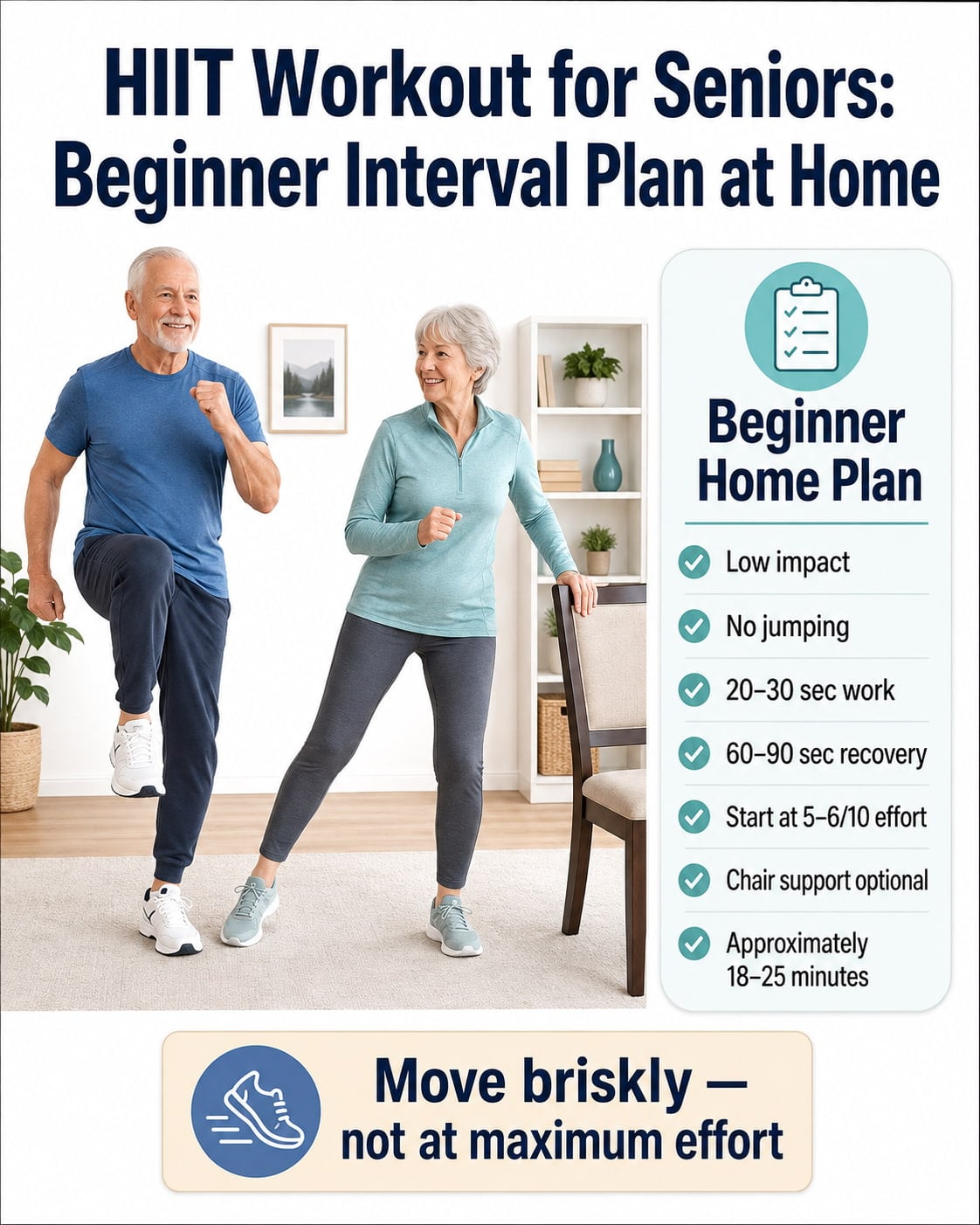
A beginner HIIT workout for seniors should alternate 20–30 seconds of brisk, low-impact movement with 60–90 seconds of easy recovery. Start around 5–6 out of 10 effort, use a sturdy chair for support, and progress toward 7 out of 10 only when you can maintain good form and recover comfortably.
The at-home plan below takes approximately 20 minutes. It requires no gym equipment, jumping, running, or floor exercises. The goal is not to move as fast as possible. The goal is to raise your breathing rate for a short period and then give your body enough time to recover.
According to the CDC, adults aged 65 and older should aim for at least 150 minutes of moderate-intensity aerobic activity or 75 minutes of vigorous activity each week, plus muscle-strengthening and balance activities. A HIIT workout can contribute to your weekly aerobic activity, but it should not replace strength and balance training.
HIIT Workout for Seniors at a Glance
| Workout detail | Beginner recommendation |
|---|---|
| Total time | Approximately 18–25 minutes |
| Frequency | 2 nonconsecutive days per week |
| Warm-up | 5–8 minutes |
| Work interval | 20–30 seconds |
| Recovery interval | 60–90 seconds |
| Starting work effort | 5–6 out of 10 |
| Progressed work effort | 6–7 out of 10 |
| Recovery effort | 2–3 out of 10 |
| Equipment | Sturdy chair, timer, water |
| Impact level | Low impact with no jumping |
| Best surface | Flat, uncluttered, nonslip floor |
This is a conservative beginner plan rather than a direct copy of one clinical research protocol. Adjust the movements and recovery periods to your abilities.
What Is a HIIT Workout for Seniors?
HIIT stands for high-intensity interval training. It alternates short periods of relatively challenging activity with easier recovery periods.
For example, you might march briskly for 30 seconds and then march slowly for 60 seconds. That combination is one interval. You repeat the pattern using the same movement or several different exercises.
The word “high-intensity” can be misleading. It does not automatically mean:
- Sprinting
- Jumping
- Burpees
- Exercising at maximum effort
- Moving so quickly that you lose control
Intensity is relative to your current fitness. A brisk march may feel moderate to one person but vigorous to someone else.
The CDC uses a 0–10 effort scale:
- 5–6 out of 10: Moderate intensity. You can talk but probably cannot sing.
- 7–8 out of 10: Vigorous intensity. You can say only a few words before pausing for breath.
- 9–10 out of 10: Near-maximum or maximum effort.
Beginners do not need to reach 8–10 out of 10. Start around 5–6 and progress toward 7 only when the movements feel stable and controlled. Your first few sessions may technically be moderate-to-vigorous interval training rather than full HIIT. That is a sensible starting point, not a failure.
Is HIIT Safe for Seniors?
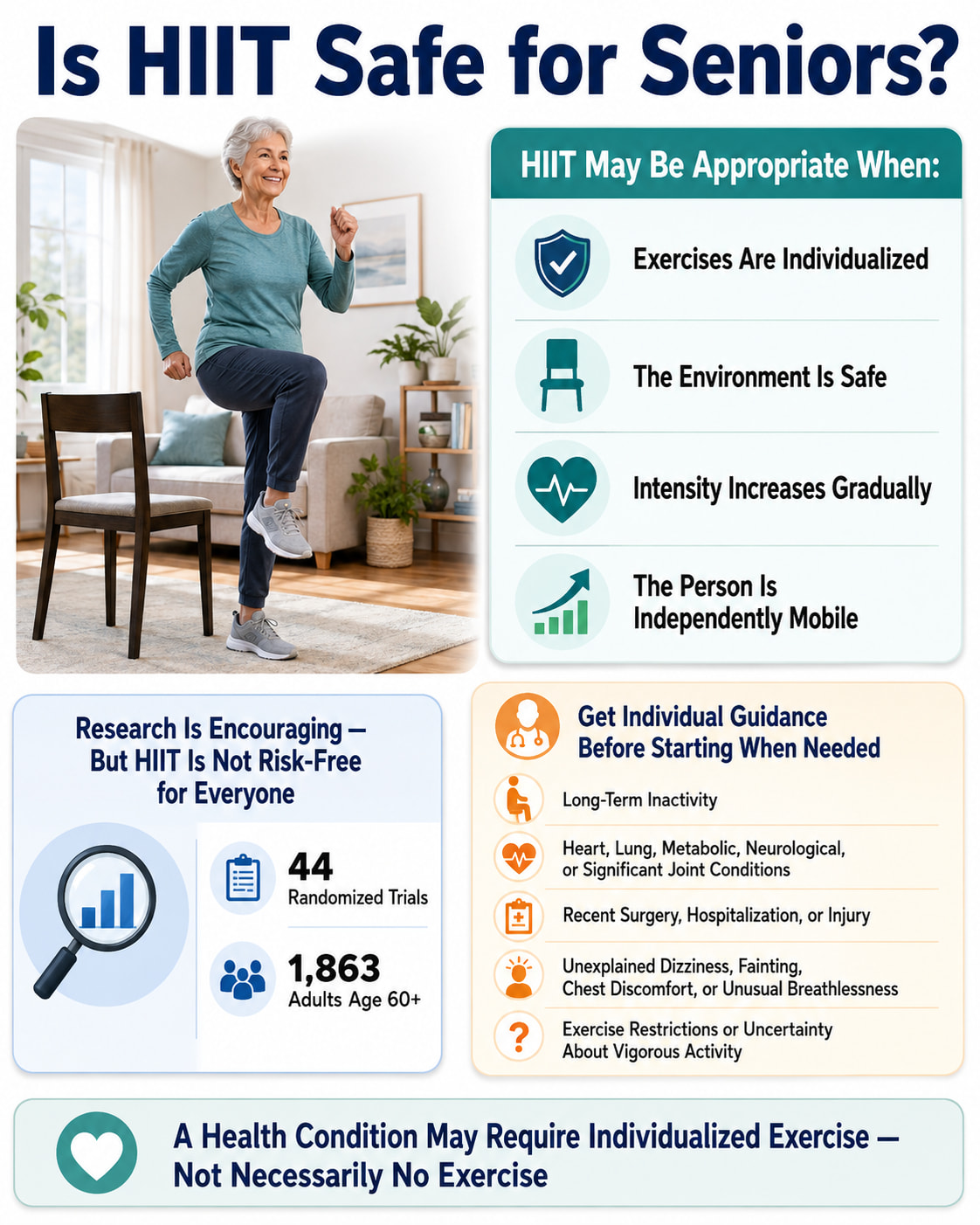
HIIT may be appropriate for many healthy and independently mobile older adults when the exercises are individualized, the environment is safe, and intensity increases gradually.
A September 2024 systematic review published in Sports Medicine – Open analyzed 44 randomized controlled trials involving 1,863 adults aged 60 and older. The findings were encouraging, but the researchers also reported substantial differences among the programs and varying evidence quality.
Safety reporting was not complete across all studies. Of the 31 studies that reported adverse-event information, 25 reported no events. Thirteen of the 44 studies did not provide relevant safety information. Therefore, the evidence does not show that HIIT is risk-free for every older adult.
A small 2022 randomized study published in BMC Geriatrics tested an equipment-free program in 30 independent, community-dwelling older adults with an average age of approximately 71. The participants completed five one-minute bodyweight intervals separated by 90-second recoveries. No adverse safety events were reported, and both the supervised and home groups improved cardiorespiratory fitness. However, the participants were screened, independently mobile, and taught the program before exercising at home.
Get Individual Guidance Before Starting When Needed
Speak with a healthcare professional before beginning vigorous intervals when you:
- Have been inactive for a long period
- Have a heart, lung, metabolic, neurological, or significant joint condition
- Have a disability that changes how you exercise
- Are recovering from surgery, hospitalization, or a recent injury
- Have unexplained dizziness, fainting, chest discomfort, or unusual breathlessness
- Have been told to limit exercise intensity
- Are uncertain whether vigorous exercise is appropriate
A health condition does not necessarily mean you cannot exercise. It may mean that your movements, intensity, or supervision need to be individualized.
What You Need Before Starting
Choose a Safe Exercise Area
Use a flat area with enough room to step in every direction.
Before beginning:
- Remove loose rugs, cords, bags, and other trip hazards.
- Keep pets away from the workout space.
- Avoid slippery floors.
- Place a sturdy chair against a wall.
- Do not use a chair with wheels or a swivel base.
- Keep a countertop or stable surface nearby if you need more support.
Wear Appropriate Clothing and Shoes
Wear clothing that allows comfortable movement. Choose stable athletic or walking shoes with a secure fit and nonslip sole.
Avoid exercising in loose slippers, unstable sandals, or socks on a slippery floor.
Prepare Basic Equipment
You will need:
- A sturdy chair
- A phone, clock, or interval timer
- Drinking water
- Optional heart-rate monitor
- Optional exercise mat for standing comfort
Check How You Feel
Postpone the workout when you are acutely ill, unusually fatigued, feverish, or unable to move safely.
Do not use HIIT to “push through” unexplained chest discomfort, dizziness, severe breathlessness, or sharp pain.
How to Measure Your Exercise Intensity
You do not need an expensive fitness tracker. The effort scale and talk test are practical ways to judge intensity.
| Effort | How it should feel | Talk test |
|---|---|---|
| 0–2 out of 10 | Very easy | Normal conversation |
| 3–4 out of 10 | Easy | Full sentences comfortably |
| 5–6 out of 10 | Moderate | Talking is possible, singing is difficult |
| 7 out of 10 | Vigorous but controlled | Only short phrases |
| 8 out of 10 | Very challenging | A few words at a time |
| 9–10 out of 10 | Near maximum | Not appropriate for this beginner plan |
During your first week, keep the work intervals around 5–6 out of 10. Breathing should increase, but you should remain in control.
During later weeks, some intervals may reach 6–7 out of 10. You should still be able to maintain balance, posture, and smooth movement.
During recovery, slow down until you return to approximately 2–3 out of 10. Extend the recovery period when your breathing remains too hard to begin the next exercise safely.
Beginner HIIT Workout for Seniors at Home
This low-impact plan uses six movements. Complete one work interval for each exercise.
Beginner Timing Options
Easier starting option:
- Work for 20 seconds.
- Recover for 90 seconds.
- Aim for 5–6 out of 10 effort.
Standard beginner option:
- Work for 30 seconds.
- Recover for 60 seconds.
- Aim for 5–6 out of 10 initially.
- Progress toward 6–7 out of 10 over time.
Do not shorten the recovery period simply because the timer says to start. Take additional recovery when needed.
Warm-Up: 5–8 Minutes
The American Heart Association recommends gradually warming up and cooling down for approximately 5–10 minutes around aerobic exercise.
Perform each movement slowly:
- Easy march in place
- Gentle side-to-side steps
- Alternating heel taps
- Ankle raises
- Shoulder rolls
- Comfortable arm swings
- Two or three slow chair stands, if appropriate
Your body should feel warmer by the end of the warm-up, but you should not feel tired.
Main Interval Plan
| Interval | Work movement | Work time | Recovery movement |
|---|---|---|---|
| 1 | Brisk march in place | 20–30 seconds | Easy march for 60–90 seconds |
| 2 | Side step touches | 20–30 seconds | Slow step touches for 60–90 seconds |
| 3 | Chair sit-to-stands | 20–30 seconds | Easy heel-toe taps for 60–90 seconds |
| 4 | Heel digs with forward reaches | 20–30 seconds | Easy march for 60–90 seconds |
| 5 | Supported alternating knee lifts | 20–30 seconds | Slow step touches for 60–90 seconds |
| 6 | Low-impact step jacks | 20–30 seconds | Begin the cool-down |
Complete the circuit once. Do not add a second round during your first sessions.
Cool-Down: 5–10 Minutes
Gradually reduce your pace instead of stopping suddenly.
Use:
- Slow marching
- Gentle walking around the room
- Easy heel taps
- Relaxed breathing
- Gentle calf or chest stretches, if comfortable
Continue until your breathing and heart rate move closer to their normal resting levels.
How to Perform Each Exercise
1. Brisk March in Place
Stand tall with your feet approximately hip-width apart. March in place, lifting each foot only as high as you can control.
Swing your arms naturally and keep your steps quiet.
Make it easier: Hold the back of a sturdy chair or perform a seated march.
Form cue: Increase intensity through purposeful movement, not by stomping or leaning backward.
2. Side Step Touches
Step your right foot to the side. Bring your left foot toward it without crossing your legs. Repeat in the opposite direction.
Keep your knees soft and your toes facing generally forward.
Make it easier: Take smaller steps or keep one hand on a chair.
Form cue: Stay tall and avoid letting your feet collide.
3. Chair Sit-to-Stands
Sit near the front half of a sturdy chair with your feet flat and approximately hip-width apart.
Lean slightly forward from your hips, press through your feet, and stand. Sit back down slowly and under control.
Make it easier: Push lightly from the chair or your thighs with your hands.
Use an alternative when needed: Continue marching or perform supported shallow squats if repeated chair stands are uncomfortable.
Form cue: Control the descent. Do not drop quickly onto the chair.
4. Heel Digs With Forward Reaches
Place one heel on the floor in front of you with the toes pointing upward. Return the foot and alternate sides.
At the same time, reach or gently punch your hands forward at chest height.
Make it easier: Use only the feet or keep one hand on a chair.
Form cue: Keep the planted knee soft and avoid forcefully locking it.
5. Supported Alternating Knee Lifts
Stand beside or behind a sturdy chair. Hold it lightly with one or both hands.
Lift one knee to a comfortable height, lower it, and alternate sides.
Make it easier: Lift each foot only slightly or perform a seated march.
Form cue: Keep your torso tall instead of leaning back to lift the knee higher.
6. Low-Impact Step Jacks
Step your right foot to the side while raising your arms as high as comfortable. Return to the center and repeat on the left.
One foot remains on the floor throughout the exercise.
Make it easier: Use smaller side taps and keep your hands below shoulder height.
Seated option: Sit tall, tap one foot to the side, return it, and alternate while moving your arms comfortably.
Form cue: This is a step, not a jump.
Four-Week Beginner Progression
Progress only when you can finish the current week without losing balance, rushing your movements, or needing unusually long recovery afterward.
| Week | Work interval | Recovery interval | Target effort |
|---|---|---|---|
| Week 1 | 20 seconds | 90 seconds | 5–6 out of 10 |
| Week 2 | 30 seconds | 90 seconds | 5–6 out of 10 |
| Week 3 | 30 seconds | 60–75 seconds | 6 out of 10 |
| Week 4 | 40 seconds | 60–75 seconds | 6–7 out of 10 |
Increase only one variable at a time. For example, increase the work interval before shortening recovery.
You do not have to progress every week. Repeat a week whenever you need more time.
Chair-Supported and Seated Modifications
| Standard exercise | Chair-supported option | Seated option |
|---|---|---|
| Brisk march | Hold chair and use smaller steps | Seated march |
| Side step touch | Hold chair and shorten the step | Alternating side toe taps |
| Sit-to-stand | Use hands and partial stands | Seated knee extensions |
| Heel digs | Hold chair with one hand | Seated heel taps |
| Knee lifts | Lift feet only slightly | Seated march |
| Step jacks | Side toe taps without arm raises | Seated step-outs |
A fully seated interval workout can still increase breathing and provide useful activity. However, it may feel less intense than standing exercise. Use larger controlled arm movements or a slightly quicker rhythm when you need more challenge and can remain stable.
How Often Should Seniors Do HIIT?
Start with two nonconsecutive sessions per week. Leave at least one easier day between workouts.
After several weeks, some people may progress to three weekly sessions. Three sessions are not required if two challenging workouts fit your abilities and schedule better.
A balanced week might look like this:
| Day | Activity |
|---|---|
| Monday | Beginner HIIT workout |
| Tuesday | Easy walk and balance practice |
| Wednesday | Strength training |
| Thursday | Rest or light activity |
| Friday | Beginner HIIT workout |
| Saturday | Strength and balance exercises |
| Sunday | Rest or comfortable walking |
Your HIIT sessions are only one part of an active week. Continue including regular walking or other aerobic activity, muscle-strengthening exercise, and balance work.
Common HIIT Mistakes Seniors Should Avoid
Starting at Maximum Effort
The first interval should not feel like a sprint. Begin at a moderate effort and build gradually.
Moving Too Quickly to Maintain Balance
Speed is useful only when the movement remains controlled. Reduce your pace when you start stumbling, twisting, or grabbing the chair suddenly.
Using Too Little Recovery
Longer recovery is not cheating. The recovery period allows you to perform the next interval safely and effectively.
Holding Your Breath
Continue breathing throughout every exercise, especially during chair sit-to-stands.
Adding Too Much at Once
Do not simultaneously increase work time, add rounds, shorten recovery, and move faster. Change one part of the workout at a time.
Performing HIIT Every Day
Harder intervals require recovery. Use easier walking, mobility, strength, or balance work between HIIT sessions.
Ignoring the Exercise Area
A loose rug or object on the floor can be more dangerous than the exercise itself. Clear the room before starting.
Potential Benefits of HIIT Workouts for Older Adults
May Improve Cardiorespiratory Fitness
Cardiorespiratory fitness describes how effectively your heart, lungs, blood vessels, and muscles work together during physical activity.
The 2024 review found that HIIT improved cardiorespiratory fitness compared with both nonexercise control groups and other exercise programs. Better aerobic fitness may make walking, climbing stairs, shopping, and other daily activities feel more manageable.
Provides a Time-Efficient Cardio Option
Interval workouts concentrate the challenging activity into short periods. You do not need to maintain the harder pace continuously.
This can make interval training practical for people who dislike long cardio sessions or have difficulty setting aside large blocks of time.
May Support Some Cardiovascular Health Markers
The 2024 review found improvements in resting heart rate and systolic blood pressure in several comparisons. However, results differed among outcomes, and HIIT did not outperform other exercise for everything.
HIIT should not be viewed as a replacement for medication, medical care, or other forms of physical activity.
Can Include Functional Movements
Exercises such as marching, side steps, knee lifts, and controlled chair stands resemble movements used during daily life.
When performed correctly, these exercises challenge coordination and lower-body control while also raising your breathing rate.
Can Be Performed at Home
A beginner low-impact HIIT workout requires little space and no specialized machine. A sturdy chair, timer, clear floor, and supportive footwear are enough for this plan.
Consistency Matters More Than Making Every Session Extreme
A May 2026 analysis published in BMC Sports Science, Medicine and Rehabilitation examined adherence within a six-month home HIIT trial involving healthy adults aged 60–84. Better total, frequency, and intensity adherence was associated with larger improvements in peak aerobic fitness. Session duration alone was not associated with the same result.
The practical lesson is simple: a manageable workout performed consistently is more useful than an exhausting session that you cannot repeat.
When to Stop Exercising
Stop the workout when you experience:
- Chest pressure, heaviness, tightness, or discomfort
- Feeling dizzy, lightheaded, confused, or faint
- Unusual or extreme shortness of breath
- A fast or uneven heartbeat that feels abnormal
- Sudden weakness or extreme fatigue
- Sharp, worsening, or unstable joint pain
- Loss of balance that does not quickly resolve
The American Heart Association advises stopping and contacting a healthcare professional when warning signs such as chest discomfort, dizziness, unusual breathlessness, or an abnormal heartbeat occur. Seek emergency care for severe or persistent chest symptoms or another possible medical emergency.
Normal harder breathing during a work interval should improve during recovery. Breathlessness that feels unusual, severe, or does not settle is different and should not be ignored.
Frequently Asked Questions
Can a 70-Year-Old Do HIIT?
Many healthy 70-year-olds can perform appropriately designed interval training. Age alone does not determine whether HIIT is suitable.
Current health, mobility, exercise experience, balance, and medical conditions matter more than the number on your birthday. Start with moderate intervals and seek individualized guidance when you have health concerns.
How Long Should a Senior HIIT Workout Last?
A beginner session may last approximately 15–25 minutes, including the warm-up and cool-down.
The challenging intervals may total only two to five minutes. More work is not automatically better. Start with an amount you can recover from comfortably.
How Often Should Seniors Perform HIIT?
Two nonconsecutive days per week is a practical starting point.
A third weekly session may be added after your body has adapted, provided you are recovering well and not experiencing ongoing joint discomfort, unusual fatigue, or declining performance.
Can Seniors Do HIIT Without Jumping?
Yes. Jumping is not required.
Brisk marching, side steps, heel digs, chair stands, supported knee lifts, low-impact step jacks, cycling, swimming, and uphill walking can all be used for intervals when they raise your effort sufficiently.
Is Walking Considered HIIT?
Walking becomes interval training when you alternate harder and easier periods.
For example, walk briskly or uphill for 30–60 seconds and then walk slowly for one to two minutes. It qualifies as vigorous HIIT only when the harder interval reaches a vigorous intensity relative to your fitness.
What Heart Rate Should Seniors Use During HIIT?
There is no single heart-rate number that is appropriate for every older adult.
For a general home workout, the 0–10 effort scale and talk test are easier to apply. Aim for approximately 5–6 out of 10 initially and progress toward 7 out of 10. Use a personalized heart-rate range when one has been provided by your healthcare professional or qualified exercise specialist.
Can This Workout Be Done Entirely Seated?
Yes. Seated marching, side toe taps, heel taps, knee extensions, and controlled arm movements can be arranged into an interval workout.
A seated version may be appropriate when standing balance is limited. Choose a sturdy chair without wheels, keep both feet controlled, and avoid leaning so far that the chair becomes unstable.
Conclusion
A HIIT workout for seniors does not need to involve running, jumping, or maximum effort. Short periods of brisk marching, side steps, chair stands, and other low-impact movements can create a practical interval session at home.
Begin with 20-second work periods, generous recovery, and an effort of approximately 5–6 out of 10. Focus on balance and form before increasing speed. When the workout becomes comfortable, progress one variable at a time.
Start with two nonconsecutive sessions this week, record how you feel afterward, and repeat the same level until you can complete it with steady breathing and confident movement.
References
- CDC — Older Adults: Adding Activity Recommendations.
- CDC — What Counts as Physical Activity for Older Adults.
- American Heart Association — Develop a Physical Activity Plan for You.
- Sports Medicine – Open — Effects of HIIT on the Physical Fitness and Health of Older Adults.
- BMC Geriatrics — Equipment-Free, Unsupervised HIIT in Older Adults.
- BMC Sports Science, Medicine and Rehabilitation — Home-Based HIIT Adherence and Cardiorespiratory Fitness.