
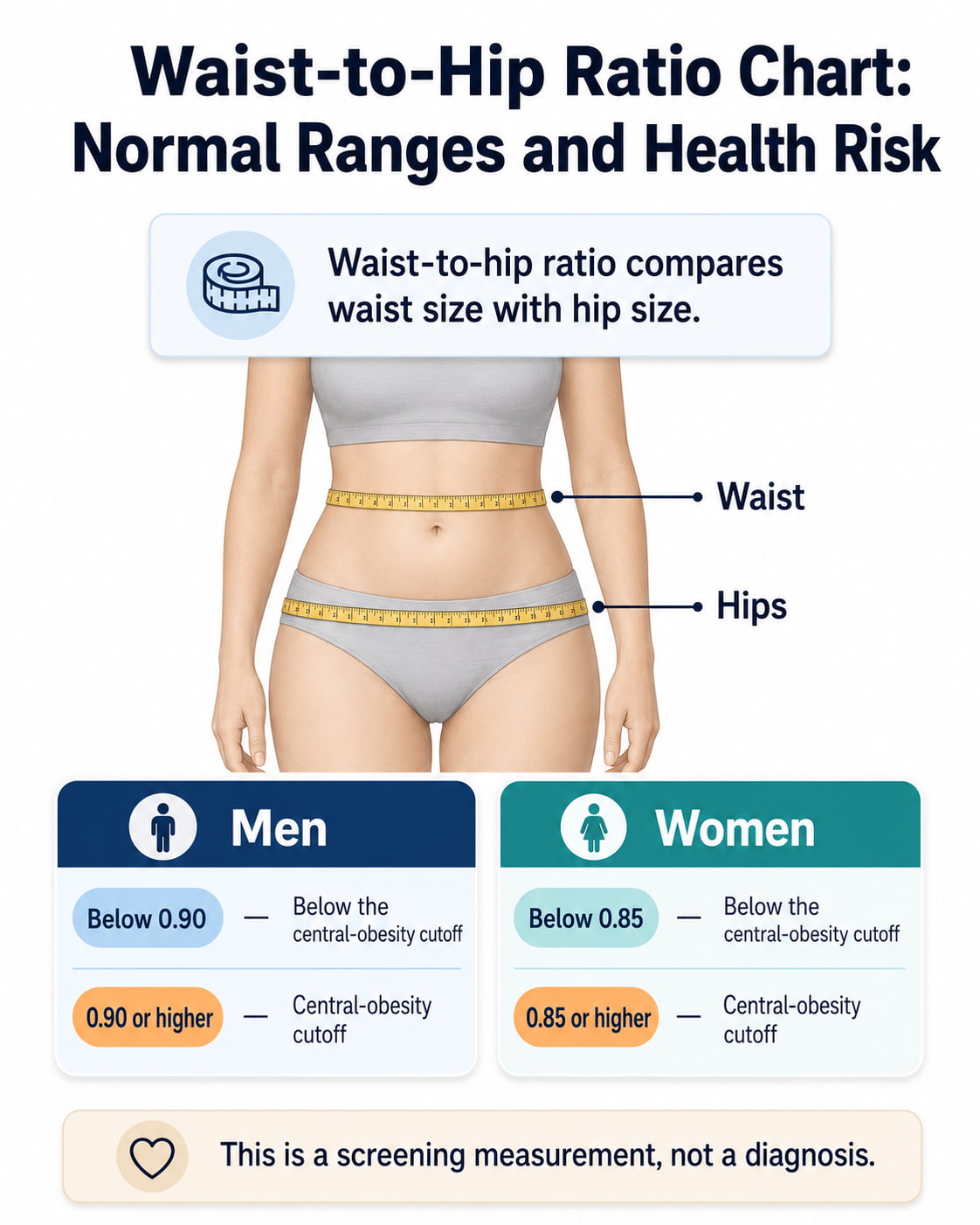
For adults, a waist-to-hip ratio below 0.90 for men and below 0.85 for women falls below the commonly used World Health Organization cutoff for central obesity. A ratio of 0.90 or higher in men or 0.85 or higher in women indicates greater abdominal fat distribution and a potentially higher risk of metabolic complications.
A waist-to-hip ratio chart is a quick screening tool—not a diagnosis. Your blood pressure, blood sugar, cholesterol, medical history, and other body measurements also affect your overall health risk. The World Health Organization recommends interpreting waist-to-hip ratio alongside these other factors.
Waist-to-Hip Ratio Chart
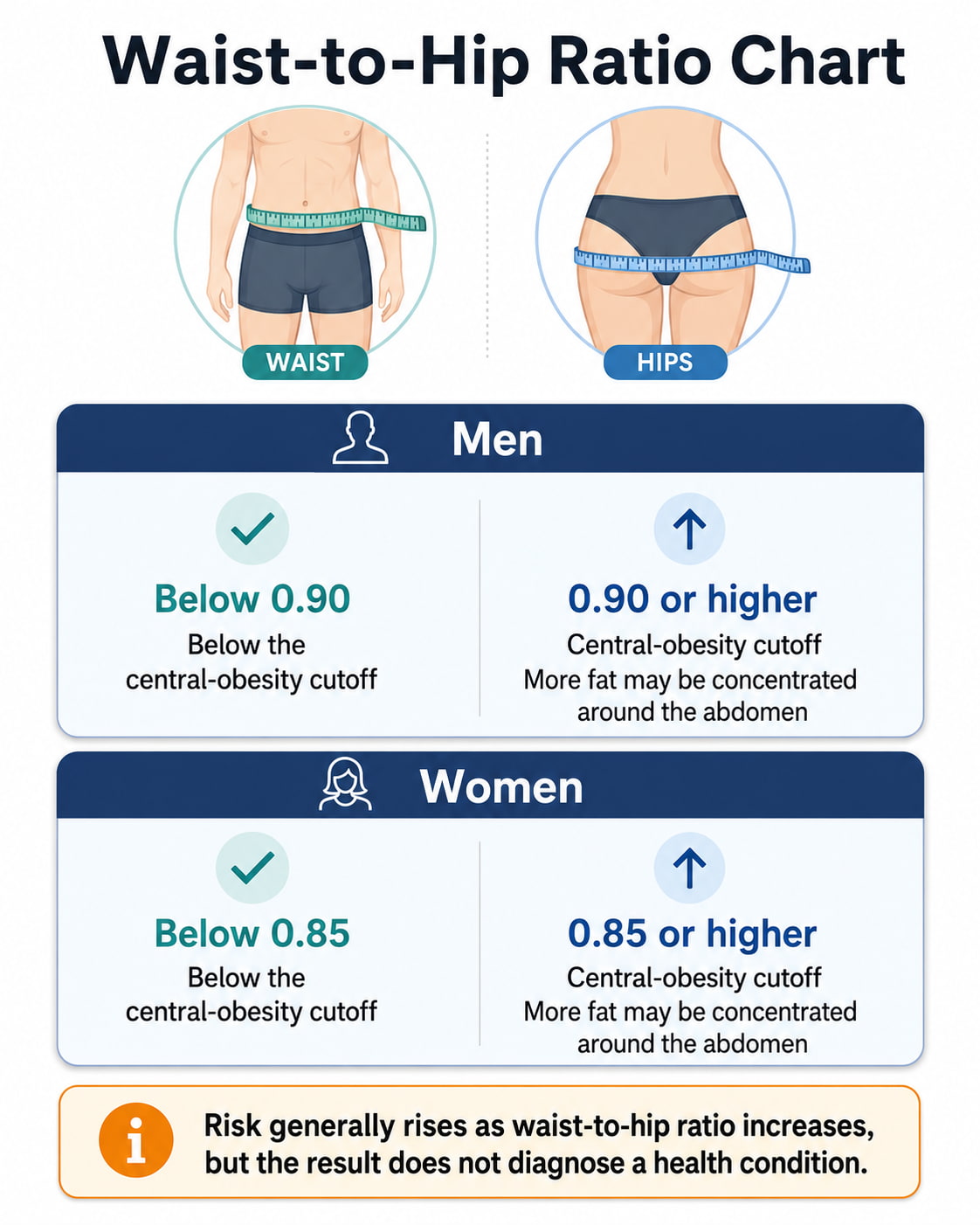
The chart below uses the commonly applied WHO-based adult cutoffs.
| Adult group | Below the central-obesity cutoff | Central-obesity cutoff | What the result suggests |
|---|---|---|---|
| Men | Below 0.90 | 0.90 or higher | More fat may be concentrated around the abdomen |
| Women | Below 0.85 | 0.85 or higher | More fat may be concentrated around the abdomen |
These are screening thresholds rather than strict boundaries between “healthy” and “unhealthy.” Risk generally rises as waist-to-hip ratio increases, but a result below the cutoff does not rule out diabetes, high blood pressure, abnormal cholesterol, or cardiovascular disease.
Important: Many online charts divide waist-to-hip ratio into low, moderate, and high-risk categories. Those additional ranges are not one universally accepted WHO classification. The sex-specific central-obesity cutoffs above provide a clearer official reference.
What Is Waist-to-Hip Ratio?
Waist-to-hip ratio, commonly shortened to WHR, compares the circumference of your waist with the circumference of your hips.
It provides an estimate of how body fat is distributed. Two people can have the same weight or body mass index but carry fat in different areas. A person who carries proportionally more weight around the abdomen may have a higher WHR.
Waist-to-Hip Ratio Formula
Waist-to-hip ratio = Waist circumference ÷ Hip circumference
Use the same unit for both measurements. You can use either inches or centimeters because the units cancel during the calculation.
Calculation Example
Suppose your measurements are:
- Waist: 34 inches
- Hips: 42 inches
34 ÷ 42 = 0.81
Your waist-to-hip ratio is 0.81.
A calculator may display several decimal places, but rounding the result to two decimal places is normally enough for home screening.
How to Measure Your Waist and Hips Correctly
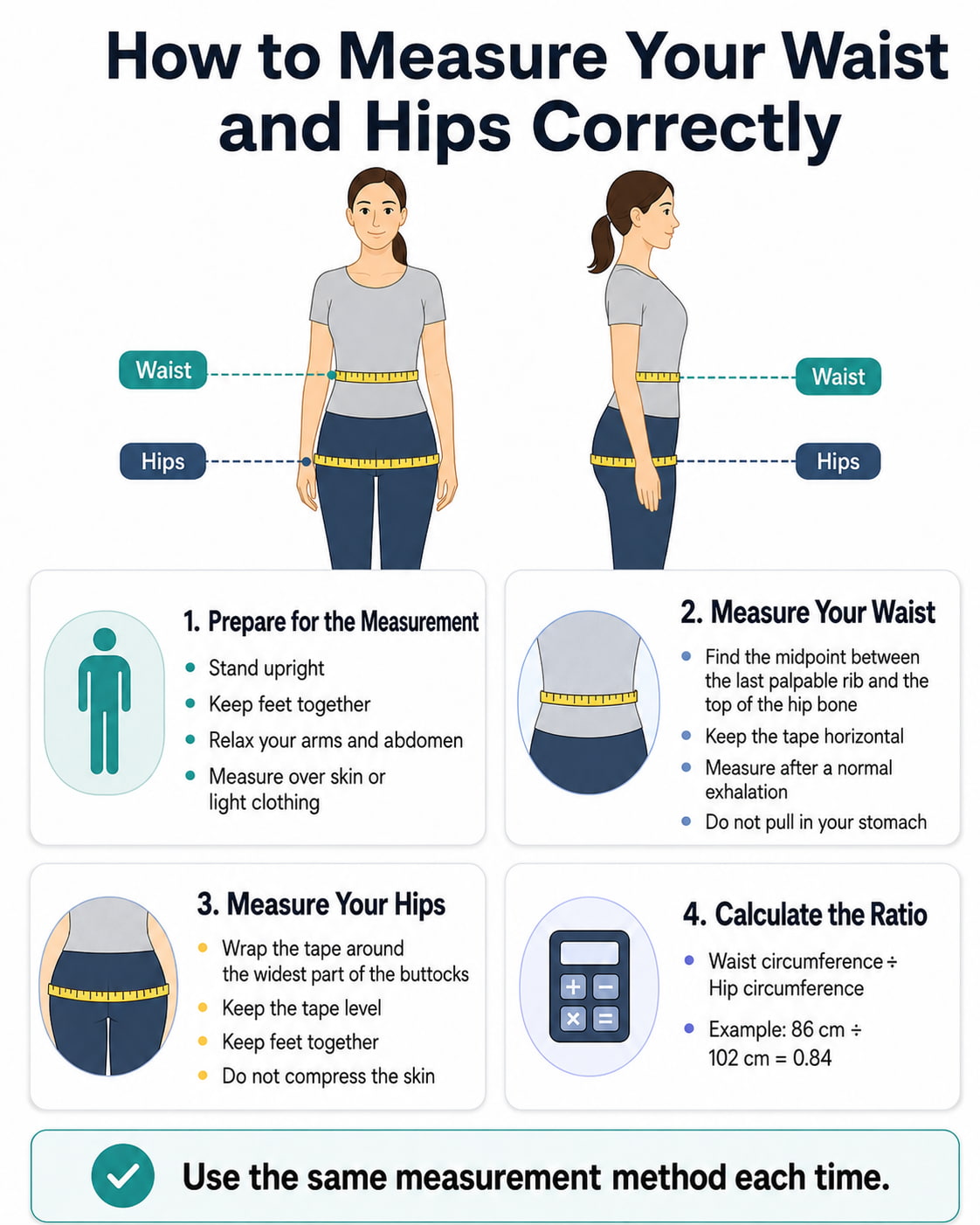
Incorrect tape placement can noticeably change your result. The following method is based on the World Health Organization STEPS physical measurement protocol.
You will need a flexible, nonstretching measuring tape.
1. Prepare for the Measurement
Stand upright with:
- Your feet together
- Your weight evenly distributed
- Your arms relaxed at your sides
- Your abdomen relaxed
Measure directly over the skin when practical. Light clothing may be acceptable, but thick or bulky clothing can distort the result.
2. Measure Your Waist
Locate:
- The lower edge of your last palpable rib
- The top of your hip bone, called the iliac crest
Place the tape at the midpoint between these two landmarks.
Make sure the tape is:
- Horizontal around your body
- Parallel to the floor
- Snug without compressing your skin
Breathe normally and record the measurement at the end of a normal exhalation. Do not hold your breath or pull in your stomach.
3. Measure Your Hips
Wrap the tape around the widest part of your buttocks.
Keep your feet together and check that the tape remains horizontal all the way around your body. The tape should touch the skin or light clothing without squeezing it.
4. Calculate the Ratio
Divide your waist measurement by your hip measurement:
Waist ÷ Hips = Waist-to-hip ratio
For example:
86 cm ÷ 102 cm = 0.84
Common Measurement Mistakes
Results may be inaccurate when you:
- Measure over heavy clothing
- Measure the hips too high
- Use the narrowest part of the waist instead of the selected protocol
- Pull the tape too tightly
- Allow the tape to tilt at the back
- Hold your breath or tighten your abdomen
- Use inches for one measurement and centimeters for the other
Different health organizations sometimes use different waist landmarks. Pick one reliable method and use it consistently when tracking changes.
What Does a High Waist-to-Hip Ratio Mean?
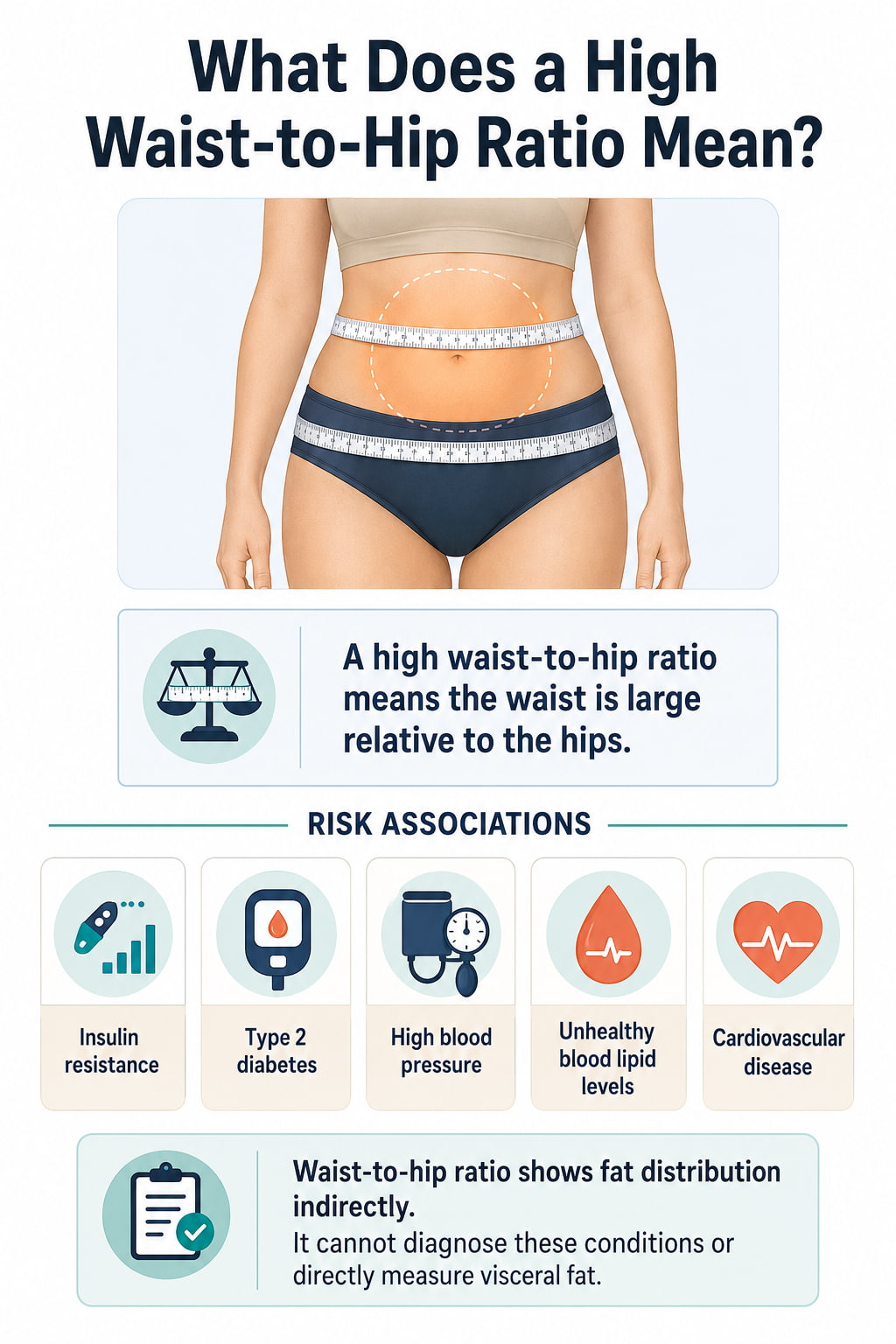
A high WHR suggests that your waist is large relative to your hips. This pattern is commonly described as central obesity or abdominal obesity.
Greater abdominal fat distribution is associated with an increased likelihood of metabolic complications, including:
- Insulin resistance
- Type 2 diabetes
- High blood pressure
- Unhealthy blood lipid levels
- Cardiovascular disease
Waist-to-hip ratio cannot confirm that you have any of these conditions. It also does not directly measure the amount of fat surrounding your internal organs. It is an indirect, low-cost screening measurement that helps identify people who may benefit from further health assessment.
What Does a Low Ratio Mean?
A ratio below the central-obesity cutoff generally means that your waist is smaller relative to your hips.
That is usually a more favorable fat-distribution pattern, but it does not automatically confirm good health. Someone can have a lower WHR and still have:
- A large waist circumference
- High blood pressure
- High blood sugar
- Abnormal cholesterol
- Low muscle mass
- Limited physical activity
- Other cardiovascular risk factors
Your WHR should therefore be treated as one piece of information rather than a complete health score.
Waist-to-Hip Ratio for Men and Women
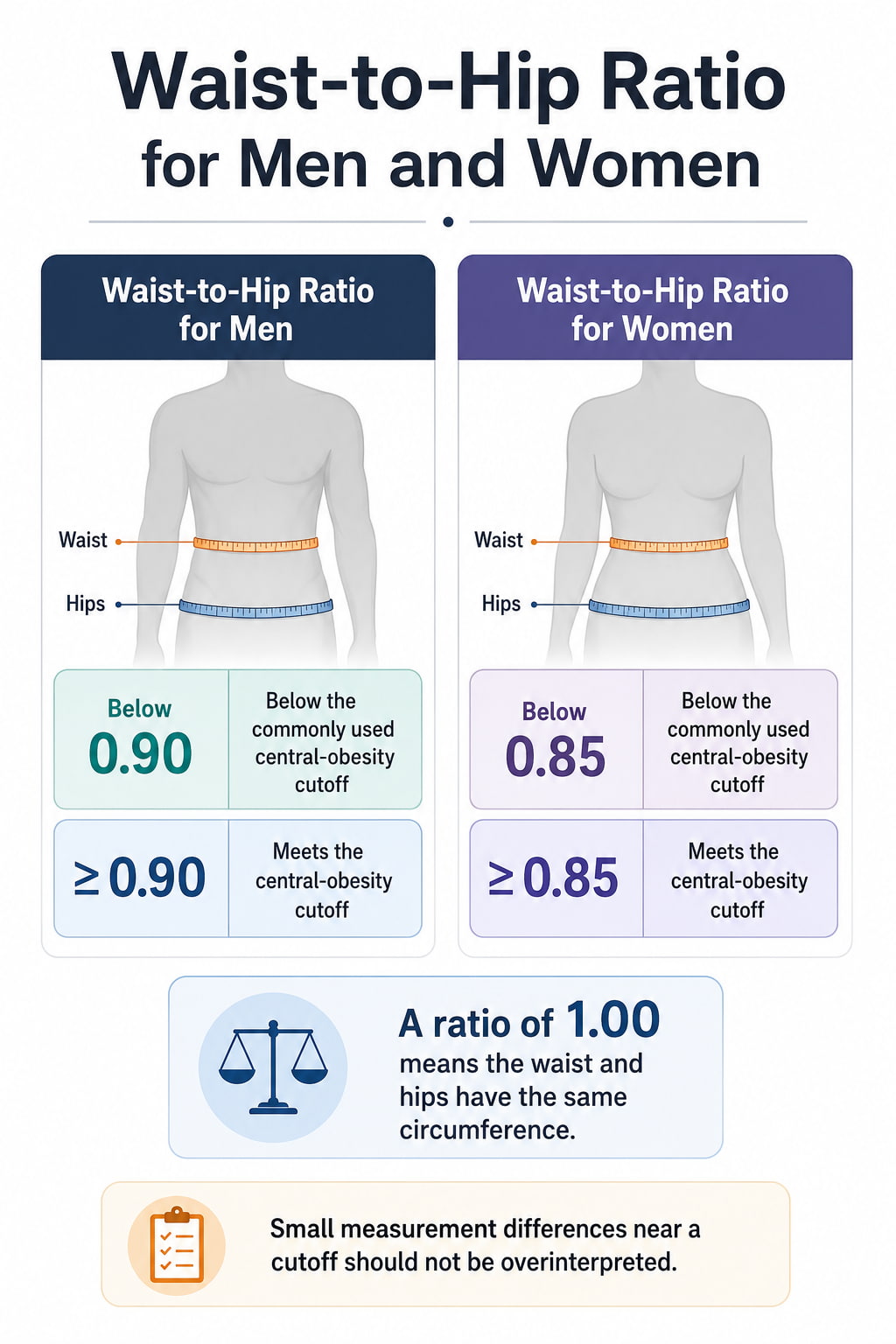
WHO-based cutoffs are different for men and women because typical body-fat distribution differs between the two groups.
Waist-to-Hip Ratio for Men
- Below 0.90: Below the commonly used central-obesity cutoff
- 0.90 or higher: Meets the cutoff for central obesity
A ratio of 1.00 means the waist and hips have the same circumference. For example, a 40-inch waist and 40-inch hip measurement produce a WHR of 1.00.
Waist-to-Hip Ratio for Women
- Below 0.85: Below the commonly used central-obesity cutoff
- 0.85 or higher: Meets the cutoff for central obesity
A ratio very close to the cutoff should not be overinterpreted. Small differences in tape placement or breathing can change a measurement by several millimeters.
The terms “men” and “women” reflect the sex-specific categories used in the published reference standards. A healthcare professional can help determine how to interpret the result when those categories do not fit an individual’s medical situation.
Waist-to-Hip Ratio vs. Other Body Measurements
No single measurement works best for every person. BMI, waist circumference, WHR, and waist-to-height ratio provide different information.
| Measurement | What it compares | Main advantage | Important limitation |
|---|---|---|---|
| BMI | Weight with height | Quick and widely used | Does not show where fat is stored |
| Waist circumference | Waist size alone | Simple measure of abdominal size | Does not account for height or hip size |
| Waist-to-hip ratio | Waist with hips | Shows relative fat distribution | Hip size can affect the result |
| Waist-to-height ratio | Waist with height | Accounts for a person’s height | Does not measure overall body composition |
Waist-to-Hip Ratio vs. BMI
BMI is calculated from weight and height. It is useful for population screening, but it does not distinguish between muscle and fat or show where body fat is located.
WHR adds information about fat distribution. A person may have a BMI in the usual healthy range but still carry a relatively large amount of weight around the abdomen.
Neither measurement diagnoses a medical condition. Using both may provide more context than relying on either number alone.
Waist-to-Hip Ratio vs. Waist Circumference
Waist circumference measures abdominal size directly and requires only one measurement.
The National Heart, Lung, and Blood Institute identifies waist measurements greater than 40 inches for men and 35 inches for women as unhealthy body-fat distribution thresholds. These are waist-circumference cutoffs, not WHR cutoffs, and may require individualized interpretation.
Waist-to-Hip Ratio vs. Waist-to-Height Ratio
Waist-to-height ratio divides waist circumference by height.
The National Institute for Health and Care Excellence classifies adult waist-to-height ratio as:
- 0.40–0.49: Healthy central adiposity
- 0.50–0.59: Increased central adiposity
- 0.60 or higher: High central adiposity
A simple practical message is to keep your waist below half your height. Some current clinical guidance emphasizes waist-to-height ratio rather than WHR because it uses one cutoff across adult sexes and accounts for height.
When Waist-to-Hip Ratio May Be Misleading
WHR is less useful or requires professional interpretation in several situations.
Pregnancy
Adult WHR cutoffs should not be used to assess abdominal obesity during pregnancy. Normal changes in abdominal size make the result unsuitable for standard interpretation.
Children and Teenagers
The adult chart should not be applied to children. Growth, puberty, age, and sex affect body proportions, and pediatric assessment requires age-appropriate standards.
Conditions That Change Abdominal Size
Abdominal swelling, fluid retention, recent surgery, or other medical conditions can alter waist circumference without representing an ordinary change in body fat.
Unusual Body Composition
Large hip or gluteal muscles can lower the ratio, while reduced hip muscle mass can increase it. This means the result may change even when waist size stays the same.
Inconsistent Measurement Methods
Measuring the waist at the navel one time and at the midpoint between the rib and hip bone another time can create a false trend. Use the same anatomical landmarks, tape, posture, and breathing method each time.
Cutoff performance and interpretation may vary with sex, age, ethnicity, and the measurement protocol used.
How to Improve Your Waist-to-Hip Ratio and Health Risk
The goal should be to improve overall health rather than chase one ratio. A lower waist measurement may reduce WHR when hip size remains similar, but changes should come from sustainable habits rather than crash diets.
Be Physically Active Regularly
The Centers for Disease Control and Prevention recommends that adults get at least:
- 150 minutes of moderate-intensity aerobic activity each week, or 75 minutes of vigorous activity
- Two days of muscle-strengthening activity each week
Brisk walking, cycling, swimming, dancing, resistance training, and similar activities can all contribute. People who are currently inactive can begin with shorter, manageable sessions and build gradually.
Follow a Balanced Eating Pattern
Base most meals on minimally processed foods such as:
- Vegetables and whole fruits
- Beans and lentils
- Whole grains
- Nuts and seeds
- Fish or other lean protein sources
- Unsaturated fats
Limit sugary drinks, heavily processed foods, excess sodium, trans fats, and frequent large portions of foods high in saturated fat.
Track More Than Your Ratio
Consider monitoring:
- Waist circumference
- Weight trend
- Blood pressure
- Blood glucose or A1C when appropriate
- Cholesterol and triglycerides
- Physical fitness and strength
A small change in WHR does not always represent a meaningful change in health. Consistent trends and clinical measurements are more informative than one reading.
When to Speak With a Healthcare Professional
Consider discussing your result with a healthcare professional when:
- Your WHR is at or above the central-obesity cutoff
- Your waist size is increasing steadily
- You have high blood pressure, prediabetes, diabetes, or abnormal cholesterol
- You have a strong family history of heart disease or type 2 diabetes
- You need help choosing a safe weight-management plan
- Your abdomen becomes enlarged suddenly or is accompanied by pain, swelling, or breathing difficulty
A clinician may review your measurements together with laboratory results, medications, medical conditions, sleep, activity, and family history.
Frequently Asked Questions
What is a normal waist-to-hip ratio?
There is no universal multi-level “normal range.” Commonly used WHO-based screening cutoffs are below 0.90 for men and below 0.85 for women. Results at or above those values indicate central obesity.
Is a waist-to-hip ratio of 0.80 healthy?
A ratio of 0.80 is below the commonly used central-obesity cutoff for both men and women. However, it does not guarantee that blood pressure, glucose, cholesterol, or waist circumference is healthy.
Is a waist-to-hip ratio of 1.0 high?
Yes. A ratio of 1.0 is above the common central-obesity cutoff for both men and women. It means the waist and hips have equal circumferences.
Is waist-to-hip ratio more accurate than BMI?
WHR can provide more information about fat distribution, while BMI describes weight relative to height. Neither is universally more accurate for every health outcome or every person. They are often most useful when interpreted together with waist circumference and clinical risk factors.
Should I use waist circumference or waist-to-hip ratio?
Waist circumference is simpler and commonly used in US clinical guidance. WHR adds information about waist size relative to hip size. Using both can provide a broader picture, but a healthcare professional may prefer one method based on the guideline being followed.
How often should I measure my waist-to-hip ratio?
Frequent measurements are usually unnecessary. Measurements taken several weeks apart under similar conditions are more useful than daily checks. Always use the same tape placement and technique.
Can exercise lower waist-to-hip ratio?
Regular physical activity may help reduce abdominal fat and waist circumference, especially when combined with a balanced diet and sustainable weight management. The amount of change varies because genetics, age, hormones, muscle mass, medications, and medical conditions also affect body shape.
Conclusion
A waist-to-hip ratio chart offers a simple way to screen abdominal fat distribution. For adults, the main WHO-based cutoffs are 0.90 or higher for men and 0.85 or higher for women. Measure carefully, use the same method each time, and interpret the result alongside your waist size, BMI or waist-to-height ratio, blood pressure, glucose, cholesterol, and medical history.
Use your result as a starting point for healthier habits or a conversation with a healthcare professional—not as a diagnosis or a judgment about your health.
This content is for informational purposes only and not medical advice.
References
- World Health Organization: Waist Circumference and Waist-Hip Ratio
- WHO STEPS: Physical Measurement Protocol
- National Heart, Lung, and Blood Institute: Overweight and Obesity Assessment
- NICE: Identifying Central Adiposity
- CDC: Physical Activity Guidelines for Adults
- World Health Organization: Healthy Diet