
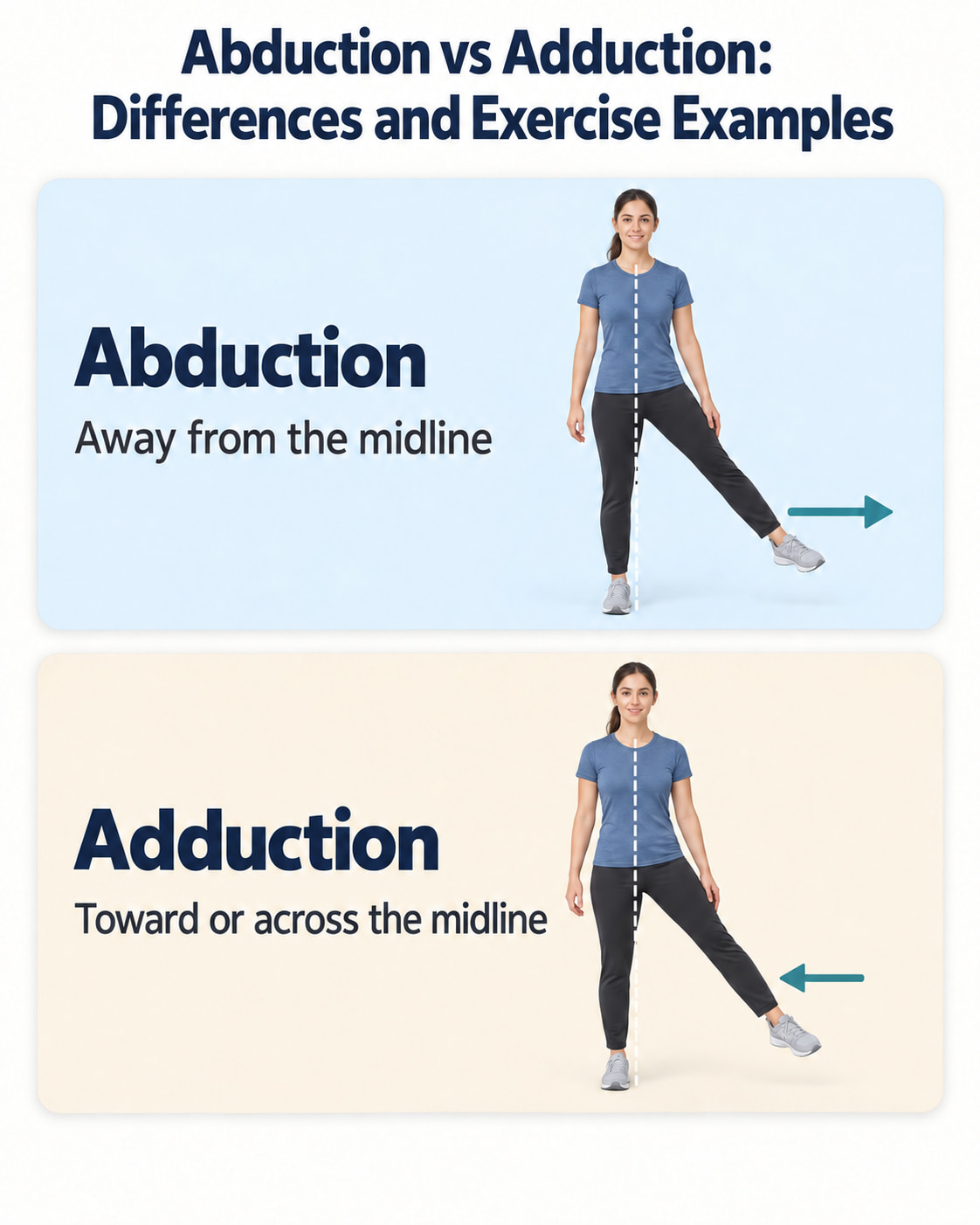
Abduction moves a limb away from your body’s midline, while adduction brings it toward or across the midline. Understanding abduction vs adduction is easier with a simple example: raising your leg sideways is abduction, and bringing it inward is adduction.
Knowing these terms helps you understand exercise instructions, choose the correct machine, and recognize which movement you are training. The comparison applies to your shoulders as well as your hips.
What Is the Difference Between Abduction and Adduction?
Your body’s midline is an imaginary line dividing it into right and left halves. Movement is described relative to your body, regardless of whether you are standing, sitting, or lying down.
As OpenStax’s anatomy reference explains, abduction and adduction are opposing movements.
| Comparison | Abduction | Adduction |
|---|---|---|
| Direction | Away from the midline | Toward or across the midline |
| Hip example | Moving a leg sideways | Bringing that leg inward |
| Shoulder example | Raising an arm sideways | Bringing the raised arm toward your side |
| Memory cue | AB = Away | ADD = Add back toward the body |
Ordinary side-to-side hip and shoulder movements occur in the frontal plane, also called the coronal plane.
Shoulder horizontal adduction describes a different path: bringing an elevated upper arm across the front of your chest, as in a hugging motion. Horizontal abduction moves it outward again. These movements occur in the transverse plane.
Abduction vs Adduction Muscles Worked
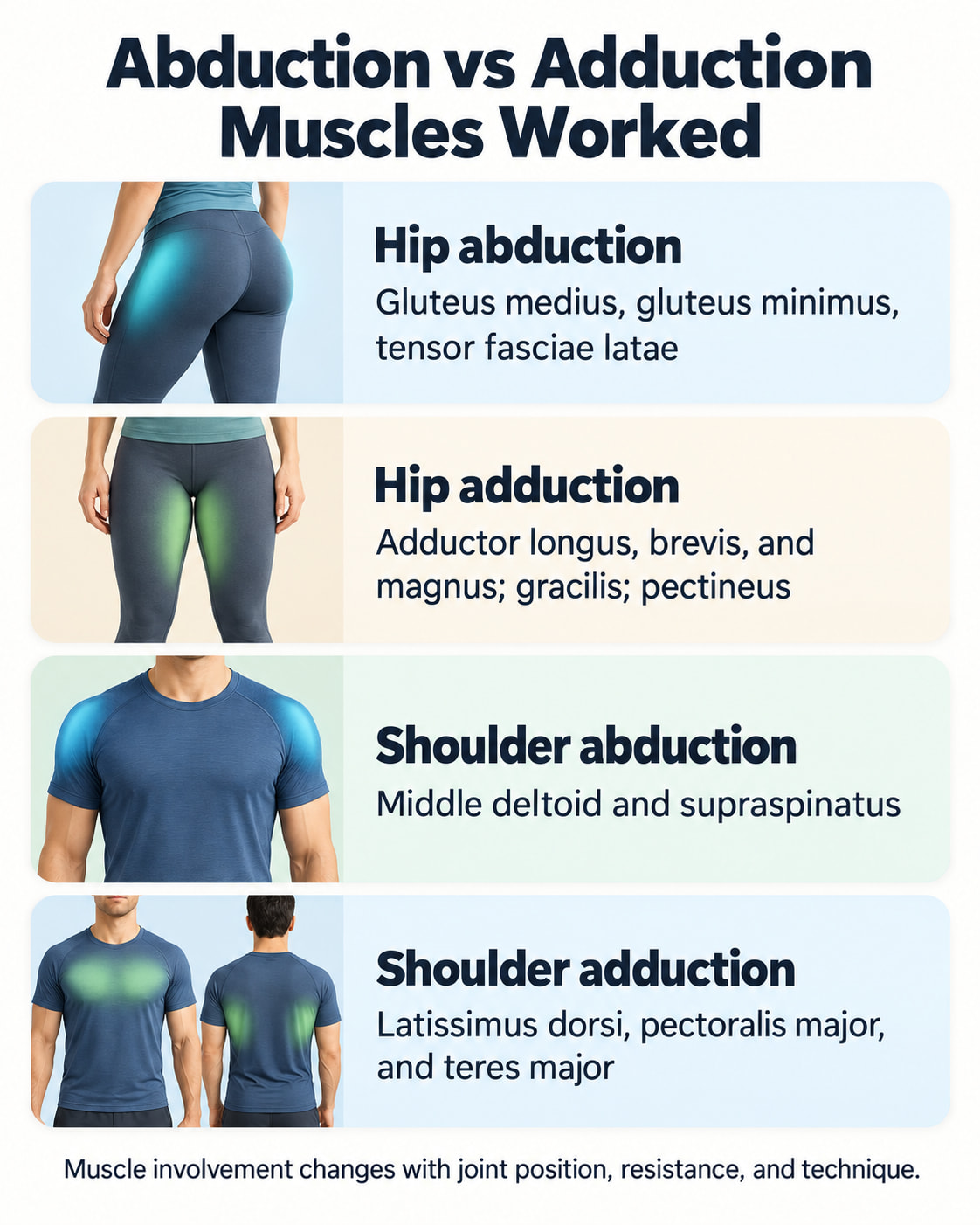
“Abductors” and “adductors” describe muscles by their actions. They are not the names of just two individual muscles.
| Movement | Major muscles involved | Where they are located |
|---|---|---|
| Hip abduction | Gluteus medius, gluteus minimus, tensor fasciae latae | Outer hip and upper outer thigh |
| Hip adduction | Adductor longus, brevis, and magnus; gracilis; pectineus | Mainly the inner thigh |
| Shoulder abduction | Middle deltoid and supraspinatus | Shoulder and upper shoulder blade region |
| Shoulder adduction | Latissimus dorsi, pectoralis major, and teres major | Back, chest, and shoulder blade region |
Muscle involvement changes with joint position, resistance, and technique. Several of these muscles also help with rotation, flexion, extension, or stabilization.
For example, a clinical anatomy review explains that the gluteus medius helps support the pelvis when one foot is off the ground. This makes the hip abductors relevant to walking and standing on one leg, even when you are not deliberately lifting a leg sideways.
Abduction Exercise Examples
These exercises demonstrate outward movement at the hip or shoulder. Start with a resistance and range you can control.
1. Side-Lying Hip Abduction
This is the top-leg version of a side-lying leg raise.
- Lie on your side with your head supported and hips stacked.
- Bend your lower knee for stability. Keep the upper leg straight without locking the knee.
- Lift the upper leg through a comfortable range without rolling backward.
- Lower slowly, then repeat on the other side.
Form cue: Keep your leg from turning just to lift higher.
The American Academy of Orthopaedic Surgeons includes this and the bottom-leg adduction exercise below in its hip conditioning program.
2. Supported Standing Hip Abduction
This upright option lets you practice moving your leg while keeping your torso steady.
- Stand beside a sturdy counter and hold it for balance.
- Shift your weight onto one leg, keeping that knee slightly relaxed.
- Move the other leg sideways with your toes facing forward.
- Return slowly and repeat on both sides.
Form cue: Keep your pelvis level and avoid leaning away from the moving leg.
Begin without a band. Once the movement is comfortable and controlled, a light loop band around your ankles can add resistance.
3. Dumbbell Lateral Raise
The lifting phase is shoulder abduction.
- Stand with light dumbbells beside your thighs.
- Keep a slight bend in your elbows and your wrists straight.
- Raise your arms outward to approximately shoulder height, or a lower comfortable height.
- Lower the weights slowly.
Form cue: Keep your torso still instead of swinging the weights upward.
The American Council on Exercise’s lateral-raise instructions emphasize controlled lifting and lowering.
Adduction Exercise Examples
These examples load the inner-thigh muscles as the working leg moves inward.
1. Side-Lying Hip Adduction
For this version, the bottom leg performs the lift.
- Lie on your side with the lower leg straight.
- Bend your upper leg and place its foot on the floor in front of the lower leg.
- Lift the lower leg a short distance without rolling your torso backward.
- Lower slowly, then switch sides.
Form cue: A small, controlled lift is enough to demonstrate the movement.
Both side-lying exercises lift a leg upward against gravity. The top-leg lift is abduction; the bottom-leg lift is adduction. Your position relative to the room does not determine the movement’s name.
2. Standing Cable or Band Hip Adduction
This provides resistance as you draw one leg inward.
- Secure a suitable resistance band to a low anchor and to your working ankle, or attach an ankle cuff to a low cable pulley.
- Stand sideways with the working leg nearest the anchor. Hold a stable support.
- Begin with that leg slightly out to the side and your toes forward.
- Draw it inward toward the standing leg without twisting your pelvis.
- Return slowly against the resistance.
Form cue: Stop before your feet collide or your balance changes. Crossing far beyond the midline is unnecessary.
Check the band, cuff, and anchor before starting, and use a light resistance while learning the movement.
Hip Abduction vs Adduction Machines
Many gyms have separate machines or a combination machine for these movements.
| Machine setting | Resisted movement | Typical pad contact |
|---|---|---|
| Hip abduction | Pressing the thighs apart | Outside of the thighs |
| Hip adduction | Bringing the thighs together | Inside of the thighs |
Follow the machine’s setup diagram because designs vary. Adjust the starting position to a comfortable range, keep your pelvis supported, and move without bouncing or letting the weight stack slam.
The weights do not need to match between movements. Different muscle groups, machine designs, and starting positions affect how difficult a setting feels. Choose each load according to your control and comfort.
Common Mistakes When Comparing Abduction and Adduction
Confusing Movement Direction With Muscle Effort
When you lower your arms during a lateral raise, the shoulders move into adduction. However, the abductors continue working to control the descent.
This is an eccentric contraction: the active muscles lengthen under load. Applied to the lateral raise, it explains why the lowering phase remains part of training the shoulder abductors.
Simply seeing an arm or leg move inward does not prove that the adductors are producing the main effort. The direction of the resistance matters.
Assuming Muscles Must Move a Joint to Work
Muscles can also produce force while a joint stays nearly still. This is an isometric contraction.
For example, holding a gentle squeeze against a firm cushion between your thighs loads the hip adductors with little visible movement. It is an adductor exercise, although it is less useful for demonstrating the direction of adduction.
Using More Range Than You Can Control
Reduce the load or range if you need to lean, twist, or swing. Aim for repeatable technique before increasing resistance.
How to Include Abduction and Adduction in Your Workouts
Both movements can fit into a strength program. Which exercises you add depends on your goals, current routine, equipment, and comfort.
The CDC’s adult activity guidance, dated December, 2023, recommends muscle-strengthening activity on at least two days per week that covers all major muscle groups. This is overall guidance, not a required schedule for every isolation exercise.
For someone new to these movements:
- Choose one hip abduction exercise and one hip adduction exercise to learn.
- Practice a small number of controlled repetitions before adding resistance.
- Finish the set when you would need to swing, lean, or change position to continue.
- Increase repetitions or resistance gradually, changing one variable at a time.
- Allow recovery between demanding sessions for the same muscles.
There is no single set-and-repetition prescription that suits every exercise and person. You also do not need every variation in one workout.
When to Stop and Seek Advice
Warm up before strength exercises and use a comfortable range. Muscle effort is expected, but sharp pain or joint pain is a reason to stop.
Speak with a healthcare professional or physical therapist if exercise repeatedly causes hip, groin, or shoulder pain, or if symptoms interfere with everyday movement.
If you are recovering from an injury or surgery, follow your clinician’s movement restrictions. A general exercise example may need modification for your situation.
Frequently Asked Questions
How Do You Remember Abduction vs Adduction?
Use “AB = Away” for abduction and “ADD = Add back” for adduction. Picture moving a leg sideways and then bringing it inward.
Which Movement Works the Inner Thighs?
Resisted hip adduction emphasizes the inner-thigh adductors. Examples include a bottom-leg side-lying raise and standing cable adduction.
Is a Clamshell an Abduction Exercise?
A standard clamshell primarily demonstrates hip external rotation. It can recruit muscles that also contribute to abduction, but a straight-leg side raise is a clearer example of outward hip movement.
Are Jumping Jacks Abduction or Adduction?
They include both. Moving your arms and legs apart involves abduction, while bringing them back toward the body involves adduction. Jumping jacks also involve other joint movements.
Is Adduction the Same as Flexion?
No. Bringing a thigh inward is hip adduction; lifting the knee forward is hip flexion. The movement’s direction and the joint involved determine its name.
Is Abduction or Adduction Better?
Neither is universally better. They train different actions. Choose exercises that suit the muscles and movements you want to develop within your overall routine.
Conclusion
Understanding abduction vs adduction makes exercise instructions easier to follow. Use the body’s midline as your reference, then pay attention to the resistance and your technique.
Start with one comfortable example of each hip movement. Practice slowly, keep your position steady, and add resistance as your control improves.
This content is for informational purposes only and not medical advice.
References
- OpenStax. Muscles of the Pectoral Girdle and Upper Limbs.
- OpenStax. Appendicular Muscles of the Pelvic Girdle and Lower Limbs.
- StatPearls, NCBI Bookshelf. Anatomy, Bony Pelvis and Lower Limb, Gluteus Medius Muscle.
- American Academy of Orthopaedic Surgeons. Hip Conditioning Program.
- American Council on Exercise. Lateral Raise.
- OpenStax. Nervous System Control of Muscle Tension.
- Merck Manual. Side-Lying Hip External Rotation (Clamshell Exercise).
- CDC. Adult Activity: An Overview.