
If you’re searching for the most effective arm exercises with weights, the short answer is: yes, weighted arm training is one of the fastest and most reliable ways to build strength and definition in your biceps, triceps, and shoulders.
Understanding how to train your arms properly matters because strong arms support lifting, pushing, pulling, carrying, and everyday movements. In this guide, you’ll learn key training principles, proper technique, and the 15 best weighted arm exercises backed by current fitness guidelines.
Why Arm Exercises With Weights Matter
Weighted arm training is essential because it:
- Builds lean muscle across the biceps, triceps, shoulders, and forearms.
- Increases everyday functional strength (lifting bags, pushing open doors, carrying loads).
- Supports joint health by strengthening the muscles surrounding the elbows, wrists, and shoulders.
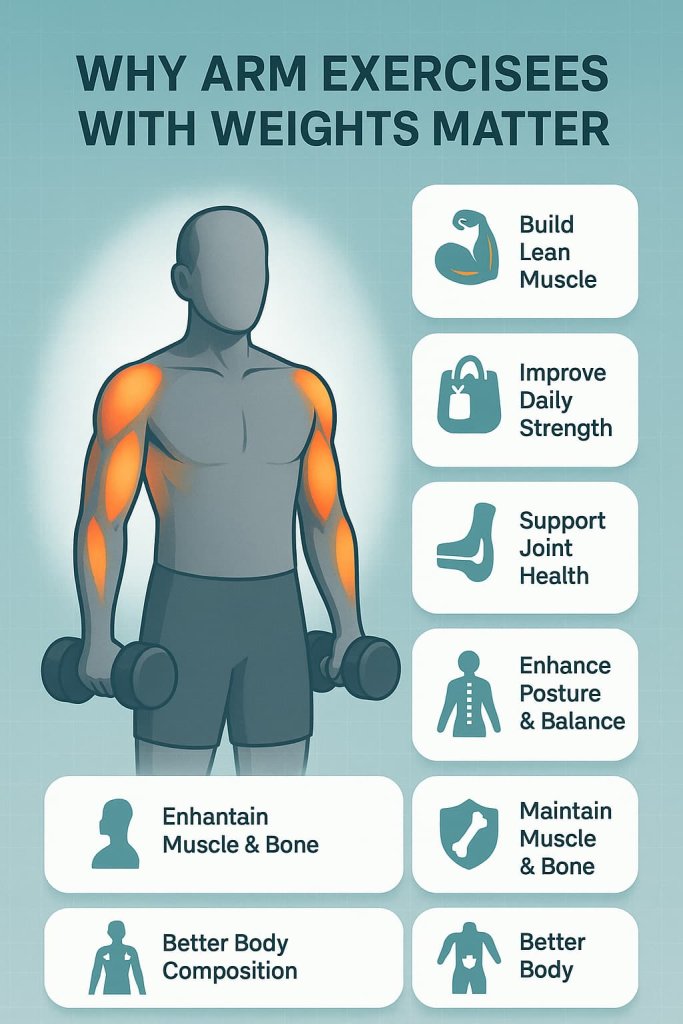
- Improves posture and upper-body balance.
- Helps maintain muscle mass and bone health, especially as you age.
- Enhances overall body composition when paired with proper nutrition.
15 Best Arm Exercises With Weights
These weighted arm movements target your biceps, triceps, shoulders, and forearms to build strength and definition from every angle. Each exercise focuses on controlled form, full range of motion, and progressive overload for the best results.
Biceps Exercises
1. Dumbbell Biceps Curl
Why it works:
This foundational curl isolates the biceps and helps build overall arm size and strength. It reinforces strict elbow flexion and improves muscle symmetry.
Muscles worked:
- Biceps brachii
- Brachialis
- Forearm flexors
How to do it:
- Stand tall with dumbbells at your sides, palms facing forward.
- Keep elbows close to your torso and curl the weights upward.
- Pause at the top and squeeze the biceps.
- Lower the weights slowly under control.
Trainer Tip:
Avoid swinging—keep your torso still so the biceps handle all the work.
2. Hammer Curl
Why it works:
A neutral-grip curl that targets deeper arm muscles responsible for thickness and strength. Great for building stronger forearms and a fuller arm shape.
Muscles worked:
- Brachialis
- Brachioradialis
- Biceps brachii
How to do it:
- Hold dumbbells at your sides with palms facing inward.
- Curl both weights (or alternate arms) straight up.
- Keep elbows tight to your sides.
- Lower slowly with full control.
Trainer Tip:
Focus on squeezing your forearms at the top for better brachialis activation.
3. Incline Dumbbell Curl
Why it works:
By placing your arms behind your torso, this variation stretches the biceps long head and increases the range of motion—ideal for developing peak shape.
Muscles worked:
- Biceps brachii (long head emphasized)
- Brachialis
How to do it:
- Sit on a bench set to 30–45°.
- Let arms hang straight down with dumbbells in hand.
- Curl the weights upward without moving your shoulders.
- Lower slowly until you feel a deep stretch.
Trainer Tip:
Use lighter weights—this position increases difficulty and stretch.
4. Concentration Curl
Why it works:
This strict curl eliminates momentum and forces maximum contraction in the biceps. Excellent for improving shape and mind-muscle connection.
Muscles worked:
- Biceps brachii
- Brachialis
How to do it:
- Sit and spread your legs slightly.
- Rest your elbow on the inside of your thigh.
- Curl the dumbbell slowly toward your shoulder.
- Lower with full control.
Trainer Tip:
Exhale as you lift; focus on squeezing the biceps from start to finish.
5. Alternating Single-Arm Curl
Why it works:
Training one arm at a time improves balance, control, and reduces strength imbalances between left and right arms.
Muscles worked:
- Biceps brachii
- Brachialis
- Forearm flexors
How to do it:
- Stand with dumbbells resting by your sides.
- Curl one arm upward while the other remains still.
- Lower that arm fully before switching sides.
- Maintain a stable torso.
Trainer Tip:
Turn your palm slightly outward at the top to maximize biceps contraction.
Triceps Exercises
6. Overhead Dumbbell Triceps Extension
Why it works:
This overhead angle targets the long head of the triceps, which contributes significantly to upper-arm size and overall strength.
Muscles worked:
- Triceps brachii (long head emphasized)
How to do it:
- Hold one or two dumbbells overhead with straight arms.
- Bend elbows to lower the weight behind your head.
- Extend arms fully without locking elbows hard.
- Repeat in a slow, controlled rhythm.
Trainer Tip:
Keep elbows pointed forward—not wide—to keep tension on the triceps.
7. Dumbbell Kickback
Why it works:
One of the strongest isolation exercises for the triceps, especially during the final extension phase of the movement.
Muscles worked:
- Triceps brachii (all three heads)
How to do it:
- Hinge forward at the hips with a flat back.
- Keep your upper arm glued to your side.
- Extend your arm straight back until fully straight.
- Lower the weight slowly.
Trainer Tip:
Pause at full extension for 1 second to maximize contraction.
8. Lying Dumbbell Triceps Extension
Why it works:
This lying variation increases stability and places strong tension on the triceps through their full range—excellent for strength and muscle gain.
Muscles worked:
- Triceps brachii (long, medial, and lateral heads)
How to do it:
- Lie on a flat bench with dumbbells above your chest.
- Bend elbows to lower weights toward your head.
- Extend elbows back to the starting position.
- Keep upper arms still throughout.
Trainer Tip:
Angle the dumbbells slightly backward instead of straight up to maintain tension.
9. Close-Grip Dumbbell Press
Why it works:
A compound press that allows you to train triceps with heavier loads while supporting them through chest and shoulder involvement.
Muscles worked:
- Triceps brachii
- Chest (secondary)
- Front deltoids (secondary)
How to do it:
- Lie on a bench holding dumbbells close together.
- Keep elbows tight to your body.
- Press the dumbbells upward.
- Lower slowly and repeat.
Trainer Tip:
To emphasize triceps, think about “pushing with your elbows” rather than your chest.
10. Reverse-Grip Triceps Extension
Why it works:
The reverse grip changes arm alignment and increases activation of the triceps’ medial head—great for full-arm definition.
Muscles worked:
- Triceps brachii (medial head emphasized)
How to do it:
- Hold a dumbbell or cable handle with palms facing you.
- Keep elbow tight and extend downward.
- Pause briefly at full extension.
- Return with control.
Trainer Tip:
Use lighter weight; the reverse grip reduces leverage but increases precision.
Shoulder & Forearm Exercises
11. Dumbbell Shoulder Press
Why it works:
A key upper-body strength builder that improves shoulder power and gives the arms a more defined, rounded look.
Muscles worked:
- Deltoids (all heads)
- Triceps (secondary)
- Upper chest (minor)
How to do it:
- Hold dumbbells at shoulder height.
- Press overhead until arms are fully extended.
- Lower with a controlled motion.
- Keep your core braced.
Trainer Tip:
Don’t flare elbows too wide—slight inward angle protects shoulders.
12. Dumbbell Lateral Raise
Why it works:
Targets the medial deltoids, the muscles responsible for shoulder width and upper-arm shape. This is a must-do for definition.
Muscles worked:
- Medial deltoid
- Upper trapezius (minor)
How to do it:
- Stand with dumbbells at sides.
- Raise arms outward until shoulder height.
- Lower slowly without dropping.
- Keep elbows slightly bent.
Trainer Tip:
Lead with your elbows, not your hands, to hit the delts correctly.
13. Bent-Over Reverse Fly
Why it works:
Strengthens the rear deltoids and upper back, improving posture and creating a balanced, sculpted arm–shoulder look.
Muscles worked:
- Rear deltoids
- Rhomboids
- Upper back stabilizers
How to do it:
- Hinge forward with dumbbells hanging down.
- Lift arms outward like “wings.”
- Pause briefly at the top.
- Lower under control.
Trainer Tip:
Do not shrug—keep shoulders away from ears to isolate the rear delts.
14. Dumbbell Wrist Curl
Why it works:
Strengthens the forearm flexors and improves grip strength, enhancing performance in all upper-body lifting.
Muscles worked:
- Forearm flexors
How to do it:
- Sit and rest forearms on your thighs or bench.
- Hold dumbbells palms up.
- Curl wrists upward.
- Lower slowly with full stretch.
Trainer Tip:
Keep forearms still—only the wrists move.
15. Reverse Wrist Curl
Why it works:
Balances the forearms by strengthening the wrist extensors, reducing the risk of elbow and wrist strain.
Muscles worked:
- Wrist extensors
- Brachioradialis (secondary)
How to do it:
- Rest forearms on thighs or bench, palms down.
- Curl wrists upward toward the ceiling.
- Lower slowly.
- Repeat for controlled reps.
Trainer Tip:
Use lighter weight than regular wrist curls—extensors are smaller muscles.
How to Structure Arm Training With Weights
Training Frequency
- Train arms 2–3 days per week, with at least 48 hours of rest between sessions targeting the same muscles.
- Beginners can start with 1–2 sessions weekly and gradually increase.
Sets & Reps
Based on standard resistance-training guidelines:
- 8–12 reps per set for strength and muscle growth.
- 1–3 sets per exercise for beginners; up to 3–4 sets for intermediate lifters.
- Choose a weight where the last 1–2 reps feel challenging but maintainable with good form.
Load & Progression
- Increase weight by roughly 2–10% once your current sets feel easy.
- Keep reps slow and controlled—especially the lowering phase.
- Track your weights and reps to ensure consistent progression.
Warm-Up & Safety
- Warm up 5–7 minutes with gentle cardio and arm mobility (arm circles, shoulder rolls, light marching).
- Keep wrists neutral, elbows stable, and avoid swinging the weights.
- Stop any movement that causes joint pain or sharp discomfort.
- Consult a professional if you have pre-existing injuries or medical conditions.
Sample Arm Workout (Beginner to Intermediate)
Weighted Arm Workout (2–3 days/week)
| Exercise | Sets | Reps |
|---|---|---|
| Dumbbell Biceps Curl | 3 | 8–12 |
| Hammer Curl | 2 | 10–12 |
| Overhead Triceps Extension | 3 | 8–12 |
| Dumbbell Kickback | 2 | 10–12 |
| Dumbbell Shoulder Press | 2 | 8–10 |
| Wrist Curl | 2 | 12–15 |
| Reverse Wrist Curl | 2 | 12–15 |
Trainer Tip: If the last reps feel easy, increase the weight next session.
Common Mistakes to Avoid
- Swinging the weights or using momentum
- Lifting too heavy without proper form
- Ignoring triceps (they make up most of upper-arm size)
- Training arms too frequently without recovery
- Skipping warm-up
- Neglecting forearm strength, limiting grip and performance
FAQ
1. How many times a week should I train arms with weights?
Aim for 2–3 times per week, with rest between sessions.
2. Do weighted arm exercises make arms bulky?
Not unless you intentionally train for size with high volume and heavy loads. Moderate weight + moderate reps = tone & definition.
3. Can I train arms every day?
No. Arms need recovery to grow; daily training can lead to fatigue and slower progress.
4. What weight should I start with?
Choose a weight where the last 1–2 reps are difficult but still done with clean form.
5. Do I need multiple dumbbells?
Adjustable dumbbells are convenient, but any weight you can progressively increase will work.
6. Should I pair arm workouts with chest or back?
Yes, many people train arms during push (chest/shoulder/triceps) or pull (back/biceps) sessions.
7. When will I see results?
Most people see noticeable improvements in 4–8 weeks with consistent training and proper nutrition.
Conclusion
Arm exercises with weights are one of the most effective ways to build strength and definition in your upper body. By combining proper technique, progressive overload, and a balanced mix of biceps, triceps, and supporting shoulder-forearm work, you can make steady and visible progress. Stick to your routine, challenge yourself gradually, and keep your form strict—you’ll build stronger, more defined arms with every session.
References
- American College of Sports Medicine – Progression Models in Resistance Training
American College of Sports Medicine. “Progression Models in Resistance Training for Healthy Adults.” Medicine & Science in Sports & Exercise. 2009;41(3):687–708. - World Health Organization – 2020 Physical Activity Guidelines
Bull FC, et al. “World Health Organization 2020 guidelines on physical activity and sedentary behaviour.” British Journal of Sports Medicine. 2020. - Physical Activity Guidelines for Americans, 2nd Edition
U.S. Department of Health and Human Services. Physical Activity Guidelines for Americans, 2nd ed. 2018. - CDC – How Much Physical Activity Do Adults Need?
Centers for Disease Control and Prevention. “How much physical activity do adults need?” Physical Activity Basics. - Training Frequency & Strength Gain (Meta-Analysis)
Ralston GW, et al. “Weekly Training Frequency Effects on Strength Gain: A Meta-Analysis.” Sports Medicine – Open. 2018;4(1):36. - Resistance Training Frequency & Hypertrophy Review
Grgic J, et al. “Resistance training frequency and skeletal muscle hypertrophy: A review.” Sports Medicine. 2019. - CDC – Growing Stronger: Strength Training for Older Adults
Seguin RA, et al. Growing Stronger: Strength Training for Older Adults. Centers for Disease Control and Prevention.