
Arm stretching exercises instantly help loosen tight muscles by improving flexibility, increasing blood flow, and reducing upper-body stiffness. These stretches target the shoulders, biceps, triceps, chest, and forearms—areas that commonly tighten from desk work, workouts, or daily activities.

Understanding proper arm stretching is important because it supports posture, reduces tension, and prepares your upper body for safe movement. A consistent routine includes static and dynamic stretches, done gently and often.
This guide includes 14 science-based arm stretches, easy instructions, safety notes, and FAQs.
Benefits of Arm Stretching Exercises
Arm stretching exercises offer several evidence-supported benefits:
- Increase shoulder and elbow range of motion
- Improve upper-body posture
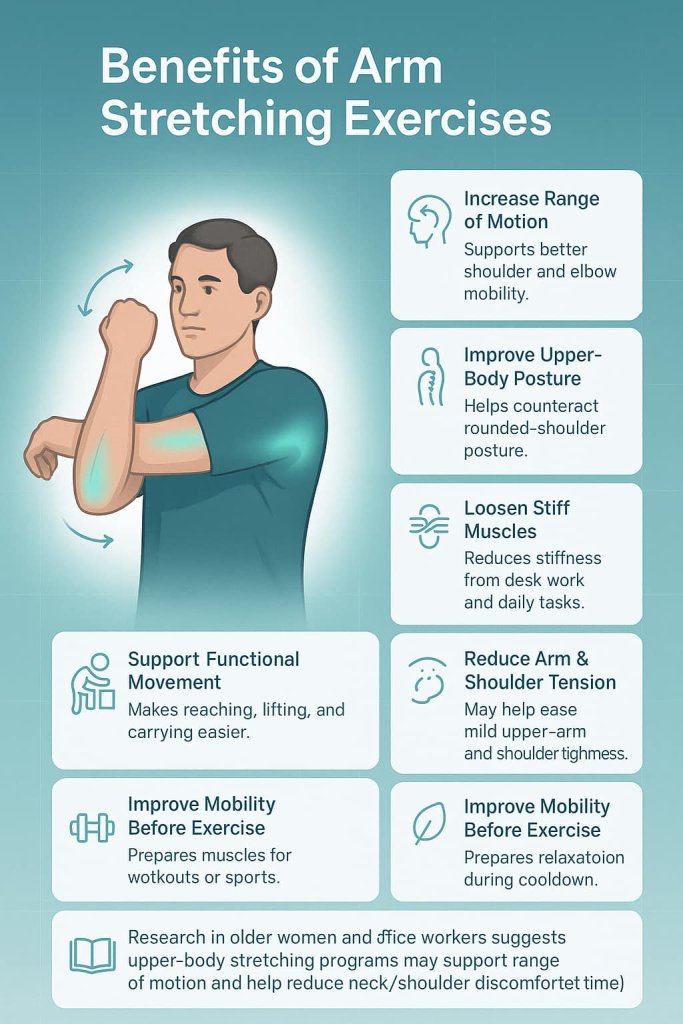
- Loosen stiff muscles (common in desk workers)
- Support functional movement for reaching, lifting, or carrying
- May help reduce upper-arm, forearm, and shoulder tension
- Prepare muscles for exercise by improving mobility
- Support recovery after workouts
Recent studies in older women and office workers show that structured upper-body stretching and exercise programs may help support range of motion and reduce neck/shoulder discomfort over time (Webber et al., 2022; Johnston et al., 2021).
How to Stretch Safely (Before You Begin)
Follow these safety tips to protect your joints and get the most out of each stretch:
- Stretch only to mild tension, never to pain.
- Move slowly and avoid bouncing.
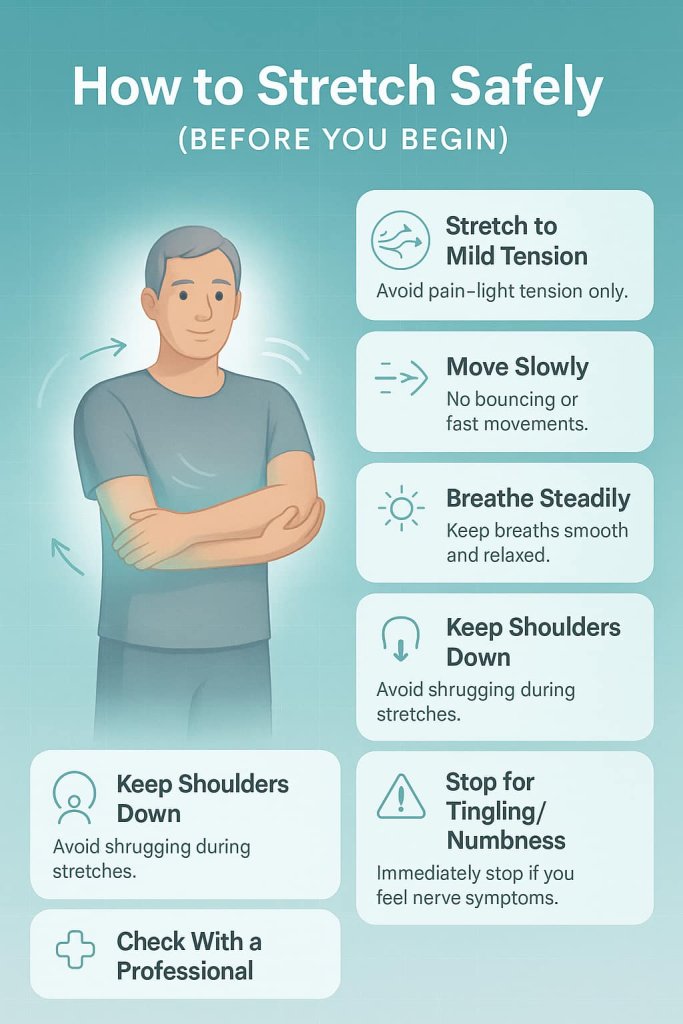
- Keep your breathing steady and relaxed.
- Warm up lightly if you feel stiff (arm circles, marching, shoulder rolls).
- Keep shoulders down and avoid shrugging during upper-body stretches.
- Modify the position if a stretch feels too intense.
- Stop immediately if you feel numbness or tingling.
- Consult a healthcare professional if you have recent injuries or severe shoulder/wrist issues.
These simple steps help you stretch comfortably, safely, and effectively.
14 Best Arm Stretching Exercises
These 14 arm stretching exercises target the shoulders, biceps, triceps, and forearms to quickly loosen tight muscles and improve mobility. They’re simple, effective, and suitable for beginners, desk workers, and anyone needing better upper-body flexibility.
1. Cross-Body Shoulder Stretch
Why it works:
This stretch targets the rear deltoids and upper-back muscles that tighten from repetitive reaching, typing, and rounded posture. By pulling the arm across the body, you lengthen the shoulder capsule and improve horizontal shoulder mobility. This may help reduce stiffness around the shoulder blade and support smoother arm movement during daily tasks and upper-body workouts.
Muscles worked:
Rear deltoid, rotator cuff (infraspinatus, teres minor), rhomboids, posterior shoulder complex
How to do it:
- Raise one arm straight in front of you.
- Pull it gently across your chest using your opposite hand.
- Keep your shoulders relaxed and level.
- Feel a stretch behind the shoulder and upper-back region.
- Hold 20–30 seconds. Repeat on the other side.
Trainer Tip:
Straighten the elbow and gently pull the arm slightly upward or downward until you find the angle that releases the most tension.
2. Overhead Triceps Stretch
Why it works:
This stretch opens the triceps and lat muscles, which often restrict overhead mobility. Tight triceps can pull the shoulder joint forward or limit elbow flexibility, and tight lats can create back-arching during overhead movements. Lengthening these muscles helps promote better posture and overhead movement patterns.
Muscles worked:
Triceps, latissimus dorsi, rear deltoid
How to do it:
- Lift one arm overhead.
- Bend your elbow so your hand drops behind your upper back.
- Use the opposite hand to apply a gentle downward pressure on the raised elbow.
- Keep your ribs tucked and core engaged.
- Hold 20–30 seconds per side.
Trainer Tip:
Standing tall with your spine neutral makes this stretch more effective and protects your lower back.
3. Doorway Chest Stretch
Why it works:
Poor posture, desk work, and phone use often tighten the chest muscles, pulling the shoulders forward. This stretch opens the front of the shoulders and chest, counteracting that forward-rounded posture. This may support shoulder joint mobility and help improve upper-body alignment.
Muscles worked:
Pectoralis major and minor, front deltoids, biceps (secondary)
How to do it:
- Stand in a doorway and place your forearms on the frame at 90 degrees.
- Step forward gently.
- Lean until you feel a stretch across the chest and shoulders.
- Keep your neck neutral.
- Hold 20–30 seconds.
Trainer Tip:
Move your elbows slightly higher or lower to target different fibers of the chest.
4. Wall Shoulder Stretch
Why it works:
This stretch improves shoulder rotation and reduces stiffness in the deltoid and lat muscles. It’s ideal for those who sit with rounded shoulders or perform heavy upper-body lifting. It may also help make daily reaching tasks smoother and more comfortable.
Muscles worked:
Deltoids, lats, upper-back stabilizers
How to do it:
- Stand sideways next to a wall.
- Extend your arm and place your palm flat against the wall.
- Keep elbow straight.
- Slowly rotate your torso away from the wall.
- Hold 20–30 seconds per side.
Trainer Tip:
Think “down and back” with your shoulders to keep the stretch on the deltoid instead of the neck.
5. Child’s Pose with Arm Reach
Why it works:
This gentle stretch targets the lats and upper back, helping reduce tightness that contributes to stiffness during overhead movements. It lengthens the spine, relaxes the shoulder blades, and provides a soothing stretch that helps undo tension from stress or long periods sitting.
Muscles worked:
Lats, shoulders, upper back, trunk stabilizers
How to do it:
- Begin on your knees.
- Sit back onto your heels.
- Walk your hands forward until your chest lowers toward the floor.
- Relax your shoulders.
- Hold 20–30 seconds.
Trainer Tip:
Walk your hands slightly to one side to stretch one lat more intensively.
6. Thread-the-Needle Stretch
Why it works:
This stretch focuses on the thoracic spine and the rear shoulder muscles. Tightness in these areas contributes to poor rotation, stiff shoulder blades, and a “locked” upper back. Improving mobility here may support better posture, easier arm movement, and reduced tension across the upper body.
Muscles worked:
Rear deltoid, rhomboids, mid-upper back, thoracic extensors
How to do it:
- Start in a tabletop position.
- Reach one arm underneath your torso toward the opposite side.
- Lower your shoulder and part of your upper back onto the floor.
- Feel gentle rotation through your spine.
- Hold 20–30 seconds per side.
Trainer Tip:
Avoid forcing rotation. The stretch should feel relieving, not intense.
7. Wrist Flexor Stretch
Why it works:
Wrist flexors tighten from typing, gripping weights, or repetitive hand tasks. This stretch helps loosen the front of the forearm and may support healthier wrist movement. It pairs well with any activity that involves gripping or pressing.
Muscles worked:
Wrist and finger flexors, forearm musculature
How to do it:
- Extend your arm forward with the palm up.
- Use your other hand to gently pull your fingers back.
- Keep your elbow straight.
- Hold 20–25 seconds.
Trainer Tip:
Rotate your wrist slightly outward or inward until you find the most effective angle.
8. Wrist Extensor Stretch
Why it works:
This stretch targets the muscles used in lifting, computer work, and gripping. Tight wrist extensors can contribute to elbow or forearm discomfort. Improving flexibility in this area supports healthier wrist mechanics for daily tasks.
Muscles worked:
Wrist extensors, brachioradialis, upper forearm
How to do it:
- Extend your arm forward with the palm facing down.
- Use your opposite hand to gently pull the fingers downward and inward.
- Hold 20–25 seconds.
Trainer Tip:
Keep your shoulder relaxed and avoid shrugging to maintain proper forearm focus.
9. Forearm All-Fours Stretch
Why it works:
This stretch lengthens both sides of the forearm at once and helps improve wrist extension and flexion. It is especially useful for people who do push-ups, planks, or spend long hours typing.
Muscles worked:
Forearm flexors, forearm extensors, wrist capsule
How to do it:
- Start on all fours.
- Turn your fingers backward so the fingertips point toward your knees.
- Gently shift your weight back to feel a stretch.
- Hold 15–20 seconds.
Trainer Tip:
Keep the stretch light. The wrists respond best to gentle, gradual mobility work.
10. Behind-the-Back Shoulder Stretch
Why it works:
This stretch helps open the front of the shoulders and biceps, areas that tighten from carrying, lifting, and poor posture. By clasping the hands behind the body, you counteract shoulder rounding and promote a more upright posture.
Muscles worked:
Chest, front deltoid, biceps, shoulder stabilizers
How to do it:
- Stand tall.
- Clasp your hands behind your back.
- Straighten your arms and lift them gently.
- Keep your chest open and shoulders back.
- Hold 20–30 seconds.
Trainer Tip:
Pull your shoulder blades together slightly for improved alignment.
11. Bicep Wall Stretch
Why it works:
This stretch isolates the biceps and chest, improving arm rotation and shoulder posture. Tight biceps can pull the shoulder forward, limiting movement and contributing to tension.
Muscles worked:
Biceps (long and short head), pectorals
How to do it:
- Stand beside a wall.
- Place your palm on the wall with fingers pointing backward.
- Straighten your arm fully.
- Slowly turn your chest away until you feel a stretch.
- Hold 20–30 seconds.
Trainer Tip:
Keep the shoulder down and avoid leaning your head forward.
12. Dynamic Arm Circles
Why it works:
This dynamic stretch increases blood flow, warms up the shoulder muscles, and prepares your upper body for exercise. It also improves joint lubrication and primes the rotator cuff for movement.
Muscles worked:
Deltoids, rotator cuff, upper arms, scapular stabilizers
How to do it:
- Extend both arms out to your sides.
- Make small forward circles for 20–30 seconds.
- Reverse for another 20–30 seconds.
- Increase circle size slowly if comfortable.
Trainer Tip:
Keep your core engaged to prevent swaying and maintain control.
13. Overhead Shoulder Opener
Why it works:
This stretch targets the lats and triceps, two major muscles limiting overhead mobility. It also helps lengthen the side of the body, promoting better posture and reducing top-of-shoulder tightness.
Muscles worked:
Lats, triceps, shoulders, obliques (light)
How to do it:
- Clasp both hands overhead.
- Lean gently to one side.
- Hold 10–15 seconds.
- Switch sides.
Trainer Tip:
Avoid rotating your torso; keep movement strictly lateral for a true lat stretch.
14. Wall Lat Stretch
Why it works:
This stretch opens the lats, triceps, and shoulder stabilizers—muscles that commonly limit shoulder flexion and contribute to upper-back stiffness. It helps improve overhead movement and relieves tension along the sides of the body.
Muscles worked:
Lats, triceps, serratus anterior, shoulder stabilizers
How to do it:
- Place hands on a wall at shoulder height.
- Step back slightly.
- Lean your chest toward the floor while hips move back.
- Keep your arms straight.
- Hold 20–25 seconds.
Trainer Tip:
Keep your spine long—imagine reaching your hips back while your arms reach forward.
How Often Should You Do Arm Stretching Exercises?
Based on ACSM flexibility guidelines and major clinical reviews:
- 2–3 days per week minimum
- Daily stretching provides best results
- Hold each stretch 20–30 seconds, 2–4 repetitions
- Avoid pain; stretch only to mild tension
These recommendations support better long-term flexibility and mobility.
Who Should Be Careful With Arm Stretching?
Check with a professional before stretching if you have:
- A recent shoulder, elbow, or wrist injury
- Severe shoulder impingement or frozen shoulder
- Uncontrolled pain
- Recent surgery
- Inflammation or swelling in the upper limbs
Stop immediately if you feel numbness, sharp pain, or joint instability.
FAQ
1. How long should arm stretches be held?
Most adults benefit from holding each stretch 20–30 seconds.
2. Is it OK to stretch arms every day?
Yes. Daily stretching is safe for most people.
3. Should I stretch before or after workouts?
Use dynamic stretches before workouts and static stretches after or on rest days.
4. Do arm stretches help reduce muscle tightness?
They may help support flexibility, improve circulation, and reduce stiffness.
5. Are arm stretches good for desk workers?
Yes. Many reduce tension from typing and forward-shoulder posture.
6. Can stretching improve posture?
It supports posture when combined with strengthening exercises.
7. Is stretching safe for older adults?
Gentle stretching is generally safe; slow movements are recommended.
Conclusion
Arm stretching exercises are simple, effective, and essential for reducing stiffness, improving mobility, and supporting healthy upper-body movement. You can perform these stretches anywhere—at home, at work, or after a workout. Start with a few exercises daily, be consistent, and increase duration gradually.
Take action today—add these 14 arm stretches to your routine and feel the difference in your flexibility and comfort.
References
- Page P. Current concepts in muscle stretching for exercise and rehabilitation. International Journal of Sports Physical Therapy. 2012;7(1):109–119.
https://www.ncbi.nlm.nih.gov/pmc/articles/PMC3273886 - American College of Sports Medicine (ACSM). Stretching Guidelines – recommended duration and frequency.
https://westporty.org/wp-content/uploads/2016/12/Stretching-Guidelines1.pdf - Tunwattanapong P, Kongkasuwan R, Kuptniratsaikul V. The effectiveness of a neck and shoulder stretching exercise program among office workers with neck pain: a randomized controlled trial. Clinical Rehabilitation. 2016;30(1):64–72.
https://pubmed.ncbi.nlm.nih.gov/25780258 - Shariat A, et al. Effects of stretching exercise training and ergonomic modifications on musculoskeletal discomforts of office workers: a randomized controlled trial. Journal of Bodywork and Movement Therapies. 2018.
https://www.sciencedirect.com/science/article/abs/pii/S1413355517304148 - Behm DG, et al. Acute effects of various stretching techniques on range of motion: a systematic review with meta-analysis. Sports Medicine – Open. 2023;9(1):74.
https://sportsmedicine-open.springeropen.com/articles/10.1186/s40798-023-00652-x - Daneshjoo A, et al. Effects of slow dynamic, fast dynamic, and static stretching on recovery of performance and range of motion. BMC Sports Science, Medicine and Rehabilitation. 2024;16(1).
https://bmcsportsscimedrehabil.biomedcentral.com/articles/10.1186/s13102-024-00841-5 - Esteban-García P, et al. Does the inclusion of static or dynamic stretching in warm-up routines have a positive or negative effect on performance? A systematic review with meta-analysis. Applied Sciences. 2024;14(9):3872.
https://www.mdpi.com/2076-3417/14/9/38