
The back squat is a barbell strength exercise that builds lower-body strength by training your quads, glutes, hamstrings, hips, core, and spinal stabilizers in one compound movement. When done with proper form, the back squat can help improve strength, muscle, balance, athletic performance, and everyday movement.
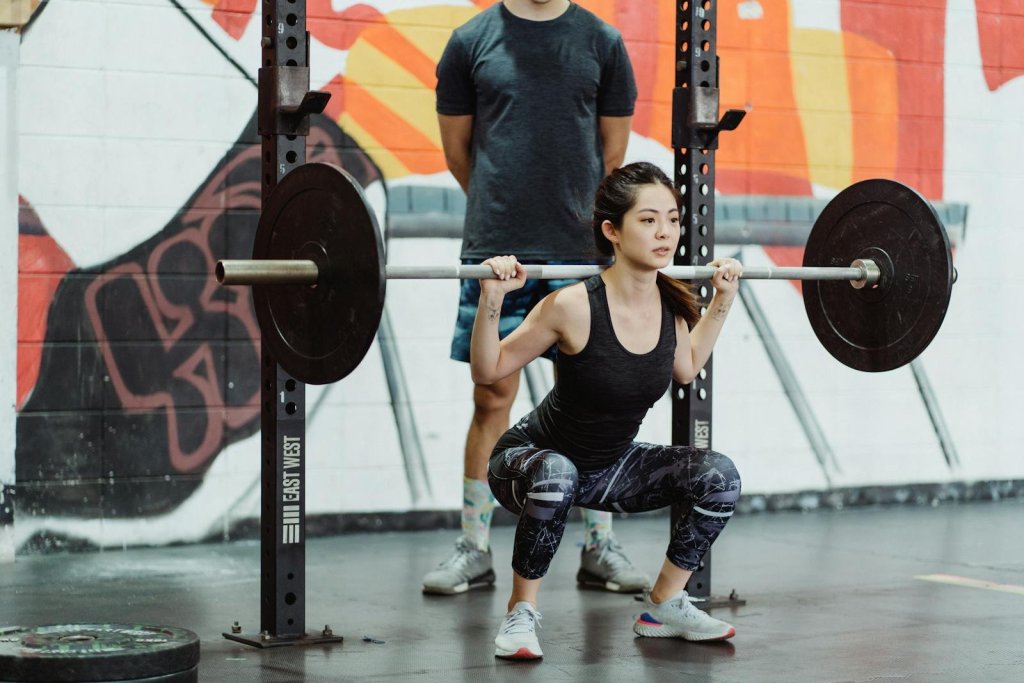
The back squat is popular because it trains several major muscle groups at once. But it also requires good technique, controlled depth, safe loading, and enough mobility. For beginners, the goal is not to lift the heaviest weight right away. The goal is to learn the movement, control your body, and progress slowly.
The American Council on Exercise describes the back squat as a barbell exercise for the butt, hips, and thighs, while the NASM explains that the barbell squat is a compound movement involving the lower body and the lumbo-pelvic-hip complex.
What Is a Back Squat
A back squat is a lower-body strength exercise where a barbell rests across your upper back while you bend your knees and hips to lower into a squat, then stand back up.
Unlike bodyweight squats, the back squat adds external resistance. This makes it more challenging and useful for building strength over time.
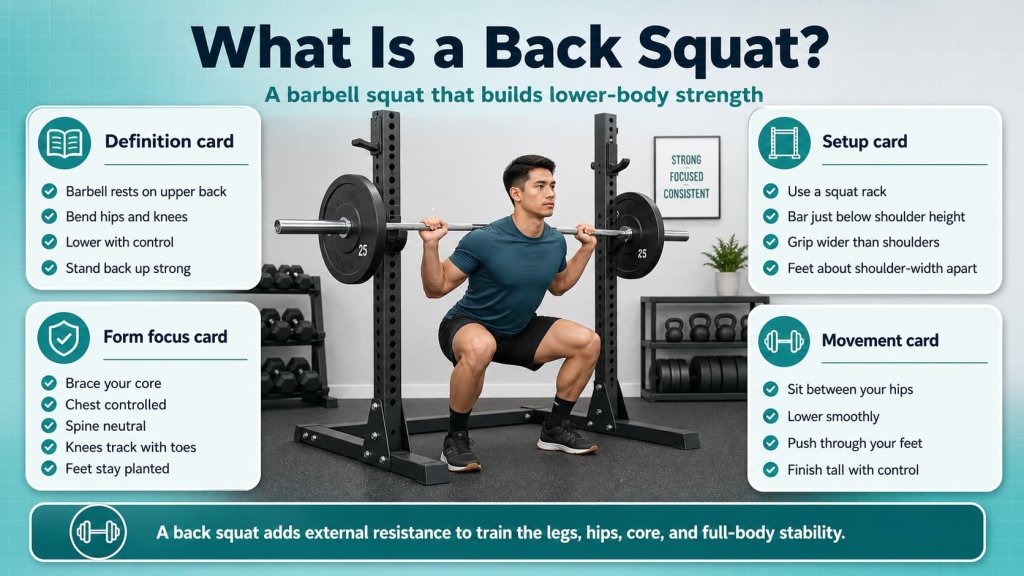
The basic movement looks like this:
- Place the barbell on your upper back.
- Stand with your feet about shoulder-width apart.
- Brace your core.
- Bend your hips and knees to lower.
- Keep your chest controlled and spine neutral.
- Push through your feet to stand back up.
ACE’s back squat setup recommends placing the bar in a rack just below shoulder height, positioning it across the top of the back, gripping wider than shoulder width, keeping the chest lifted, and sitting back into the hips while keeping the back straight.
How to Do a Back Squat With Proper Form
Before loading the bar heavily, learn the movement with a bodyweight squat, goblet squat, or empty barbell.
The back squat should feel controlled from start to finish. You should not bounce, twist, collapse inward, or lose your brace.
How to do it:
- Set the barbell in a squat rack just below shoulder height.
- Step under the bar and place it across your upper back, not on your neck.
- Grip the bar slightly wider than shoulder width.
- Pull your shoulder blades back and down to create a stable shelf.
- Stand up to unrack the bar.
- Take 1 to 3 small steps back.
- Set your feet about shoulder-width apart or slightly wider.
- Turn your toes slightly outward if that feels natural.
- Brace your core before you lower.
- Bend your hips and knees together.
- Lower with control while keeping your feet planted.
- Keep your knees tracking in the same direction as your toes.
- Go as deep as you can while maintaining control and a neutral spine.
- Push through your whole foot to stand.
- Finish tall without overextending your lower back.
Trainer Tip
Think “brace, sit between your hips, then drive the floor away.” This cue helps you stay controlled instead of dropping too fast or leaning forward too much.
Back Squat Form Checklist
Use this quick checklist before every set.
- Bar rests on the upper back, not the neck
- Hands grip the bar evenly
- Feet are planted firmly
- Knees track with toes
- Core stays braced
- Chest stays controlled
- Spine stays neutral
- Heels do not lift
- Reps stay smooth
- Weight feels manageable
If you cannot keep good form, reduce the weight or shorten the range of motion.
The Mayo Clinic recommends using proper form, choosing the right amount of weight, breathing correctly, and lowering the weight or reps if form breaks down.
Back Squat Muscles Worked
The back squat works many muscles at the same time. That is why it is called a compound exercise.
Your legs create most of the force, but your core, hips, and back muscles help stabilize the bar and keep your body controlled.
Primary muscles worked
The main muscles used during the back squat include:
- Quadriceps: Help straighten the knees as you stand up.
- Gluteus maximus: Helps extend the hips and drive you upward.
- Hamstrings: Assist with hip control and support knee stability.
- Adductors: Help stabilize the hips and assist with hip extension.
- Calves: Help support ankle position and lower-body control.
NASM lists the gluteus maximus and quadriceps as major squat muscles, with the hamstrings, erector spinae, adductor magnus, calves, and core muscles also involved.
Stabilizing muscles worked
The back squat also trains stabilizing muscles, including:
- Erector spinae
- Transverse abdominis
- Rectus abdominis
- Internal and external obliques
- Multifidus
- Hip stabilizers
- Upper-back muscles
These muscles help you keep your torso braced, your spine stable, and your hips controlled during each rep.
Back Squat Benefits
Back squats are effective because they train strength, coordination, balance, and full-body tension at the same time.
They are not only a leg exercise. They are a full-body strength skill.
Builds lower-body strength
The back squat can help strengthen the quads, glutes, hamstrings, hips, and calves.
These muscles are important for:
- Standing up from a chair
- Walking uphill
- Climbing stairs
- Jumping
- Sprinting
- Lifting objects safely
- Playing sports
Because the barbell can be loaded gradually, the back squat is useful for progressive strength training.
Supports muscle growth
Back squats can support muscle growth when they are done with enough effort, good form, and proper recovery.
For muscle growth, training volume matters. The American College of Sports Medicine notes in its 2026 resistance training guideline update that hypertrophy goals often benefit from higher weekly volume, around 10 sets per muscle group.
This does not mean beginners need 10 hard squat sets right away. It means your total weekly leg training volume should match your experience, recovery, and goal.
Trains core stability
Your core has to work hard during a back squat.
It helps you:
- Keep your ribs and pelvis stacked
- Avoid excessive lower-back arching
- Maintain a stable torso
- Control the bar path
- Transfer force from the legs into the bar
A strong squat is not just about strong legs. It also requires full-body bracing.
Improves movement coordination
The back squat trains the hips, knees, and ankles to move together.
NASM explains that the lowering phase includes hip flexion, knee flexion, and ankle dorsiflexion. The lifting phase includes hip extension, knee extension, and ankle plantarflexion.
In simple terms, your hips, knees, and ankles all need to work together for a smooth squat.
Fits general strength guidelines
Back squats can be one part of a balanced weekly strength routine.
The CDC says adults should get at least 150 minutes of moderate-intensity aerobic activity and 2 days of muscle-strengthening activity each week.
Back squats can count toward muscle-strengthening activity when they are programmed safely with other exercises for the upper body, core, and posterior chain.
Common Back Squat Mistakes and How to Fix Them
Small form errors can make the back squat feel harder than it needs to be. They may also increase stress on the knees, hips, or lower back.
| Mistake | What it looks like | Simple fix |
|---|---|---|
| Bar resting on the neck | Pressure or discomfort near the neck | Place the bar across the upper back and create a shoulder shelf |
| Knees cave inward | Knees collapse toward each other | Keep knees tracking in line with the toes |
| Heels lift | Weight shifts too far forward | Keep pressure through the whole foot |
| Lower back rounds | Pelvis tucks under at the bottom | Stop at the deepest range you can control |
| Chest drops fast | Torso folds forward | Brace harder and slow the descent |
| Too much weight | Reps look shaky or uneven | Reduce load and rebuild clean form |
| Rushing the setup | Uneven grip or unstable walkout | Take time before unracking the bar |
High Bar vs Low Bar Back Squat
The back squat has two common bar positions: high bar and low bar.
Both are useful. The best choice depends on your goal, mobility, comfort, and training experience.
High bar back squat
In the high bar back squat, the bar sits higher on the upper traps.
This version usually keeps the torso more upright and often feels more natural for general fitness, Olympic weightlifting-style training, and quad-focused squatting.
Best for:
- Beginners learning barbell squats
- Lifters who prefer a more upright torso
- Quad-focused training
- General strength training
Low bar back squat
In the low bar back squat, the bar sits slightly lower across the rear delts.
This version usually creates more forward torso lean and may allow some trained lifters to lift heavier weight.
Best for:
- Experienced lifters
- Powerlifting-style training
- Lifters with strong hip hinge control
- People who feel stable with a lower bar position
Which one should you choose
Most beginners should start with the high bar back squat because it is usually easier to learn.
Choose the version that lets you squat with:
- Less discomfort
- Better control
- Stable feet
- A neutral spine
- Consistent depth
- No sharp or worsening pain
Back Squat Variations
Back squat variations can help you learn the movement, build confidence, and train around your current ability.
1. Bodyweight squat
How to do it:
- Stand with your feet about shoulder-width apart.
- Brace your core.
- Bend your hips and knees.
- Lower as far as you can with control.
- Push through your feet to stand.
Why it works: The bodyweight squat teaches basic squat mechanics before adding a barbell.
Muscles worked: Quads, glutes, hamstrings, calves, and core.
Trainer Tip: Master bodyweight squats before using a barbell.
2. Goblet squat
How to do it:
- Hold one dumbbell or kettlebell at chest height.
- Keep your elbows close to your body.
- Brace your core.
- Squat down with control.
- Stand by pushing through your whole foot.
Why it works: The front-loaded weight can help many beginners stay upright and balanced.
Muscles worked: Quads, glutes, hamstrings, adductors, core, and upper back.
Trainer Tip: Use goblet squats as a bridge between bodyweight squats and barbell back squats.
3. Box squat
How to do it:
- Place a box or bench behind you.
- Set up like a regular squat.
- Lower until your hips lightly touch the box.
- Pause briefly without relaxing.
- Stand back up with control.
Why it works: The box gives you a depth target and can help build confidence.
Muscles worked: Quads, glutes, hamstrings, hips, and core.
Trainer Tip: Do not crash onto the box. Touch it lightly and stay braced.
4. Pause back squat
How to do it:
- Set up for a normal back squat.
- Lower with control.
- Pause for 1 to 3 seconds near the bottom.
- Stay tight during the pause.
- Stand up smoothly.
Why it works: The pause reduces bouncing and builds control in the hardest part of the squat.
Muscles worked: Quads, glutes, hamstrings, adductors, core, and spinal stabilizers.
Trainer Tip: Start light. Pauses make the same weight feel much harder.
How Many Sets and Reps Should You Do
Your best back squat reps and sets depend on your goal, experience, and recovery.
For beginners, the priority is clean technique. Use a weight you can control.
Mayo Clinic recommends starting with a weight you can lift comfortably for 12 to 15 repetitions and slowly increasing the weight as you get stronger while keeping correct technique.
Beginner back squat plan
A simple starting point:
| Goal | Sets | Reps | Rest |
|---|---|---|---|
| Learn form | 2 to 3 | 8 to 12 | 60 to 90 seconds |
| Build strength | 3 to 5 | 3 to 6 | 2 to 4 minutes |
| Build muscle | 3 to 4 | 6 to 12 | 90 to 180 seconds |
| Practice control | 2 to 4 | 5 to 8 | 90 to 150 seconds |
Beginners should usually leave 2 to 4 reps in reserve. That means you stop the set before your form breaks down.
Strength focused back squat training
For strength, use heavier loads only after your technique is consistent.
The ACSM 2026 resistance training update notes that strength goals are often supported by heavier loads around 80 percent of one-repetition maximum for 2 to 3 sets per exercise.
This is not a beginner starting point. It is a general strength guideline for trained lifters who can use heavy weights safely.
Muscle focused back squat training
For muscle growth, use moderate loads, controlled reps, and enough weekly volume.
A practical setup:
- 3 to 4 sets
- 6 to 12 reps
- Controlled lowering
- Full range you can safely manage
- 1 to 3 minutes of rest
Train close enough to fatigue to challenge the muscles, but not so close that your form falls apart.
How to Add Back Squats to Your Workout
Back squats are demanding, so place them early in your workout when your legs and focus are fresh.
A simple lower-body workout could look like this:
- Warm-up
- Back squat
- Romanian deadlift
- Split squat or lunge
- Leg curl or glute bridge
- Calf raise
- Core exercise
For general fitness, many people squat 1 to 2 times per week. More advanced lifters may squat more often, but volume and recovery must be managed carefully.
Warm Up Before Back Squats
A good warm-up helps you move better and feel more prepared.
Try this simple warm-up:
- 5 minutes of light cardio
- Bodyweight squats
- Hip hinges
- Glute bridges
- Walking lunges
- Ankle rocks
- Empty bar squats
- Gradual warm-up sets before your working weight
Do not jump straight into your heaviest set.
Who Should Be Careful With Back Squats
Back squats are useful, but they are not the right starting point for everyone.
Be careful or get guidance first if you have:
- Current knee, hip, ankle, or back pain
- Recent surgery
- Balance problems
- Dizziness during exercise
- Poor squat control
- Trouble bracing your core
- A history of injury during squats
- Pain that worsens during or after training
The CDC notes that people with chronic health conditions should talk with a doctor about the types and amounts of activity that are right for them.
You should stop the set if you feel sharp pain, sudden weakness, numbness, dizziness, or pain that changes your movement.
Back Squat Safety Tips
Use these tips to make the back squat safer and more effective:
- Start light.
- Learn the movement before adding heavy weight.
- Use a squat rack with safety arms when possible.
- Do not place the bar on your neck.
- Keep your core braced.
- Control the lowering phase.
- Avoid bouncing out of the bottom.
- Do not force depth you cannot control.
- Rest enough between hard sets.
- Ask a qualified coach to check your form if you are unsure.
Good form matters more than chasing numbers.
Back Squat FAQs
Is the back squat good for beginners
Yes, beginners can learn the back squat, but they should usually start with bodyweight squats, goblet squats, or an empty bar first. The goal is to build good control before adding heavy weight.
What muscles does the back squat work most
The back squat mainly works the quadriceps, glutes, hamstrings, adductors, calves, core, and spinal stabilizers. The exact muscle emphasis can change based on stance, depth, bar position, and body structure.
Are back squats bad for your knees
Back squats are not automatically bad for your knees. Poor technique, too much weight, uncontrolled depth, or ignoring pain can be problems. Keep your knees tracking with your toes, use a range of motion you can control, and reduce the load if form breaks down.
How deep should I squat
Squat as deep as you can while keeping control, stable feet, and a neutral spine. Some lifters can squat below parallel safely, while others need a slightly higher depth based on mobility, comfort, and training level.
Should I do high bar or low bar back squats
Most beginners do well with high bar back squats because they are usually easier to learn and allow a more upright torso. Low bar squats may work better for experienced lifters, especially those training for powerlifting.
How often should I do back squats
For most general fitness goals, 1 to 2 times per week is enough. Beginners should focus on quality and recovery. More advanced lifters may squat more often, but they need to manage volume, intensity, and fatigue carefully.
Can back squats build muscle
Yes, back squats can support muscle growth in the legs and hips when they are done with progressive overload, enough weekly volume, proper nutrition, and recovery. They work best as part of a balanced strength program.
Conclusion
The back squat is one of the most effective lower-body strength exercises because it trains the quads, glutes, hamstrings, hips, core, and stabilizing muscles together. It can help build strength, support muscle growth, improve movement control, and fit into a well-rounded fitness routine.
Start with proper form, use a manageable weight, and progress slowly. If your reps stay controlled and your body feels stable, the back squat can become a powerful part of your strength training plan.
References
- American Council on Exercise
Use for back squat setup, bar position, stance, proper form, and movement instructions. - NASM
Use for squat biomechanics, muscles worked, hip/knee/ankle movement, and common form compensations. - Mayo Clinic
Use for safe weight training, beginner loading, breathing, rest, and proper technique. - CDC
Use for adult physical activity guidelines and weekly muscle-strengthening recommendations. - American College of Sports Medicine
Use for current resistance training guidance, strength programming, and hypertrophy volume. - PubMed Central
Use for squat biomechanics, clinical implications, back squat vs front squat mechanics, and joint demands. - PubMed Central
Use for research comparing progressive bodyweight training and barbell back squat training. - PubMed Central
Use for back squat technique, movement screening, common deficits, and safe squat mechanics.