
Crunches are usually better than sit ups for directly targeting the abs, especially for beginners, because they use a shorter range of motion and keep more of the lower back on the floor. Sit ups can still build core endurance, but they involve the hip flexors more and may feel less comfortable for people with lower-back or neck sensitivity.
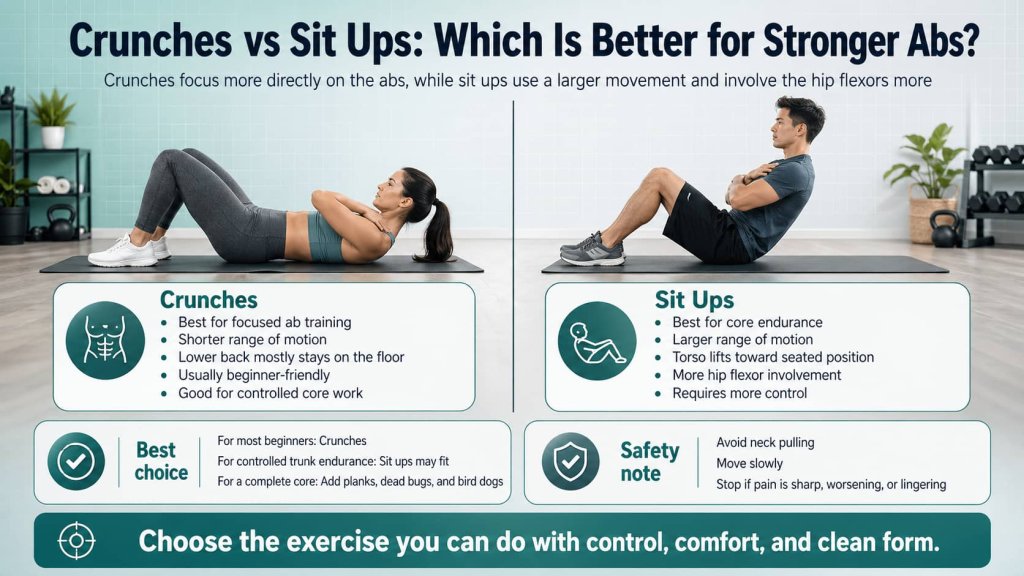
Understanding crunches vs sit ups helps you choose the right core exercise for your goal. If you want focused ab work, crunches are often the smarter starting point. If you want a larger trunk-flexion movement and can do it without discomfort, sit ups may have a place in your routine. For general fitness, core work should also include stability exercises like planks, dead bugs, and bird dogs, not just repeated bending movements.
Crunches vs Sit Ups: Quick Answer
Crunches and sit ups both train the front of your core, but they are not the same exercise.
| Feature | Crunches | Sit Ups |
|---|---|---|
| Main focus | Abs, especially rectus abdominis | Abs plus hip flexors |
| Range of motion | Shorter | Longer |
| Lower back position | Mostly stays on the floor | Lifts off the floor |
| Beginner-friendly | Usually yes | Sometimes harder |
| Hip flexor involvement | Lower | Higher |
| Best for | Focused ab training | Core endurance and full trunk flexion |
| Common issue | Neck pulling | Momentum, hip flexor dominance, back discomfort |
The simple answer: choose crunches for safer, more focused ab training, and choose sit ups only if you can do them with good control and no back or neck discomfort.
What Are Crunches?
A crunch is a core exercise where you lie on your back, bend your knees, tighten your abdominal muscles, and lift only your head and shoulders off the floor.
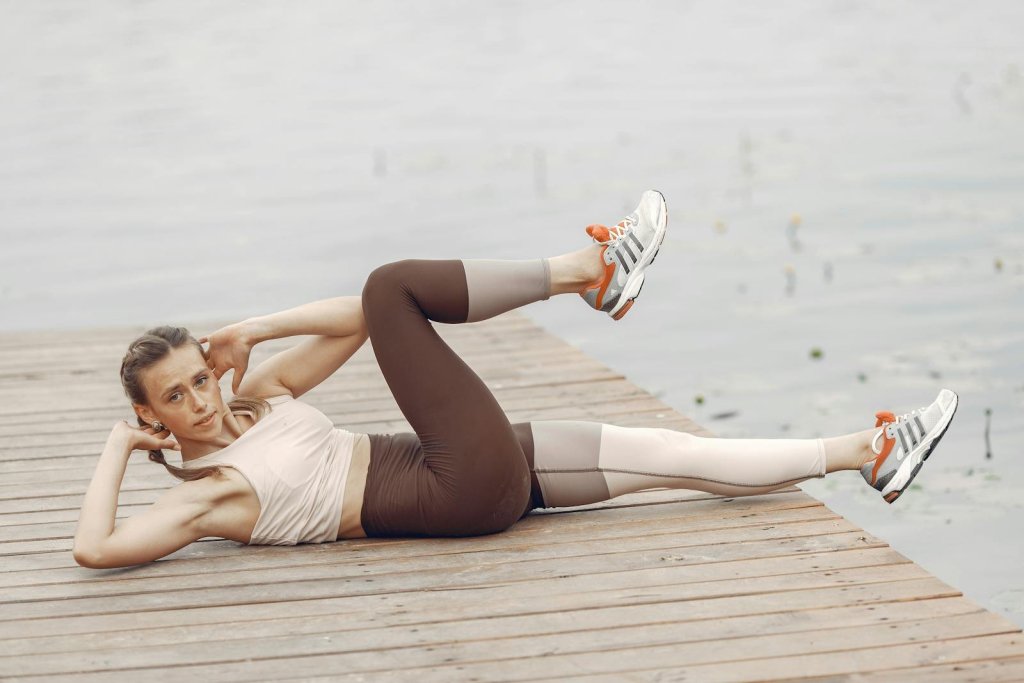
Unlike a sit up, you do not lift your entire torso. The movement is small, controlled, and focused on spinal flexion through the upper trunk.
The Mayo Clinic describes abdominal crunches as a classic core-strength exercise and recommends raising the head and shoulders while keeping the movement controlled and avoiding neck strain.
Main crunch benefits
Crunches are useful because they are simple, equipment-free, and easy to scale.
They may help:
- Strengthen the rectus abdominis
- Improve basic core endurance
- Teach controlled abdominal contraction
- Work well for beginners
- Reduce unnecessary hip flexor involvement compared with sit ups
Crunches are not a complete core workout by themselves, but they can be a useful part of a balanced routine.
What Are Sit Ups?
A sit up is a larger core exercise where you start lying on your back, then lift your torso all the way up toward a seated position.
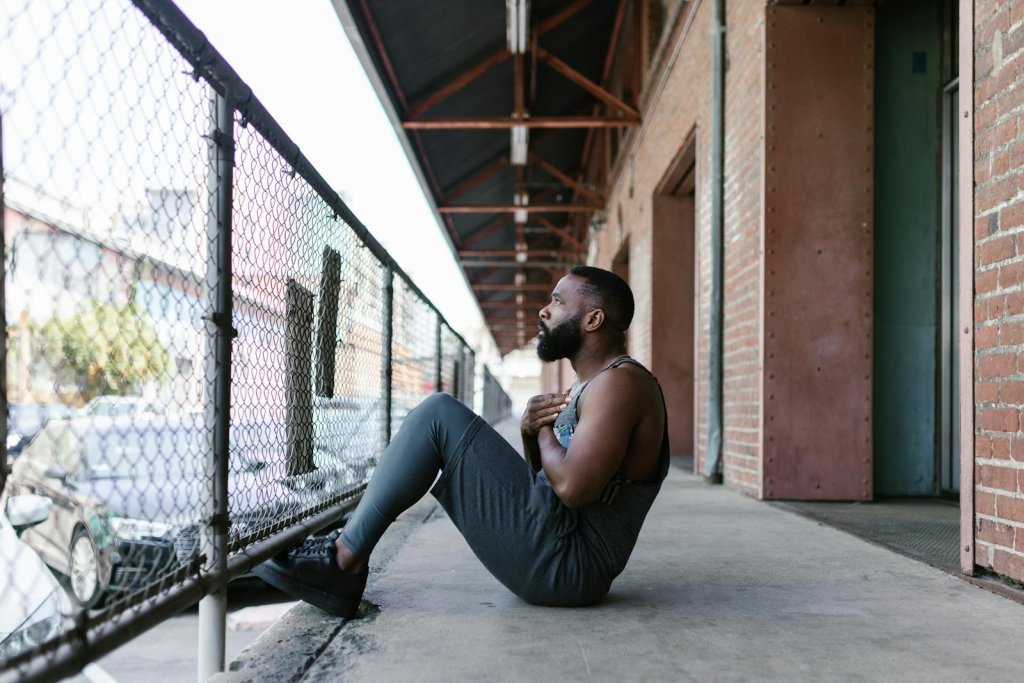
Because the movement goes farther than a crunch, sit ups involve more muscles. Your abs still work, but your hip flexors also help pull your torso upward.
Research on PubMed comparing sit-up and curl-up style movements shows that sit ups can increase hip flexor involvement compared with shorter curl-up or crunch variations. This matters because too much hip flexor dominance may make the exercise feel less focused on the abs for some people.
Main sit up benefits
Sit ups may help:
- Build core endurance
- Train a larger trunk-flexion pattern
- Challenge coordination between the abs and hip flexors
- Fit some athletic or fitness-test routines
However, sit ups are not automatically better just because the movement is bigger. Bigger range of motion can also mean more chance to use momentum or lose form.
Crunches vs Sit Ups: Muscles Worked
Both exercises mainly train the front side of the core, but the muscle emphasis is different.
Muscles worked during crunches
Crunches mainly target:
- Rectus abdominis
- Transverse abdominis for bracing support
- Obliques as secondary stabilizers
The rectus abdominis is the long front abdominal muscle involved in trunk flexion. Crunches are popular because they keep the movement short and make it easier to focus on this area.
Muscles worked during sit ups
Sit ups work:
- Rectus abdominis
- Obliques
- Hip flexors
- Deep core stabilizers
- Some thigh and pelvic muscles depending on form
Because your torso comes farther off the floor, sit ups usually bring the hip flexors into the movement more than crunches.
Which Is Better for Stronger Abs?
For most people, crunches are better for direct ab targeting, while sit ups are better for a bigger movement that also involves the hip flexors.
If your main goal is to feel and control your abdominal muscles, crunches are usually the better option. They are easier to learn, easier to slow down, and easier to perform without swinging your body.
If your goal is general trunk endurance and you already have good control, sit ups can be used carefully. But they should not be your only core exercise.
A 2020 review on PMC found that different exercises activate core muscles in different ways, which supports using a variety of core movements rather than relying on one exercise only.
Are Crunches or Sit Ups Better for Beginners?
Crunches are usually better for beginners.
The movement is smaller, easier to control, and less demanding on coordination. Beginners can also modify crunches by reducing the range of motion or keeping the arms crossed over the chest.
Sit ups may be harder for beginners because people often:
- Pull on the neck
- Swing the arms
- Anchor the feet and overuse the hip flexors
- Round aggressively through the spine
- Rush through reps
If you are new to core training, start with crunches, dead bugs, bird dogs, and planks before adding sit ups.
Are Sit Ups Bad for Your Back?
Sit ups are not automatically bad for everyone, but they may not be the best choice for people with lower-back sensitivity, poor core control, or a history of pain during trunk-flexion exercises.
The main issue is that sit ups can become hip-flexor dominant. When the hip flexors take over, some people feel pulling or pressure near the lower back or front of the hips.
Harvard Health notes that classic sit ups and crunches have become less favored compared with plank-style core exercises, especially when the goal is a stronger, more stable core.
Stop or modify the exercise if you feel sharp pain, worsening discomfort, numbness, or pain that lingers after the workout.
Do Crunches or Sit Ups Burn Belly Fat?
Crunches and sit ups can strengthen abdominal muscles, but they do not directly burn belly fat from one specific area.
This is called spot reduction, and it is not how fat loss usually works. Core exercises can be part of a healthy fitness routine, but visible abdominal definition depends on many factors, including total activity, nutrition, genetics, sleep, and overall body composition.
For general adult fitness, the CDC recommends at least 150 minutes of moderate-intensity physical activity per week plus muscle-strengthening activity on 2 days per week.
How to Do Crunches Properly
Use slow, controlled reps. The goal is not to yank your head upward. The goal is to contract your abs and lift your shoulders slightly from the floor.
How to do it
- Lie on your back with your knees bent and feet flat on the floor.
- Keep your feet about hip-width apart.
- Cross your arms over your chest or place your fingertips lightly near your ears.
- Tighten your abdominal muscles.
- Lift your head and shoulders slightly off the floor.
- Keep your lower back on the floor.
- Pause briefly at the top.
- Lower slowly with control.
- Repeat for the desired number of reps.
Trainer Tip
Keep your chin slightly tucked and imagine holding an apple under your chin. This helps reduce neck pulling and keeps the movement focused on your abs.
How to Do Sit Ups Properly
Sit ups require more control than crunches. Move slowly and avoid using momentum.
How to do it
- Stop if your lower back feels uncomfortable.
- Lie on your back with your knees bent.
- Keep your feet flat on the floor.
- Cross your arms over your chest or keep your hands lightly near your head.
- Brace your core before moving.
- Lift your torso toward your thighs.
- Avoid yanking your neck or swinging your arms.
- Sit up with control.
- Lower slowly back to the floor.
Trainer Tip
Do not rush the lowering phase. If you can lift up but collapse back down, the exercise is too hard or too fast for your current control level.
Common Crunch Mistakes
Crunches look simple, but small form errors can reduce their benefit.
Common mistakes include:
- Pulling on the head or neck
- Lifting too high
- Holding the breath
- Moving too fast
- Flattening the movement into a neck-only lift
- Doing too many reps with poor control
A better approach is to use fewer reps with cleaner form.
Common Sit Up Mistakes
Sit ups are easier to cheat than crunches because the movement is larger.
Common mistakes include:
- Swinging the arms
- Jerking the neck forward
- Anchoring the feet too aggressively
- Using mostly hip flexors
- Rounding forcefully through the lower back
- Dropping quickly on the way down
If sit ups feel uncomfortable, switch to crunches, dead bugs, or plank variations.
Crunches vs Sit Ups for Different Goals
Best for direct ab focus
Crunches are the better choice because they keep the range of motion shorter and make it easier to feel the abs working.
Best for beginners
Crunches are usually better. They are easier to learn and easier to modify.
Best for core endurance
Sit ups may help build trunk-flexion endurance, but they should be used carefully and balanced with stability exercises.
Best for lower-back comfort
Crunches are often more comfortable than sit ups, but some people may still prefer non-crunch options like dead bugs, bird dogs, side planks, or standing core work.
Best for a complete core routine
Neither exercise wins alone. A complete core routine should include flexion, bracing, anti-rotation, and stability work.
Better Core Exercises to Add With Crunches or Sit Ups
A stronger core is not just about bending forward. Your core also helps resist movement, stabilize your spine, and transfer force between your upper and lower body.
Good options include:
- Plank
- Side plank
- Dead bug
- Bird dog
- Pallof press
- Farmer’s carry
- Glute bridge
- Reverse crunch
- Standing cable chop
The Mayo Clinic explains that core exercises help train the muscles of the core to work together, supporting better balance and stability.
Sample Beginner Core Workout
Try this simple routine 2 to 3 times per week with at least one rest day between hard core sessions.
| Exercise | Sets | Reps or Time |
|---|---|---|
| Dead bug | 2 | 6 to 10 reps per side |
| Crunch | 2 | 8 to 12 reps |
| Bird dog | 2 | 6 to 10 reps per side |
| Side plank | 2 | 10 to 20 seconds per side |
Focus on slow breathing, clean form, and control. Do not chase high reps if your technique breaks down.
Who Should Be Careful With Crunches or Sit Ups?
Be careful or ask a qualified professional for guidance if you have:
- Current back, neck, hip, or abdominal pain
- Recent surgery
- A hernia or symptoms that need medical evaluation
- Dizziness during floor exercises
- Pain that gets worse with bending movements
- Pregnancy or postpartum recovery concerns
- A medical condition that affects exercise safety
This does not mean you can never train your core. It means you may need safer modifications and professional guidance.
Final Verdict: Crunches vs Sit Ups
Crunches are the better choice for most people who want focused ab training. They are simpler, easier to control, and usually more beginner-friendly.
Sit ups can still be useful for some people, but they are not necessary for building a strong core. They involve more hip flexor activity and require better control to avoid momentum and discomfort.
The best approach is to use crunches carefully, skip sit ups if they bother your back or neck, and build a balanced core routine with planks, dead bugs, bird dogs, carries, and anti-rotation exercises.
FAQs About Crunches vs Sit Ups
Are crunches better than sit ups?
Crunches are usually better for direct ab targeting. Sit ups use a larger range of motion but also involve the hip flexors more.
Are sit ups good for abs?
Sit ups can work the abs, but they are not purely an ab exercise. The hip flexors also help a lot, especially when the feet are anchored or the movement is fast.
Can crunches give you abs?
Crunches can strengthen the abdominal muscles, but visible abs depend on overall body composition, nutrition, genetics, and total activity. Crunches alone do not spot-reduce belly fat.
Should beginners do crunches or sit ups?
Beginners should usually start with crunches, dead bugs, bird dogs, and planks. These exercises are easier to control and often more comfortable than full sit ups.
Why do sit ups hurt my back?
Sit ups may bother your back if you use momentum, overuse the hip flexors, round aggressively, or lack enough core control. Stop if pain is sharp, worsening, or lingering.
How many crunches should I do?
A good starting point is 2 to 3 sets of 8 to 15 controlled reps. Quality matters more than doing a very high number of reps.
Can I do crunches every day?
You can train the core often, but daily crunches are not necessary. Most people do better with 2 to 3 focused core sessions per week plus other strength and cardio activity.
Conclusion
Crunches vs sit ups comes down to your goal, comfort, and control. Crunches are usually the better choice for focused ab training and beginners, while sit ups are a larger movement that may work for people who can perform them without back or neck discomfort.
Start with controlled crunches and safer core stability exercises. Build slowly, keep your form clean, and choose exercises that make your core feel stronger without causing pain.
References
- Mayo Clinic: Exercises to improve your core strength
- Mayo Clinic: Why you should strengthen your core muscles
- American Council on Exercise: Crunch Exercise Library
- CDC: Adult Physical Activity Guidelines
- PubMed: Abdominal and hip flexor muscle activity during 2 minutes of sit-ups and curl-ups
- PubMed: Effect of sit-up and curl-up positions on activation of abdominal and hip flexor muscles
- PMC: Core Muscle Activity during Physical Fitness Exercises
- Harvard Health: Want a stronger core? Skip the sit-ups