
Diastasis recti exercises for women are gentle, pressure-controlled core movements that train deep abdominal support (not aggressive crunching) to help improve midline control and function over time. Learning the right progressions matters because the wrong drills can increase abdominal pressure and make “doming” (coning) more noticeable during movement.
Medical guidance on postpartum activity generally supports returning to exercise gradually when it’s medically safe, especially after a C-section or complications, as explained by the American College of Obstetricians and Gynecologists (ACOG). For diastasis recti specifically, many clinical resources recommend avoiding early high-pressure ab work like sit-ups and crunches and focusing on safer core training first, which is also discussed by the Cleveland Clinic. The goal of this guide is to show you a simple, step-by-step “Top 10” list you can use at home.
What to know before you start diastasis recti exercises for women
Diastasis recti is a widening of the connective tissue at the midline of your abdomen (linea alba). In real life, what usually matters most is how well your core manages pressure during everyday tasks like rolling out of bed, lifting, carrying, and exercise.
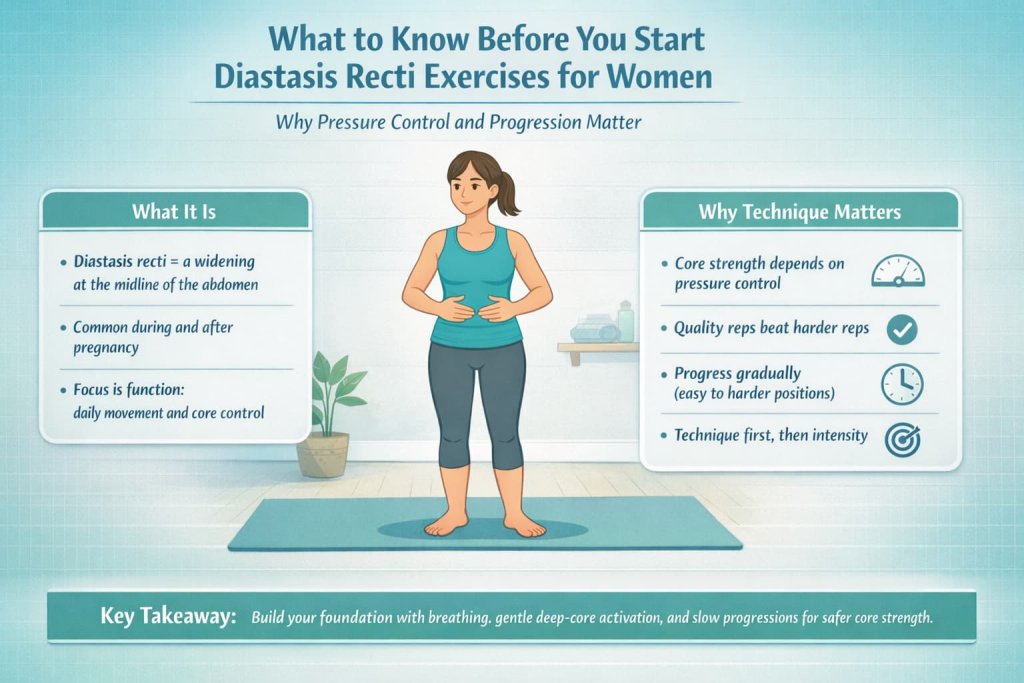
Research reviews in postpartum populations suggest that abdominal exercise training can reduce inter-rectus distance (IRD) compared with no exercise, though the best program can vary and study quality is mixed, including findings summarized in the British Journal of Sports Medicine (BJSM). That’s why technique and progression are the focus here.
The single most important rule: avoid doming or bulging
During every rep, watch your midline. If you see a ridge, tenting, or “coning,” treat it like a form warning:
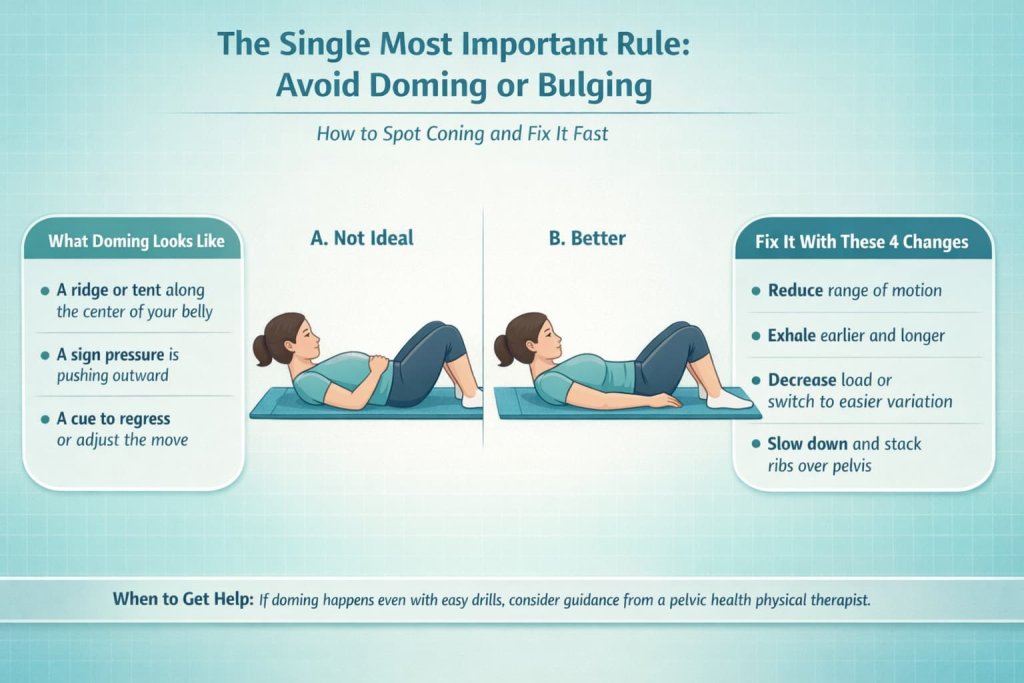
- Reduce the range of motion
- Exhale earlier and longer
- Decrease load (or switch to an easier variation)
- Slow down and keep ribs stacked over pelvis
If doming happens even with easy drills, it’s a good reason to get individualized help from a pelvic health physical therapist, which is outlined in the patient guidance from ChoosePT.
10 best diastasis recti exercises for women
Use this simple rule for your first 2–4 weeks: choose 3–5 exercises, do them 3–5 days per week, and stop sets early if you lose pressure control.
1) Side-Lying Corset Breathing (NHS stomach exercise)
How to do it:
- Lie on your side with knees slightly bent and shoulders relaxed
- Inhale gently and let your belly soften
- Exhale and gently draw the lower belly in “like a corset” (no breath-holding)
- Keep breathing normally while you hold the gentle tension for up to 10 seconds
- Relax fully, then repeat
Why it works: This builds deep abdominal engagement with low pressure. It’s commonly used early postpartum to re-train control and coordination and appears in post-pregnancy exercise guidance from the NHS.
Muscles worked: Deep abdominals (transverse abdominis), pelvic floor coordination.
Trainer Tip: Aim for “gentle tightening,” not a hard brace. If your ribs flare up, make the exhale slower.
2) 360 Breathing With Rib Stack (Supine)
How to do it:
- Lie on your back with knees bent, feet flat
- Place one hand on ribs and one on lower belly
- Inhale so your ribcage expands gently (front, sides, and back if possible)
- Exhale and feel ribs drop slightly while lower belly draws in
- Keep neck and shoulders relaxed throughout
Why it works: Many pressure issues come from rib flare and poor breathing mechanics. This drill sets a neutral “stacked” position for everything else.
Muscles worked: Diaphragm, deep abdominals, obliques (as stabilizers).
Trainer Tip: If you feel your belly push hard upward on the inhale, soften the inhale and lengthen the exhale.
3) Pelvic Floor and Deep Core “Exhale Lift”
How to do it:
- Start on your back with knees bent
- Inhale gently
- Exhale and lightly lift/close the pelvic floor (like stopping gas), then draw lower belly in
- Hold 2–4 seconds while continuing to breathe
- Fully relax between reps
Why it works: Pelvic floor and deep abs often work together for pressure management postpartum. Training coordination can support safer progressions.
Muscles worked: Pelvic floor, transverse abdominis.
Trainer Tip: “Lift” should be subtle. Over-squeezing can create tension and make breathing worse.
4) Heel Slides (Dead Bug Prep)
How to do it:
- Lie on your back, knees bent
- Exhale and gently draw lower belly in (no doming)
- Slowly slide one heel away until the leg is almost straight
- Keep ribs down and pelvis steady
- Slide back, reset, then switch sides
Why it works: You learn to stabilize your trunk while the legs move, without jumping to high-pressure moves.
Muscles worked: Deep abs, hip flexors (light), obliques (stabilizers).
Trainer Tip: If you dome, shorten the slide distance.
5) Toe Taps (Marching Progression)
How to do it:
- Start on your back with knees bent
- Exhale and brace gently
- Lift one foot a few inches (or lift knee toward tabletop if stable)
- Tap toes down softly, then switch sides
- Keep breathing and avoid rib flare
Why it works: This is a controlled progression for core stability. It’s a common bridge toward dead bug-style work, but with simpler control demands.
Muscles worked: Deep abs, lower abs function, obliques.
Trainer Tip: Move slowly enough that your exhale “leads” the motion.
6) Glute Bridge With Exhale (Low Range)
How to do it:
- Lie on your back, knees bent, feet hip-width
- Inhale to prepare
- Exhale, draw in gently, and lift hips a few inches
- Pause 1 second, then lower with control
- Repeat without pushing belly upward
Why it works: Strong glutes reduce the need to overuse your low back and can improve overall trunk mechanics during daily tasks.
Muscles worked: Glutes, hamstrings, deep core stabilizers.
Trainer Tip: Keep ribs down. If you arch your back to get higher, lower your bridge height.
7) Quadruped Rock Back (Hands and Knees)
How to do it:
- Start on hands and knees with spine neutral
- Exhale and gently “zip up” your lower belly
- Rock hips back toward heels slowly
- Return to start while staying controlled and breathing
Why it works: This adds load in a stable way and trains core control in a position you’ll use for later progressions.
Muscles worked: Deep abs, obliques, shoulder stabilizers.
Trainer Tip: If your belly hangs or domes, reduce range and slow the rock-back.
8) Bird Dog (Short Range)
How to do it:
- Start on hands and knees
- Exhale and brace gently
- Extend one leg back (start with toes on floor if needed)
- Optionally reach the opposite arm forward if stable
- Return with control and switch sides
Why it works: Bird dog trains cross-body stability with low-to-moderate load, which helps rebuild functional core control.
Muscles worked: Deep abs, obliques, glutes, back extensors (stabilizers).
Trainer Tip: Keep hips level. If you sway, shorten the reach or keep hands planted.
9) Side Plank (Modified From Knees)
How to do it:
- Lie on your side, knees bent, elbow under shoulder
- Exhale and lift hips into a straight line from shoulders to knees
- Hold 10–20 seconds while breathing
- Lower with control, then switch sides
Why it works: Side planks train the obliques in a way that often produces less midline pressure than front planks for many women.
Muscles worked: Obliques, transverse abdominis, glute medius.
Trainer Tip: If you dome or feel pelvic heaviness, shorten the hold or regress to a lighter side-lying variation.
10) Standing Wall Press With Exhale (Functional Core)
How to do it:
- Stand facing a wall, hands on wall at chest height
- Inhale to prepare
- Exhale, gently draw in, and press hands into the wall for 3–5 seconds
- Relax and repeat while staying tall (ribs stacked over pelvis)
Why it works: Standing pressure control transfers directly to real life (lifting, carrying, pushing). It’s a smart end-step before harder training.
Muscles worked: Deep abs, obliques, serratus anterior (light), posture stabilizers.
Trainer Tip: Think “tall and zipped,” not “hard and braced.”
What to avoid early on
Many women do best delaying high-pressure moves until they can control pressure and avoid doming. Common “pause for now” exercises include:
- Sit-ups and aggressive crunches
- Hard front planks if they cause doming
- Double-leg lowers and advanced leg raises
- Heavy lifting that forces breath-holding
If you want a conservative, clinically aligned approach, postpartum physiotherapy leaflets such as the diastasis recti guidance from Bedfordshire Hospitals NHS commonly emphasize rebuilding foundations before progressing to harder abdominal loading.
A simple weekly progression plan
Use this progression if your form stays clean (no doming, no breath-holding, no pelvic heaviness):
- Weeks 1–2: Breathing + gentle activation + heel slides + bridges
- Weeks 3–4: Add quadruped rock backs + short-range bird dog
- Weeks 5–6: Add modified side plank + more standing drills
- After that: Gradually increase holds, add resistance bands, and progress to harder variations if pressure control stays solid
If you prefer a hospital-style “return to basics” checklist, you’ll see similar progress-first guidance in NHS hospital patient information such as the diastasis recti leaflet from Milton Keynes University Hospital.
When to see a pelvic health physical therapist
Consider getting help if:
- Doming happens with easy drills
- You have pain, heaviness/pressure, leaking, or worsening symptoms with exercise
- You’re unsure how to progress or modify
A pelvic health PT can assess how your core and pelvic floor work together and tailor progressions.
FAQs about diastasis recti exercises for women
Can diastasis recti be fixed with exercise?
Exercise may help improve midline control and can reduce inter-rectus distance in some postpartum women, but results vary. Consistency, good pressure control, and progressive loading matter most.
How do I know if an exercise is making it worse?
If you see doming/coning, feel you must hold your breath, or symptoms worsen (pain, heaviness, leaking), regress the movement or stop and get guidance.
Are planks always bad for diastasis recti?
Not always. Some women can do planks later in recovery with good pressure control. Early on, modified side planks often feel more manageable than front planks.
How many days per week should I do these exercises?
Most women do well with 3–5 days per week, 10–20 minutes per session, focusing on quality reps and breathing.
Do I need a belly wrap or binder?
Some women find wraps helpful for comfort early postpartum, but wraps don’t replace exercise-based pressure control. If you use one, still focus on breathing and gradual strengthening.
When can I start exercising postpartum?
Many women can begin gentle activity early if they feel ready, but timing depends on delivery type and complications. If you had a C-section or complications, follow your clinician’s clearance and progress conservatively.
Should I avoid all ab exercises if I have a separation?
No. The goal is to choose low-pressure, controlled exercises that improve coordination. Avoiding all core work can slow your return to functional strength.
Conclusion
Diastasis recti exercises for women work best when they’re pressure-controlled, progression-based, and consistent. Start with breathing and deep-core activation, build stability with slow leg and hip movements, then progress to hands-and-knees and standing drills as your control improves. If doming persists or symptoms worsen, a pelvic health PT can help you choose the right next step.
This content is for informational purposes only and not medical advice.