
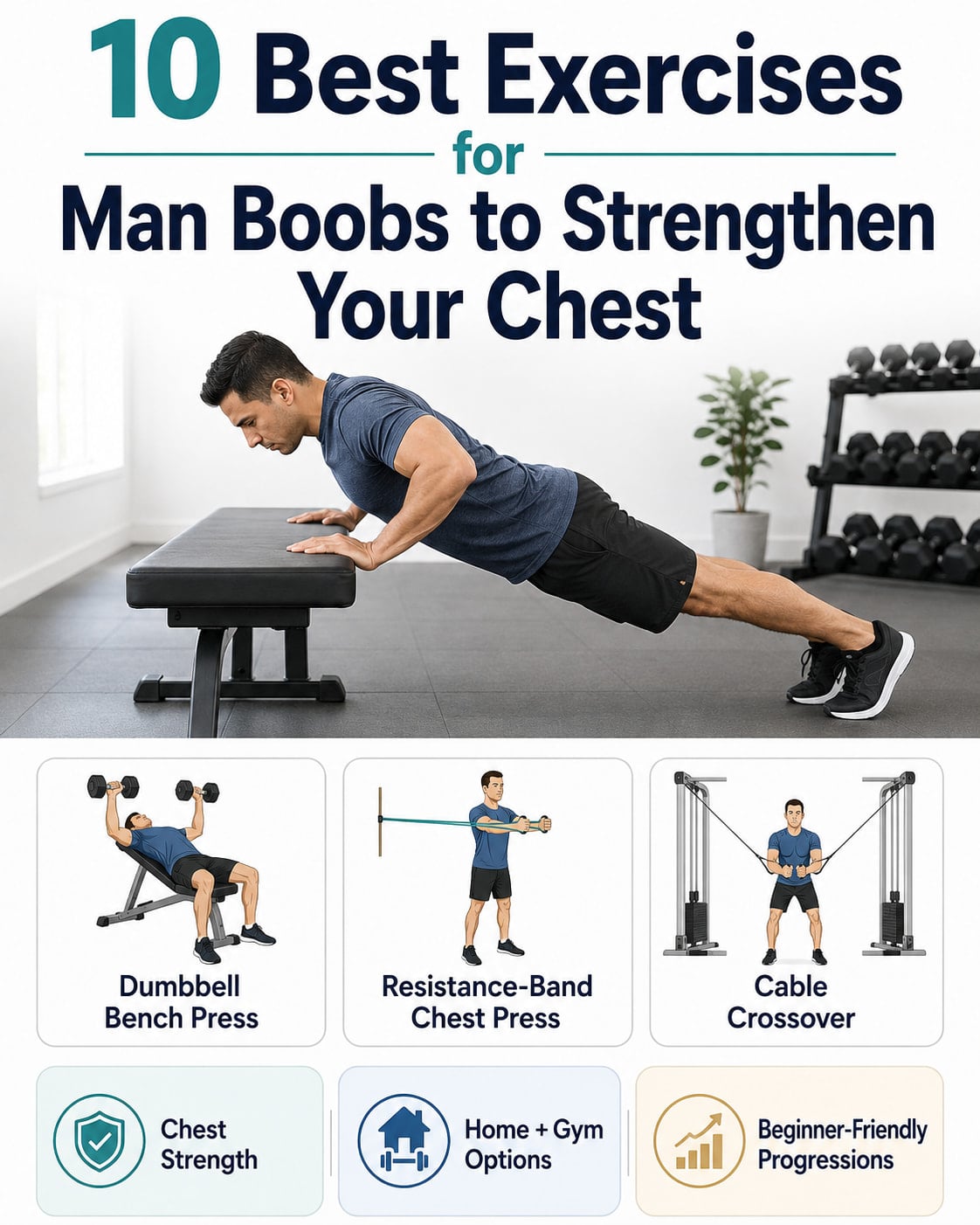
The best exercises for man boobs are push-ups, chest presses, and fly variations that strengthen and develop the pectoral muscles. However, chest exercises cannot selectively burn chest fat or remove glandular gynecomastia.
A practical approach is to train your chest twice per week, strengthen the rest of your body, stay regularly active, and use balanced eating habits. It is also important to understand whether the chest enlargement is mainly body fat or actual breast gland tissue, because exercise affects these differently.
The phrase “man boobs” is common search language rather than a medical diagnosis. This guide uses it to answer the question clearly, while using the more accurate terms pseudogynecomastia, chest fat, and gynecomastia where appropriate.
Can Exercises Get Rid of Man Boobs?
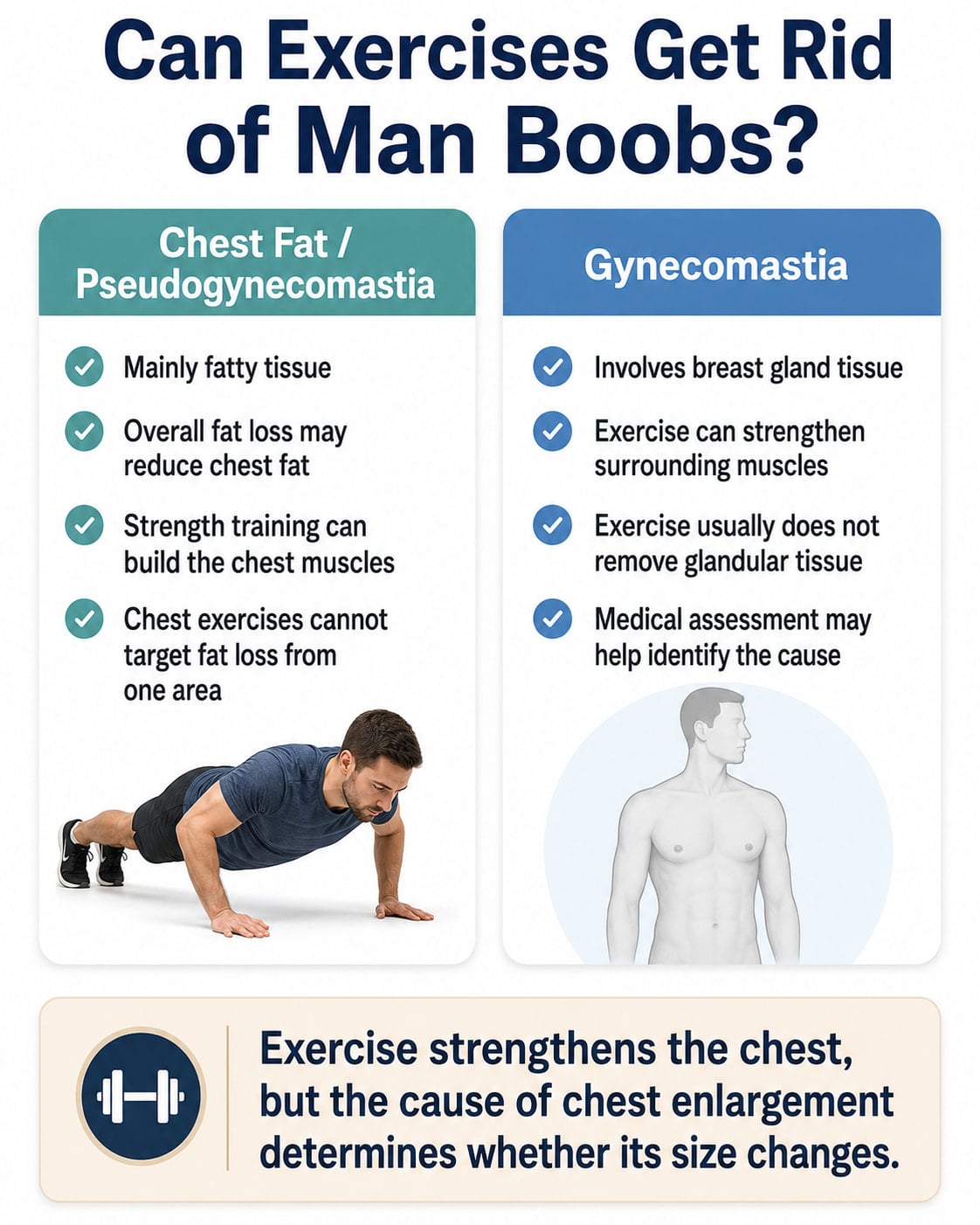
Exercises can make your chest stronger and help build the pectoral muscles beneath the chest tissue. Whether they reduce the size of an enlarged chest depends partly on what is causing it.
Chest Fat or Pseudogynecomastia
Pseudogynecomastia is an increase in fatty tissue around the male chest without an increase in breast gland tissue.
If overall body fat decreases, some chest fat may also decrease. Resistance training, aerobic exercise, regular movement, sleep, and balanced eating habits can support that process. However, your body determines where fat comes off first, and chest exercises cannot force fat loss from the chest alone.
Glandular Gynecomastia
Gynecomastia is an increase in actual breast gland tissue. Hormone changes, certain medicines, natural puberty, aging, and some health conditions may contribute to it.
The Cleveland Clinic explains that exercise may contribute to weight loss when enlarged male breasts are associated with excess fat, but exercise is unlikely to change gynecomastia caused by a hormonal imbalance.
| Type of chest enlargement | Main tissue involved | What exercise may do |
|---|---|---|
| Pseudogynecomastia | Fatty tissue | Strengthen the chest and support overall body-fat management |
| Gynecomastia | Breast gland tissue | Improve surrounding muscle strength but usually not remove the glandular tissue |
| Combination | Fat and glandular tissue | Potentially reduce some fatty tissue while glandular tissue may remain |
You cannot reliably diagnose the difference from appearance alone. A healthcare professional can assess the tissue, symptoms, medical history, and possible causes.
Why Chest Exercises Still Help
Even when exercise does not remove the tissue responsible for chest enlargement, chest training can provide useful benefits:
- Strengthen the pectoralis major and pectoralis minor
- Improve pushing strength
- Support daily tasks such as pushing doors, carts, or other objects
- Develop the triceps and front shoulders
- Increase overall resistance-training capacity
- Improve muscular balance when combined with back exercises
- Support a consistent full-body fitness program
A 2026 update from the American College of Sports Medicine emphasizes that consistent resistance training matters more than using a complicated program. It also notes that bodyweight exercises, resistance bands, machines, and free weights can all improve strength and muscular development.
Exercises for Man Boobs at a Glance
The following exercises provide options for home, gym, beginner, and more experienced training.
Do not perform all 10 exercises in one workout. Most people only need two to four chest exercises per session.
| Exercise | Equipment | Best for | Starting sets and reps |
|---|---|---|---|
| Incline push-up | Stable elevated surface | Beginners | 2–3 sets of 8–15 |
| Standard push-up | None | Bodyweight strength | 2–4 sets of 6–15 |
| Resistance-band chest press | Resistance band and anchor | Home workouts | 2–3 sets of 10–15 |
| Dumbbell floor press | Dumbbells | Controlled pressing | 2–4 sets of 8–12 |
| Dumbbell bench press | Dumbbells and bench | Balanced chest development | 3 sets of 6–12 |
| Incline dumbbell bench press | Dumbbells and adjustable bench | Upper-chest emphasis | 3 sets of 8–12 |
| Barbell bench press | Barbell, rack, bench, and plates | Progressive strength | 3 sets of 5–10 |
| Seated chest press machine | Chest-press machine | Stable resistance | 2–4 sets of 8–12 |
| Pec deck machine | Pec deck | Chest isolation | 2–3 sets of 10–15 |
| Bent-forward cable crossover | Cable station | Cable-based isolation | 2–3 sets of 10–15 |
10 Best Exercises for Man Boobs to Strengthen Your Chest
Choose two to four exercises per workout rather than performing all 10 in one session. Focus on controlled repetitions and gradual progression. These exercises strengthen the chest but cannot selectively remove chest fat or glandular gynecomastia.
1. Incline Push-Up
Why it works: The incline push-up strengthens the chest with less resistance than a floor push-up. Raising your hands reduces the amount of body weight you must press, making it easier to learn proper alignment and control.
Muscles worked: Pectoralis major, triceps, front deltoids, serratus anterior, and core.
How to do it:
- Place your hands slightly wider than shoulder-width on a stable wall, counter, rail, or bench.
- Walk your feet backward until your body forms a straight line from your head to your heels.
- Brace your core and bend your elbows to lower your chest toward the surface.
- Keep your elbows angled slightly backward instead of pointing directly sideways.
- Press through your palms to return to the starting position.
- Complete 2–3 sets of 8–15 controlled repetitions.
Trainer Tip: Start with a high surface and gradually lower the surface as you become stronger. Do not let your hips sag or your head move forward.
2. Standard Push-Up
Why it works: The standard push-up develops chest and upper-body strength without equipment. It also requires your core and hips to stabilize your body throughout the movement.
Muscles worked: Pectoralis major, triceps, front deltoids, serratus anterior, and core.
How to do it:
- Begin in a high-plank position with your hands slightly wider than your shoulders.
- Keep your head, back, hips, and legs in one straight line.
- Brace your abdomen and lower your chest toward the floor.
- Keep your elbows angled slightly back and your shoulders away from your ears.
- Stop at the deepest position you can control without losing alignment.
- Press the floor away to return to the starting position.
- Complete 2–4 sets of 6–15 repetitions.
Trainer Tip: Use incline push-ups if you cannot maintain a straight body position. Clean repetitions are more useful than forcing extra repetitions with poor form.
3. Standing Resistance-Band Chest Press
Why it works: The standing band chest press trains the same basic pushing pattern as a bench press while requiring minimal equipment. The band provides increasing resistance as your hands move forward.
Muscles worked: Pectoralis major, triceps, front deltoids, and core stabilizers.
How to do it:
- Secure a resistance band behind you at approximately chest height.
- Hold one end in each hand and step forward into a stable split stance.
- Begin with your hands beside your chest and your wrists straight.
- Brace your core and press both hands forward.
- Extend your arms without forcefully locking your elbows.
- Slowly return your hands to the starting position.
- Complete 2–3 sets of 10–15 repetitions.
Trainer Tip: Inspect the band before each workout and use an anchor that cannot move or come loose. Step closer to the anchor to reduce the resistance.
4. Dumbbell Floor Press
Why it works: The dumbbell floor press strengthens the chest and triceps while limiting how far the elbows can move behind the body. It is a practical pressing option for beginners and people who do not have a bench.
Muscles worked: Pectoralis major, triceps, and front deltoids.
How to do it:
- Sit on the floor with one dumbbell beside each thigh.
- Carefully lie back while guiding the dumbbells above your chest.
- Bend your knees and place your feet flat on the floor.
- Position your wrists directly above your elbows.
- Lower the dumbbells until the backs of your upper arms lightly touch the floor.
- Press the dumbbells upward until your arms are extended.
- Complete 2–4 sets of 8–12 repetitions.
Trainer Tip: Lower the weights slowly rather than allowing your elbows to hit the floor. Keep your wrists straight and your hips resting on the floor.
5. Dumbbell Bench Press
Why it works: The dumbbell bench press allows each arm to control its own weight. This can help develop chest strength on both sides while providing more freedom of movement than a fixed barbell.
Muscles worked: Pectoralis major, triceps, and front deltoids.
How to do it:
- Sit on a stable flat bench with one dumbbell resting on each thigh.
- Lie back while guiding the weights into position above your chest.
- Plant your feet firmly and lightly draw your shoulder blades back.
- Lower the dumbbells toward the sides of your chest.
- Keep your wrists above your elbows and your elbows angled slightly away from your torso.
- Press the weights upward until your arms are extended.
- Complete 3 sets of 6–12 repetitions.
Trainer Tip: Choose weights you can position and control safely. Increase the load only after you can complete every repetition without bouncing, twisting, or losing shoulder position.
6. Incline Dumbbell Bench Press
Why it works: The incline dumbbell bench press places greater emphasis on the upper portion of the chest while also strengthening the triceps and front shoulders.
Muscles worked: Upper portion of the pectoralis major, triceps, and front deltoids.
How to do it:
- Set an adjustable bench to a low or moderate incline of approximately 20–30 degrees.
- Sit with one dumbbell resting on each thigh.
- Carefully lie against the bench and position the dumbbells above your upper chest.
- Lower the weights under control while keeping your wrists above your elbows.
- Stop before your shoulders move into an uncomfortable position.
- Press the dumbbells upward without shrugging.
- Complete 3 sets of 8–12 repetitions.
Trainer Tip: Avoid setting the bench too upright. A steep angle shifts more work toward the shoulders and away from the chest.
7. Barbell Bench Press
Why it works: The barbell bench press is effective for developing pressing strength because the bar can be loaded gradually with small weight increases. Both arms work together to control one implement.
Muscles worked: Pectoralis major, triceps, and front deltoids.
How to do it:
- Lie on a flat bench with your eyes approximately beneath the bar.
- Plant your feet and grip the bar slightly wider than shoulder-width.
- Keep your thumbs wrapped securely around the bar.
- Unrack the bar and position it above your chest.
- Lower it under control toward the middle or lower portion of your chest.
- Press the bar upward while keeping both sides level.
- Complete 3 sets of 5–10 repetitions.
Trainer Tip: Use correctly positioned safety arms or a capable spotter. Begin with an empty bar or light load until your technique is consistent.
8. Seated Chest Press Machine
Why it works: The chest press machine provides a stable seat and guided movement path. This can make it easier to focus on pressing effort without balancing separate weights.
Muscles worked: Pectoralis major, triceps, and front deltoids.
How to do it:
- Adjust the seat so the handles are approximately level with the middle of your chest.
- Sit with your back supported and your feet flat on the floor.
- Hold the handles with your wrists straight.
- Press the handles forward smoothly.
- Stop just before your elbows lock forcefully.
- Return the handles slowly without allowing the weight stack to crash.
- Complete 2–4 sets of 8–12 repetitions.
Trainer Tip: Adjust the seat before selecting a heavy resistance. If the handles are too high or too low, the exercise may feel uncomfortable in your shoulders.
9. Pec Deck Machine
Why it works: The pec deck isolates the chest by bringing the upper arms toward the center of the body. The supported seated position makes it easier to focus on controlled chest contraction.
Muscles worked: Pectoralis major and front deltoids.
How to do it:
- Adjust the seat so the handles or arm pads are approximately level with your chest.
- Sit with your back and head supported.
- Hold the handles or place your forearms against the pads.
- Maintain a slight bend in your elbows.
- Bring your arms together in front of your chest.
- Slowly return until you feel a comfortable stretch.
- Complete 2–3 sets of 10–15 repetitions.
Trainer Tip: Do not allow the machine to pull your arms far behind your body. Use a moderate range that feels controlled and comfortable in your shoulders.
10. Bent-Forward Cable Crossover
Why it works: The bent-forward cable crossover trains the chest through a sweeping arm movement. The cables maintain resistance through much of the exercise and allow small load adjustments.
Muscles worked: Pectoralis major, front deltoids, and shoulder and core stabilizers.
How to do it:
- Set both cable pulleys above shoulder height and attach single handles.
- Hold the handles and step forward into a stable split stance.
- Lean forward slightly while keeping your spine neutral.
- Maintain a soft bend in your elbows.
- Sweep your arms forward and inward until your hands meet in front of your chest.
- Return slowly without allowing the cables to pull your arms backward suddenly.
- Complete 2–3 sets of 10–15 repetitions.
Trainer Tip: Use a weight that allows a smooth, sweeping movement. If you must bend and straighten your elbows considerably, the exercise is becoming more like a press than a cable crossover.
A Simple Home Chest Workout
Perform this workout twice per week with at least one non-chest-training day between sessions.
| Exercise | Sets | Repetitions |
|---|---|---|
| Incline or standard push-up | 3 | 8–15 |
| Resistance-band chest press | 3 | 10–15 |
| Dumbbell floor press, if available | 2 | 8–12 |
Choose the push-up variation that allows you to complete every repetition with consistent alignment. Stop the set when you feel that only one to three controlled repetitions remain.
A balanced home program should also include pulling, leg, hip, and core exercises rather than training only the chest.
A Simple Gym Chest Workout
| Exercise | Sets | Repetitions |
|---|---|---|
| Barbell or dumbbell bench press | 3 | 6–10 |
| Incline dumbbell bench press | 3 | 8–12 |
| Pec deck or cable crossover | 2 | 10–15 |
Choose one exercise from each line. You do not need both the barbell and dumbbell bench press or both isolation exercises during the same beginner workout.
Include a rowing or pulldown exercise elsewhere in the session to train the opposing upper-back muscles.
How Often Should You Train Your Chest?
For most beginners, two chest-training sessions per week is a practical starting point.
The 2026 ACSM resistance-training guidance recommends training all major muscle groups at least twice per week. For people specifically trying to build muscle, approximately 10 challenging weekly sets per muscle group is presented as a useful target, although beginners may progress with fewer sets and build gradually.
A sensible progression may look like this:
- Beginner: 6–8 chest sets per week
- After adapting: 8–10 chest sets per week
- More experienced: Adjust volume according to recovery and progress
Count only challenging working sets. Warm-up sets with very light resistance do not need to be included in the total.
Training more is not always better. Reduce your volume if your performance repeatedly decreases, your joints feel irritated, or soreness interferes with normal movement.
How to Progress the Exercises
Chest muscles need gradually increasing demands to continue adapting. You do not have to increase weight every workout.
Use this simple method:
- Choose a repetition range, such as 8–12.
- Begin with a resistance that lets you complete at least eight controlled repetitions.
- Keep the same resistance until you can reach 12 repetitions on every set.
- Increase the resistance by the smallest available amount.
- Return to the lower end of the range and repeat.
You can also progress by:
- Using a lower surface for incline push-ups
- Adding one or two repetitions
- Slowing the lowering phase
- Improving the range of motion
- Adding a controlled pause
- Improving stability and technique
You do not need to take every set to complete muscular failure. Stopping while you could still perform approximately one to three good repetitions is a practical approach for most general fitness workouts.
Can You Burn Chest Fat With Chest Exercises?
Chest exercises use energy and train the muscles beneath chest tissue, but they do not selectively burn the fat directly above those muscles.
A systematic review and meta-analysis published in Human Movement examined 13 studies involving 1,158 participants. It found no meaningful reduction in localized fat from training the nearby muscles, meaning spot reduction was not observed.
For adults who want to reduce body fat and for whom weight loss is appropriate, a broader plan is more useful:
- Perform full-body resistance training
- Include regular walking, cycling, swimming, or another enjoyable aerobic activity
- Use balanced, sustainable eating habits
- Get sufficient sleep
- Avoid crash diets and extreme restrictions
- Monitor changes over months rather than expecting a rapid transformation
The Centers for Disease Control and Prevention states that adults should generally aim for at least 150 minutes of moderate-intensity aerobic activity per week, or 75 minutes of vigorous activity, plus muscle-strengthening activity on at least two days. The amount needed for weight management varies among individuals.
Teenagers should not use aggressive diets, unverified supplements, or excessive exercise to change their chest appearance. A parent, guardian, physician, or qualified dietitian can help determine whether any weight-related changes are appropriate during growth.
Common Mistakes to Avoid
Expecting Spot Reduction
Hundreds of push-ups may improve push-up performance, but they cannot guarantee that fat will disappear specifically from the chest.
Training Only the Chest
Too much pressing without upper-back training can create an unbalanced program. Include rows, pulldowns, or other pulling movements along with leg and core training.
Using More Weight Than You Can Control
Heavy resistance is only useful when you can maintain a stable setup, controlled range, and consistent technique.
Training the Chest Every Day
Muscles need time between challenging sessions. Daily hard chest workouts can reduce performance and irritate the shoulders, elbows, or wrists.
Changing Exercises Too Often
Keep your main exercises long enough to improve them. Replacing the routine every few days makes progress difficult to measure.
Ignoring Pain
Normal muscular effort is different from sharp, sudden, or worsening pain. Stop the movement and change the exercise if it causes pain.
Self-Treating Suspected Gynecomastia
Do not stop prescribed medicine or use hormone-related products in an attempt to change breast tissue without medical guidance. Some medicines and health conditions can contribute to gynecomastia, so the underlying cause matters.
When Should You See a Healthcare Professional?
Arrange a medical evaluation if you notice:
- A new firm or hard lump
- Enlargement mainly on one side
- Nipple discharge or bleeding
- Dimpled, puckered, or scaling skin
- A nipple that begins turning inward
- Persistent pain or tenderness
- Rapid or unexplained tissue changes
- Enlargement that begins after starting a medicine
- Other symptoms that concern you
The Mayo Clinic recommends medical evaluation for swelling, pain, tenderness, nipple discharge, a firm lump, or dimpled skin. These signs do not automatically indicate a serious condition, but they should not be assumed to be ordinary chest fat.
Gynecomastia caused by natural puberty-related hormone changes often improves without treatment within approximately six months to two years. Persistent, painful, or worrying changes should still be discussed with a healthcare professional.
Frequently Asked Questions
Can exercises completely get rid of man boobs?
It depends on the cause. Exercise can strengthen the chest and support overall body-fat management. It cannot reliably remove enlarged glandular breast tissue caused by gynecomastia.
Do push-ups reduce man boobs?
Push-ups strengthen the chest, triceps, shoulders, and core. They may contribute to a full exercise program, but they cannot selectively burn fat from the chest.
What is the best exercise for man boobs at home?
The incline push-up is one of the best starting exercises because it requires no special equipment and can be adjusted to your strength level. Standard push-ups and resistance-band chest presses are useful progressions.
What is the best gym exercise for chest strength?
The barbell bench press is a practical choice for progressive strength because it can be loaded in small increments. Dumbbell presses and chest press machines are also effective, particularly when they feel more comfortable or are easier to control.
How many chest exercises should I do in one workout?
Most beginners only need two or three chest exercises in one session. One main press, one secondary press, and an optional fly movement are usually sufficient.
How long does it take to strengthen the chest?
The timeline varies with your starting level, training consistency, resistance, recovery, sleep, and nutrition. Focus first on measurable improvements such as performing more controlled repetitions or using slightly more resistance. Visible changes generally take longer than performance improvements.
Does losing weight reduce gynecomastia?
Losing excess body fat may reduce pseudogynecomastia or the fatty portion of a mixed condition. It does not necessarily remove glandular gynecomastia.
Conclusion
The best exercises for man boobs are not special fat-burning movements. They are reliable chest exercises that build strength through progressive resistance.
Start with a movement you can control, such as an incline push-up, resistance-band chest press, or dumbbell floor press. Train your chest about twice per week, add resistance gradually, and include full-body strength and regular aerobic activity.
Most importantly, do not assume every enlarged male chest is caused by body fat. Seek medical guidance for firm lumps, one-sided changes, nipple discharge, skin changes, persistent pain, or other concerning symptoms.
References
- American College of Sports Medicine: 2026 Resistance Training Guidelines
- American Council on Exercise: Evidence-Based Approach to Training the Chest
- Cleveland Clinic: Gynecomastia Causes, Diagnosis, and Treatment
- Mayo Clinic: Gynecomastia Symptoms and Causes
- Mayo Clinic: Gynecomastia Diagnosis and Treatment
- CDC: Physical Activity and Weight Management
- Human Movement: Systematic Review of Exercise and Spot Reduction