
A useful heart rate recovery is one that is reasonably strong and consistent for your age, exercise type, and recovery method. However, there is no universal heart rate recovery chart by age that applies to every workout or person.
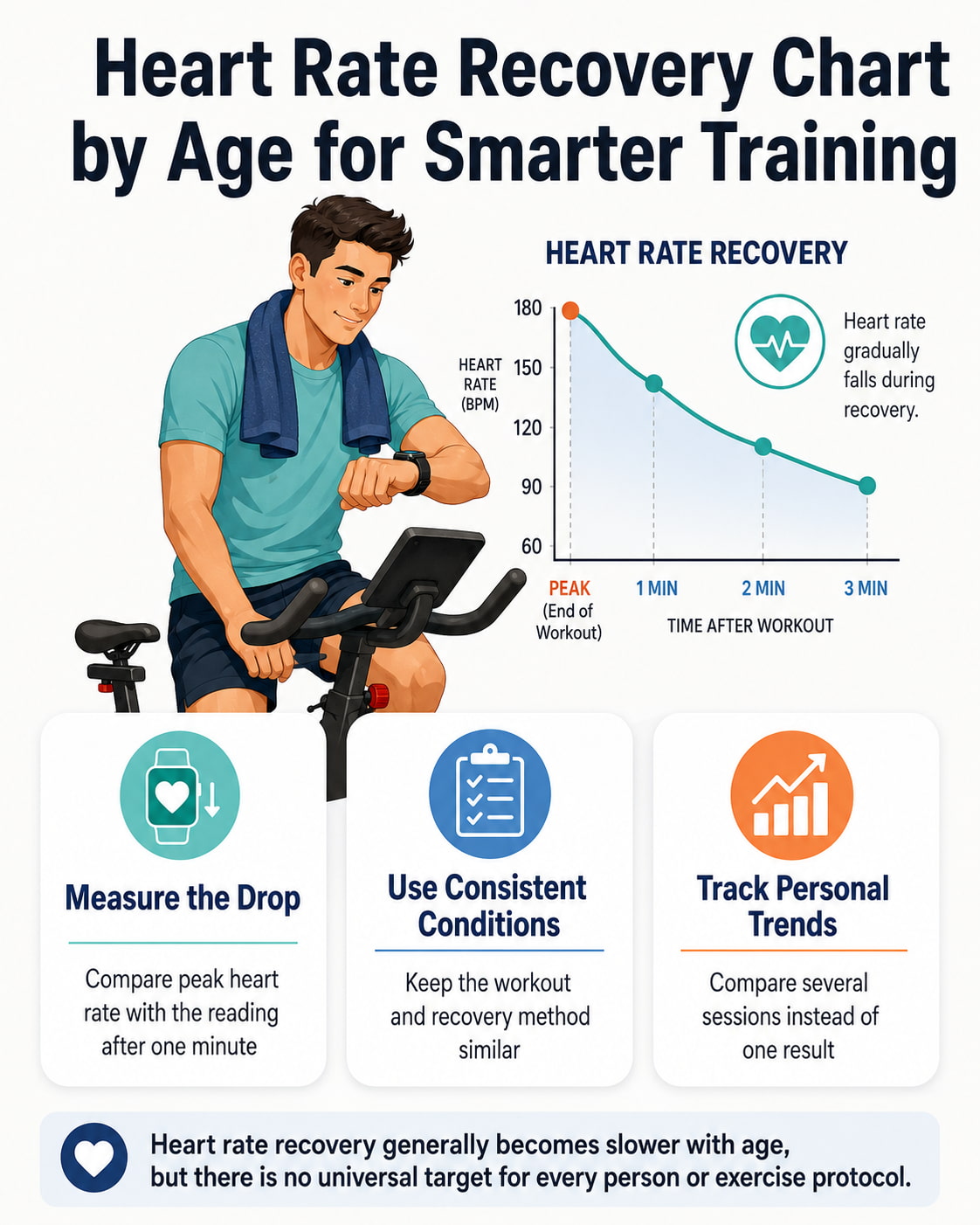
The chart below provides research-based reference values from adults who completed treadmill testing followed by active walking recovery. Use it for general comparison—not as a diagnosis or a rigid fitness score. Newer research confirms that heart rate recovery usually slows with age, especially after about age 60, but the expected result also depends on resting heart rate, exercise protocol, recovery position, health, and medication use.
Heart Rate Recovery Chart by Age
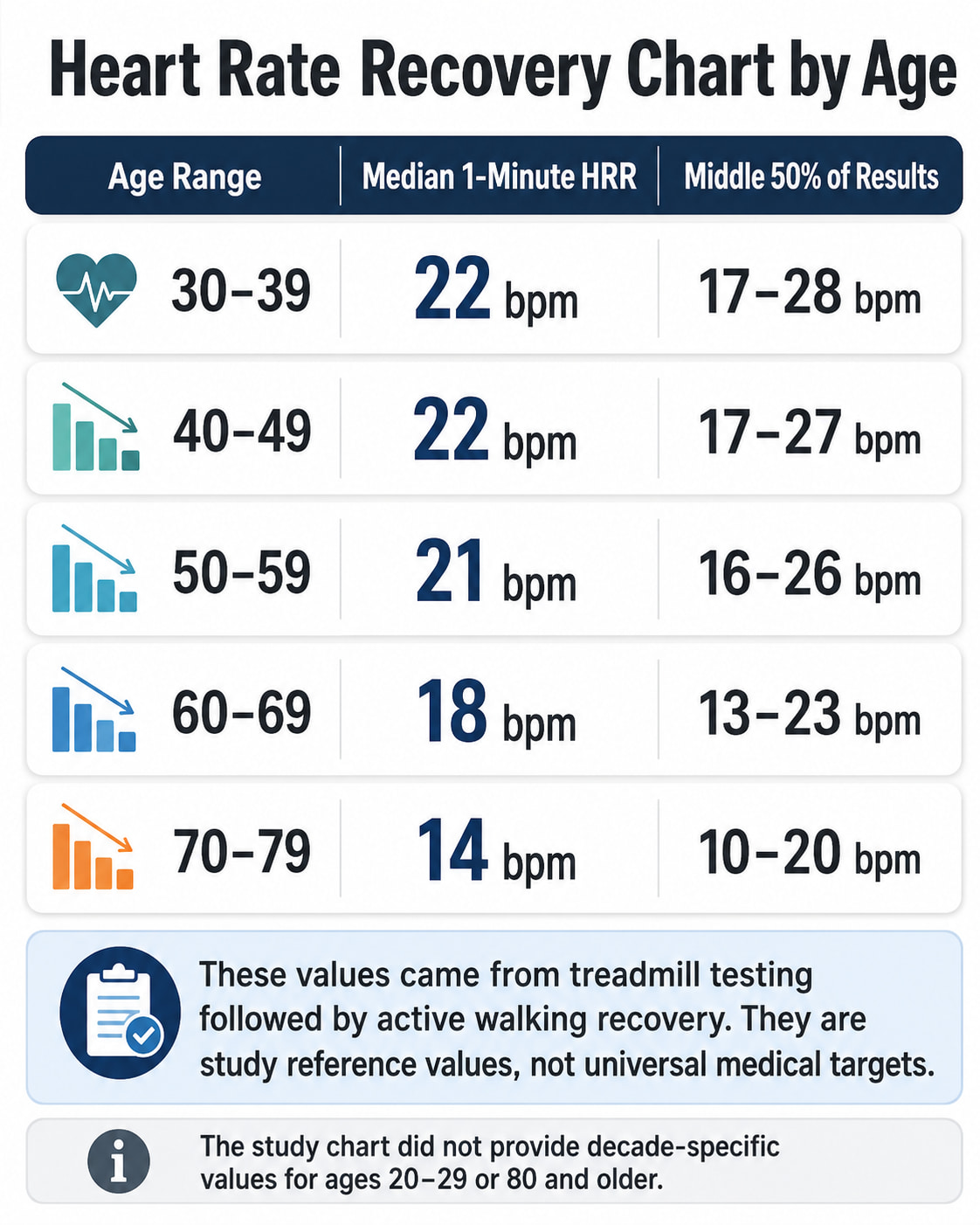
The following one-minute heart rate recovery chart comes from a 2018 Journal of the American Heart Association study. Participants completed a treadmill exercise test and then continued walking at 1.7 miles per hour on a level treadmill during recovery.
Heart rate recovery was calculated by subtracting the heart rate after one minute of active recovery from the highest heart rate reached during exercise.
| Age range | Median 1-minute HRR | Middle 50% of results | Participants below 13 bpm |
|---|---|---|---|
| 30–39 | 22 bpm | 17–28 bpm | 8.4% |
| 40–49 | 22 bpm | 17–27 bpm | 10.0% |
| 50–59 | 21 bpm | 16–26 bpm | 13.0% |
| 60–69 | 18 bpm | 13–23 bpm | 21.5% |
| 70–79 | 14 bpm | 10–20 bpm | 41.5% |
Important: These numbers are study medians, not minimum requirements. A result outside the middle range does not automatically mean that something is wrong.
The study found that average recovery remained fairly similar from the 30s through the 50s and then declined more noticeably during the 60s and 70s.
Why the Chart Does Not Include Ages 20–29 or 80 and Older
The study’s decade-by-decade reference table began with ages 30–39 and ended with ages 70–79. It would be misleading to invent or extrapolate values for younger or older groups.
A newer cycle-exercise study included adults ages 18–85, but its expected values were calculated using age, resting heart rate, body mass index, and a different recovery method. Participants stopped cycling and moved into a lying position without a cool-down. Those results cannot be directly combined with the treadmill chart above.
What Is Heart Rate Recovery?
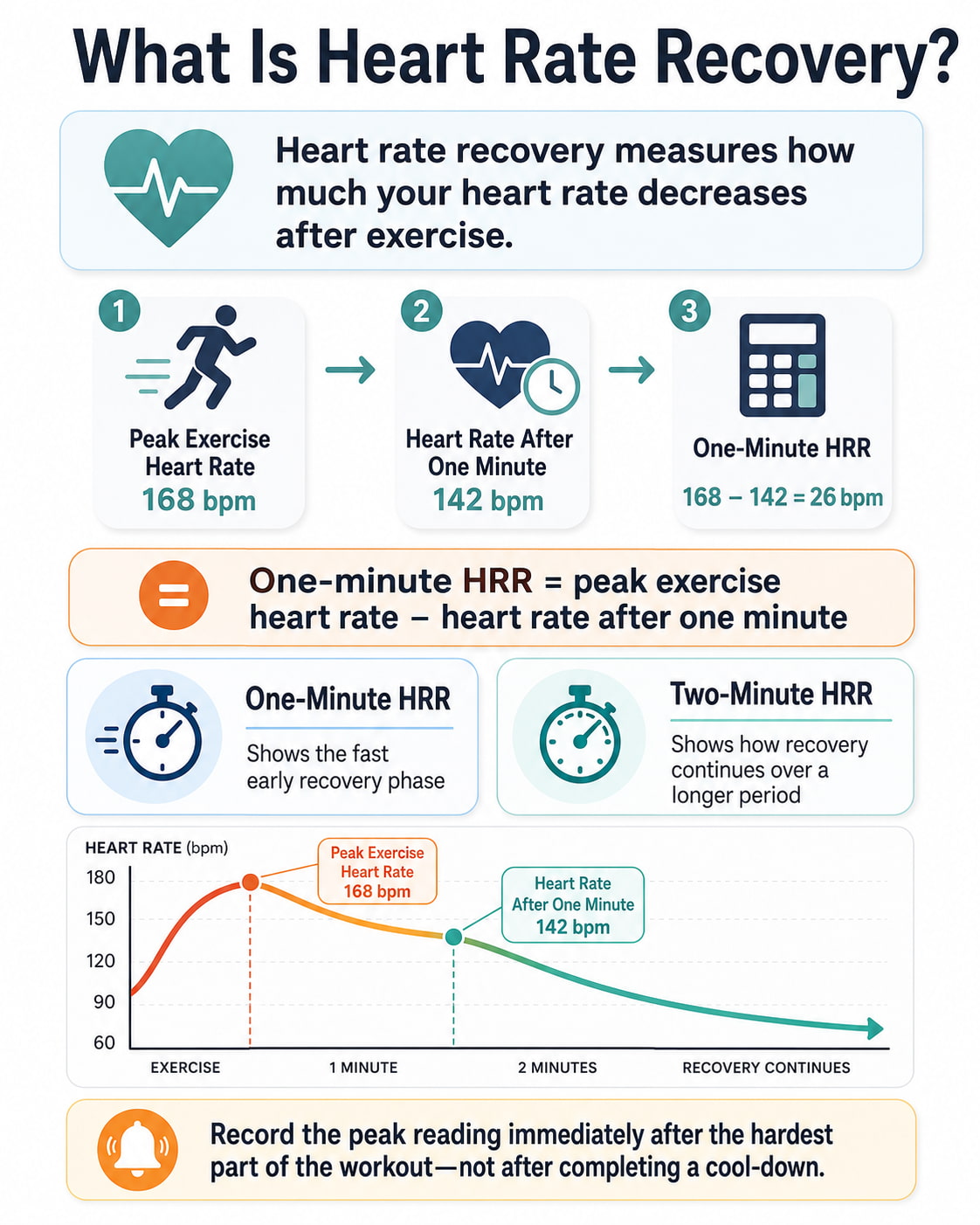
Heart rate recovery, commonly abbreviated as HRR, measures how much your heart rate decreases after exercise.
The most common calculation compares your peak exercise heart rate with your heart rate one minute later:
One-minute HRR = peak exercise heart rate − heart rate after one minute
For example:
- Peak exercise heart rate: 168 bpm
- Heart rate after one minute: 142 bpm
- Heart rate recovery: 168 − 142 = 26 bpm
A larger number means your heart rate fell farther during the measurement period. According to the Cleveland Clinic heart rate recovery guide, the peak measurement should be taken immediately after the hardest part of the workout—not after completing a cool-down.
One-Minute vs. Two-Minute Heart Rate Recovery
Heart rate recovery occurs in phases:
- Fast recovery phase: The first 30 to 60 seconds after exercise
- Slower recovery phase: Approximately two minutes and beyond
During the first minute, parasympathetic activity—the “rest and recover” part of the autonomic nervous system—rapidly increases. Afterward, recovery continues more slowly as parasympathetic activity and sympathetic withdrawal work together.
One-minute and two-minute results are not interchangeable. Always record the measurement time when tracking your results.
How to Measure Heart Rate Recovery Correctly
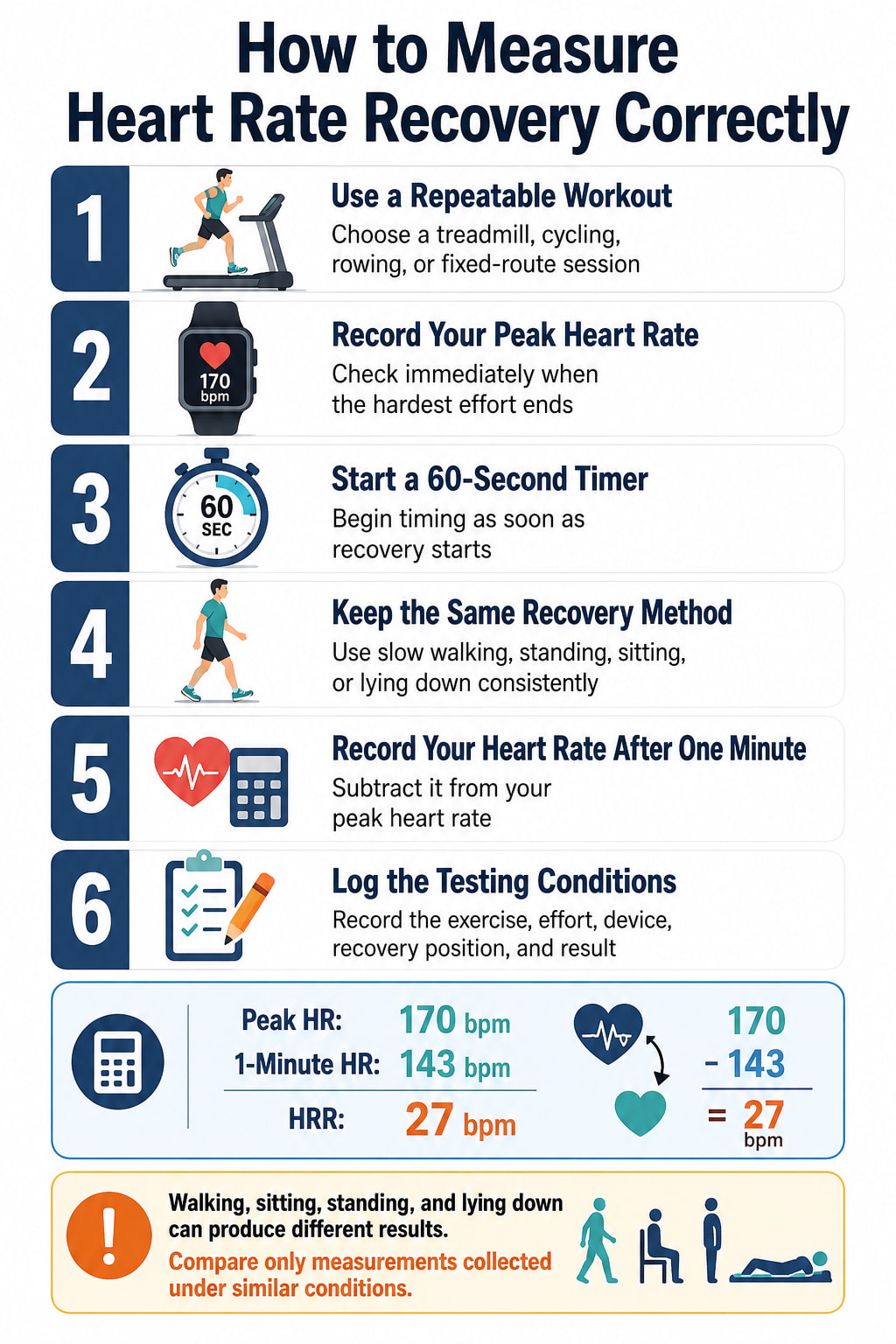
Consistency matters more than finding the perfect testing method. A result from walking recovery should not be directly compared with one measured while sitting or lying down.
Step 1: Use a Repeatable Workout
Choose an activity you can reproduce, such as:
- A treadmill walk or run
- Stationary cycling
- Rowing
- A fixed outdoor route
- A standardized interval session
Try to keep the workout duration and finishing intensity reasonably similar each time.
Step 2: Record Your Peak Heart Rate
Check your heart rate immediately when you finish the hardest part of the workout.
Use the highest reliable reading from your watch, chest strap, exercise machine, or manually counted pulse. Do not wait until after a cool-down because your heart rate may already have fallen substantially.
Step 3: Start a 60-Second Timer
Begin timing as soon as the hard effort ends.
Choose one recovery method and continue using it:
- Slow walking
- Standing still
- Sitting
- Lying down
Step 4: Record Your Heart Rate After One Minute
At exactly 60 seconds, record your heart rate again.
Subtract this number from your peak exercise heart rate.
Step 5: Optionally Measure at Two Minutes
Continue in the same recovery position and record your heart rate at two minutes.
Calculate:
Two-minute HRR = peak heart rate − heart rate after two minutes
Step 6: Write Down the Testing Conditions
A useful training log should include:
| Detail | Example |
|---|---|
| Exercise | Treadmill run |
| Workout duration | 30 minutes |
| Final effort | Hard but controlled |
| Peak heart rate | 170 bpm |
| Recovery method | Slow walking |
| 1-minute heart rate | 143 bpm |
| 1-minute HRR | 27 bpm |
| 2-minute heart rate | 126 bpm |
| 2-minute HRR | 44 bpm |
Recording the recovery method is essential. Research shows that active recovery, sitting, and lying down can produce meaningfully different results.
What Is a Good Heart Rate Recovery?
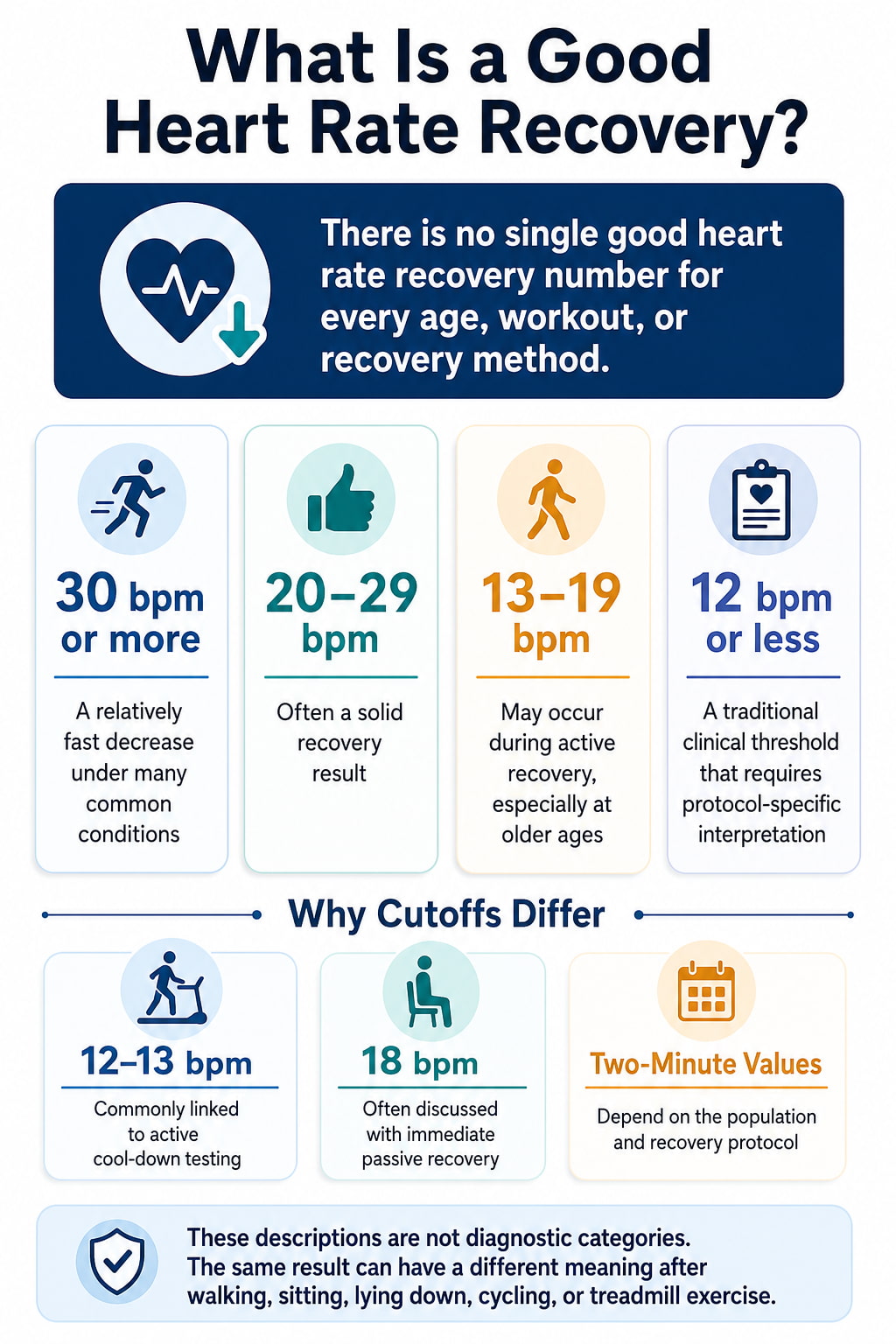
There is no single number that is good for every age and testing method.
Cleveland Clinic provides 18 bpm or more after one minute as a general consumer benchmark. However, it also notes that the result depends on age, cardiovascular health, the type of exercise, the length of the recovery period, and whether the person continues moving.
A practical interpretation is:
| One-minute HRR | General meaning |
|---|---|
| 30 bpm or more | A relatively fast decrease under many common testing conditions |
| 20–29 bpm | Often a solid recovery result |
| 13–19 bpm | May be expected under some active-recovery protocols, particularly at older ages |
| 12 bpm or less | A traditional clinical threshold that may warrant professional interpretation when measured under the relevant protocol |
These descriptions are not diagnostic categories. The same number can have a different meaning when measured after walking, sitting, lying down, cycling, maximal treadmill exercise, or a moderate home workout.
Understanding the 12-, 13-, and 18-Bpm Cutoffs
Different numbers appear online because researchers used different testing methods.
The 12- or 13-bpm threshold
A classic clinical study defined delayed recovery as a decrease of 12 bpm or less after one minute during an active cool-down. Because heart rate is usually recorded in whole beats, this may also be described as an HRR of less than 13 bpm.
This was developed as a prognostic threshold during supervised exercise testing. It was not designed as a universal fitness grade for every home workout.
The 18-bpm threshold
A threshold of approximately 18 bpm has been used when participants stopped exercising and immediately rested in a lying position. Lying down usually allows faster recovery than continued walking, so the two thresholds should not be treated as contradictory.
Two-minute thresholds
Two-minute cutoffs such as 22 bpm and 42 bpm have also appeared in research. However, they came from different populations, exercise intensities, and recovery positions.
The 2025 study emphasized that fixed cutoffs do not account adequately for age or protocol differences.
Does Heart Rate Recovery Decline With Age?
Heart rate recovery generally becomes slower with age, although the decline is not perfectly linear.
The 2025 European Journal of Preventive Cardiology study evaluated 2,242 apparently healthy adults ages 18–85 to create reference values. Both one- and two-minute recovery declined with age, while differences between males and females were small enough for the researchers to use combined equations.
The researchers found that the lower limit of expected one-minute recovery:
- Fell below 18 bpm after approximately age 65
- Fell below 12 bpm after approximately age 75
These findings applied to maximal cycling followed by immediate lying recovery. They do not mean that every person older than 75 should have an HRR below 12 bpm. Instead, they show why one fixed threshold can misclassify some older adults.
Age is also not the only factor. The study’s one-minute prediction model included:
- Age
- Age squared
- Resting heart rate
Its two-minute model also included body mass index.
How to Use Heart Rate Recovery for Smarter Training
The most helpful way to use HRR is to monitor your personal trend under similar conditions.
Do not compare a one-minute result after a hard treadmill run with a result after an easy bike ride. Do not compare sitting recovery one week with walking recovery the next.
Establish a Personal Baseline
Complete the same or a similar workout several times over two to four weeks.
Record:
- Peak heart rate
- One-minute heart rate
- Two-minute heart rate, when useful
- Recovery position
- Workout type
- Perceived effort
- Any symptoms
Your baseline is the range you commonly see—not necessarily your single best result.
Look for Sustained Trends
Suppose your usual one-minute HRR after a standard run is 25–30 bpm. One reading of 20 bpm may simply represent normal measurement variation or a different finishing effort.
Repeated results below your normal range are more useful than one isolated number. Research on repeated HRR testing has found meaningful measurement variability, supporting the use of several comparable sessions rather than relying on one test.
Compare Similar Workouts
A meaningful comparison might look like this:
| Week | Peak HR | HR at 1 minute | HRR | Recovery method |
|---|---|---|---|---|
| 1 | 170 | 146 | 24 bpm | Walking |
| 2 | 168 | 142 | 26 bpm | Walking |
| 3 | 169 | 140 | 29 bpm | Walking |
| 4 | 167 | 138 | 29 bpm | Walking |
The gradual increase may suggest that recovery is improving under those specific conditions. However, HRR should still be considered alongside workout performance, perceived effort, symptoms, and overall training consistency.
Do Not Use HRR as a Standalone Readiness Score
Heart rate recovery can add context to a training log, but it should not automatically determine whether you train or rest.
The result may change when you alter:
- Exercise intensity
- Exercise duration
- Recovery posture
- Active versus passive recovery
- Testing equipment
- Medication
- Cardiovascular health
- Environmental conditions
The 2025 study also found only a weak relationship between one-minute HRR and peak exercise heart rate, showing that a larger peak heart rate does not automatically produce a proportionally larger recovery value.
Why Is My Heart Rate Recovery Slower Than Usual?
A slower-than-usual result does not necessarily indicate a medical problem.
First, check whether anything about the test changed:
- Did you finish at a different intensity?
- Did you stop suddenly instead of walking?
- Did you sit rather than stand?
- Did you measure at a different time?
- Did your watch lose contact during the workout?
- Did you perform a different type of exercise?
- Have you started or changed a heart rate–affecting medication?
Age, cardiovascular conditions, testing method, recovery activity, and measurement timing can all influence the result.
Repeat the measurement during comparable workouts before making conclusions. Speak with a healthcare professional when recovery remains substantially below your usual pattern or you have concerns about exercising safely.
Can Exercise Improve Heart Rate Recovery?
Regular physical activity may improve heart rate recovery in many people.
Cleveland Clinic notes that exercise can improve HRR, and studies involving structured exercise programs have also reported improvement in certain clinical populations. The appropriate exercise plan depends on current fitness, health conditions, symptoms, and medical history.
For general training, focus on sustainable habits:
- Perform regular aerobic activity
- Increase duration and intensity gradually
- Include easier recovery sessions
- Avoid treating every workout as a maximum-effort test
- Use repeatable sessions when monitoring HRR
People with cardiovascular disease, recent surgery, a previous heart attack, unexplained exercise symptoms, or significant medical concerns should ask a healthcare professional about safe exercise and whether supervised cardiac rehabilitation is appropriate.
Why Heart Rate Recovery Matters
Heart rate recovery reflects how the autonomic nervous system responds when exercise ends.
A slower recovery has been associated with higher cardiovascular and overall mortality risk in observational research. A meta-analysis of prospective studies found that reduced HRR was associated with a greater risk of cardiovascular events and all-cause mortality. However, an association does not prove that a low home reading causes disease or predicts an individual outcome. (Journal of the American Heart Association meta-analysis)
The 2025 cycle-exercise study also found that reduced one- and two-minute recovery values were associated with mortality during follow-up. The researchers still emphasized the need for age- and protocol-specific interpretation. (2025 European Journal of Preventive Cardiology study)
HRR should be treated as one piece of information—not a diagnosis and not a substitute for a medical evaluation.
Heart Rate Recovery vs. Heart Rate Variability
Heart rate recovery and heart rate variability are different measurements.
Heart Rate Recovery
HRR measures how many beats per minute your heart rate decreases after exercise.
Example:
170 bpm at peak − 142 bpm after one minute = 28 bpm HRR
Heart Rate Variability
Heart rate variability, or HRV, measures small variations in the time interval between individual heartbeats. It is usually reported in milliseconds rather than beats per minute.
HRV is commonly measured during rest or sleep, while HRR is measured immediately after exercise.
Heart Rate Recovery vs. Heart Rate Reserve
These terms also sound similar but measure different things.
- Heart rate recovery: Peak exercise heart rate minus heart rate after recovery
- Heart rate reserve: Maximum or peak heart rate minus resting heart rate
Heart rate reserve is often used to estimate training intensity. Heart rate recovery describes how quickly heart rate falls after the exercise ends.
When Should You Contact a Healthcare Professional?
Consider discussing your results with a healthcare professional when:
- Your HRR remains substantially lower than your usual baseline
- Recovery becomes progressively slower over several comparable sessions
- Your heart rate remains unexpectedly high after stopping
- You notice a rapid or irregular heartbeat
- Exercise produces unusual dizziness, weakness, or breathing difficulty
- You have cardiovascular disease or take heart rate–lowering medication
- You are uncertain whether vigorous exercise is safe for you
Seek emergency help for chest pressure or pain, severe shortness of breath, fainting, or symptoms that could indicate a heart attack. The American Heart Association warning-sign guide lists chest discomfort, upper-body discomfort, shortness of breath, nausea, cold sweat, and lightheadedness among possible warning signs.
Frequently Asked Questions
What is a good heart rate recovery by age?
There is no universal number for every age. In one active-walking treadmill study, the median one-minute HRR was 22 bpm for adults in their 30s and 40s, 21 bpm in their 50s, 18 bpm in their 60s, and 14 bpm in their 70s. These are study medians rather than pass-or-fail targets.
Is a 20-bpm heart rate recovery good?
A 20-bpm decrease after one minute is generally a reasonable result under many common testing conditions. Its meaning still depends on your age, workout intensity, recovery method, health, and personal baseline.
Is a 30-bpm drop after one minute good?
A 30-bpm one-minute decrease represents relatively fast recovery under many protocols. Compare it with results from similar workouts rather than treating it as proof of exceptional fitness or cardiovascular health.
Should I walk, sit, or lie down when measuring HRR?
Any method can be used for personal tracking, but you must use the same method each time. Walking generally produces a smaller decrease than complete rest, while lying down may accelerate recovery.
Does my heart rate need to return to resting level within one minute?
No. HRR measures how far the heart rate falls during a set period. It does not require your heart rate to return completely to its pre-exercise resting level within 60 seconds.
Can a smartwatch measure heart rate recovery?
A smartwatch can provide convenient readings when it maintains reliable skin contact and records heart rate immediately after exercise. Use the same device and testing method when comparing trends. A chest strap may provide a more direct electrical heart rate measurement, while many watches estimate pulse using optical sensors.
Does heart rate recovery always get slower with age?
Population averages generally decline with age, but individual results vary widely. Fitness, resting heart rate, recovery method, exercise type, medication, and health conditions may all affect the result.
Conclusion
A heart rate recovery chart by age can provide useful context, but it should not replace your personal baseline or professional medical interpretation.
For smarter training, measure HRR after repeatable workouts, use the same recovery position, record both the peak and one-minute values, and evaluate trends across several sessions. A consistent improvement may provide encouraging feedback, while a persistent unexplained decline deserves closer attention.
Most importantly, do not use one wearable reading to diagnose a health condition. Combine HRR with how you feel, how you perform, and guidance from a qualified healthcare professional when needed.
This content is for informational purposes only and not medical advice.
References
- Cleveland Clinic: Heart Rate Recovery
- Journal of the American Heart Association: Prognostic Performance of Heart Rate Recovery on an Exercise Test
- European Journal of Preventive Cardiology: Heart Rate Response and Recovery in Cycle Exercise Testing
- Journal of the American Heart Association: HRR and Cardiovascular Events Meta-Analysis
- American Heart Association: Heart Attack, Stroke and Cardiac Arrest Symptoms