
An albumin creatinine ratio below 30 mg/g is generally considered normal to mildly increased. A result from 30 to 299 mg/g is moderately increased, while 300 mg/g or higher is severely increased.
The urine albumin-creatinine ratio, or UACR, helps detect albumin leaking into the urine—an important sign of possible kidney damage. However, one abnormal result does not automatically mean you have chronic kidney disease. The result usually needs to be repeated and interpreted with your estimated glomerular filtration rate, or eGFR.
Kidney testing matters because chronic kidney disease often causes no noticeable symptoms during its early stages. According to the Centers for Disease Control and Prevention, an estimated 14% of U.S. adults—about 37 million people—have CKD, and approximately 87% of affected adults do not know they have it. These estimates were updated in March 2026.
Albumin Creatinine Ratio Chart
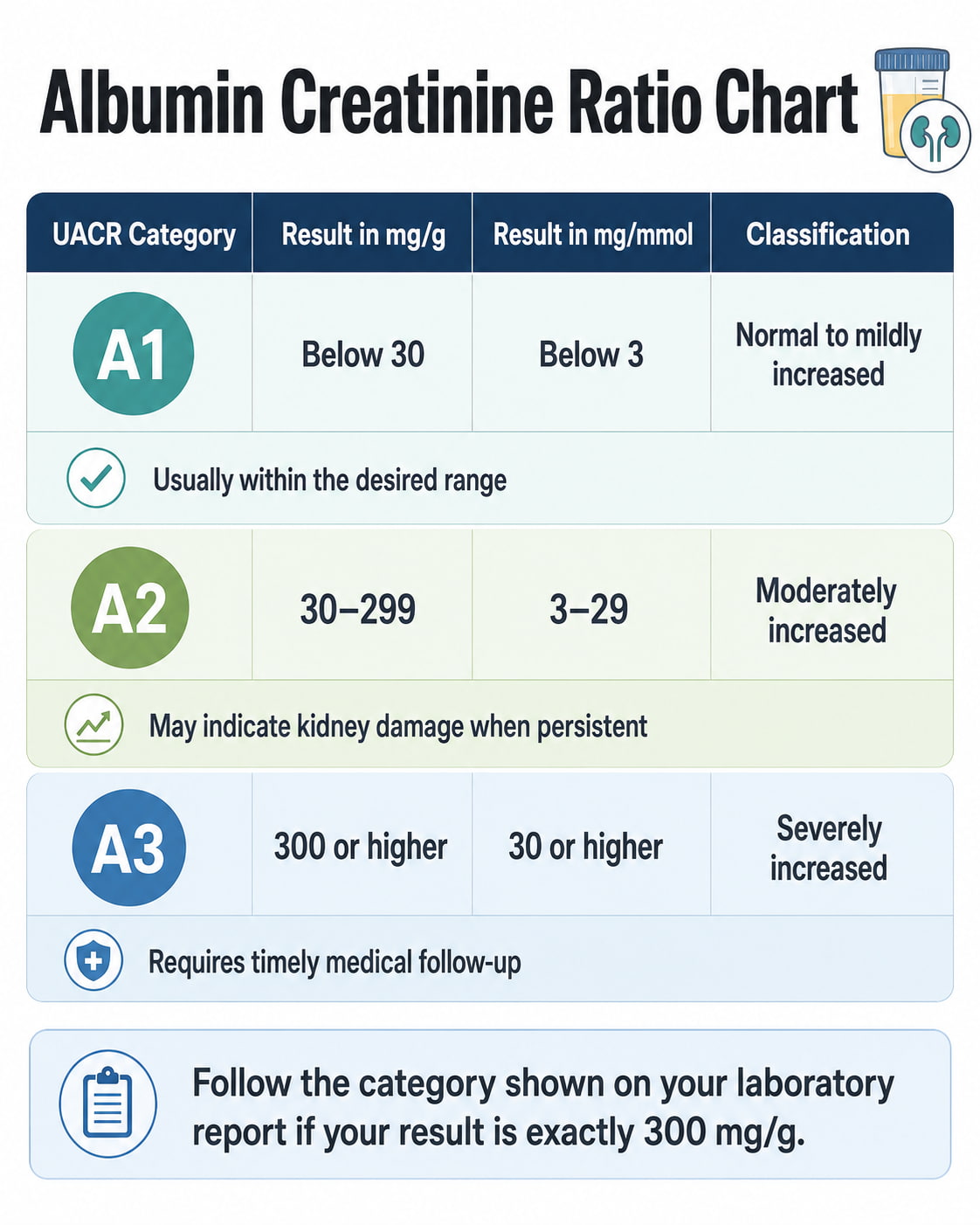
The following albumin creatinine ratio chart uses the commonly reported U.S. units of milligrams of albumin per gram of creatinine, or mg/g.
| UACR category | Result in mg/g | Result in mg/mmol | Classification | What it generally means |
|---|---|---|---|---|
| A1 | Below 30 | Below 3 | Normal to mildly increased | Usually within the desired range. Kidney disease may still be present if eGFR or another kidney marker is abnormal. |
| A2 | 30–299 | 3–29 | Moderately increased | May indicate kidney damage when the result remains elevated on repeat testing. |
| A3 | 300 or higher | 30 or higher | Severely increased | Indicates substantial albumin loss and a higher risk of kidney and cardiovascular complications. Prompt medical follow-up is important. |
The Kidney Disease: Improving Global Outcomes 2024 Clinical Practice Guideline classifies persistent albuminuria as A1, A2, or A3 and combines the result with eGFR to estimate overall kidney risk. KDIGO tables show A2 as 30–300 mg/g and A3 as above 300 mg/g, while many U.S. laboratories and patient resources use 30–299 mg/g and 300 mg/g or higher to avoid an overlapping boundary. Follow the category printed on your laboratory report when a result is exactly 300 mg/g.
What Is a Urine Albumin-Creatinine Ratio?
A urine albumin-creatinine ratio compares the amount of albumin with the amount of creatinine in a urine sample.
Albumin
Albumin is a protein normally found in the blood. Healthy kidney filters keep most albumin in the bloodstream. When the kidney’s filtering structures are damaged or under stress, some albumin may pass into the urine.
Creatinine
Creatinine is a waste product released into the urine. Including creatinine in the calculation helps account for whether the urine sample is concentrated or diluted.
The calculation is:
UACR in mg/g = urine albumin in mg/dL ÷ urine creatinine in g/dL
The laboratory normally calculates the ratio automatically. On your report, look for wording such as:
- Albumin/creatinine ratio
- Microalbumin/creatinine ratio
- Urine ACR
- UACR
- Alb/creat ratio
The National Institute of Diabetes and Digestive and Kidney Diseases recommends a spot UACR because it estimates daily albumin loss without requiring a 24-hour urine collection.
What Is a Normal Albumin Creatinine Ratio?
A UACR below 30 mg/g is generally classified as A1, or normal to mildly increased albuminuria.
A lower result is usually preferable. There is no established “too low” UACR category. However, a result below 30 mg/g does not prove that every aspect of kidney function is normal.
Kidney health should also be evaluated using:
- eGFR
- Blood creatinine
- Blood pressure
- Urinalysis
- Medical history
- Imaging or additional testing when needed
A person may have a normal UACR but a persistently reduced eGFR. Another person may have an eGFR above 60 while their UACR is elevated.
How to Read Albumin Creatinine Ratio Results
UACR Below 30 mg/g: A1
A result below 30 mg/g is considered normal to mildly increased.
For example:
UACR: 12 mg/g
This result falls in the A1 category. No increased albumin loss is identified by the standard cutoff.
However, A1 does not rule out kidney disease when:
- eGFR is persistently below 60
- Blood or abnormal cells are found in the urine
- Kidney imaging shows structural changes
- Another recognized marker of kidney damage is present
UACR From 30 to 299 mg/g: A2
A result from 30 to 299 mg/g is classified as moderately increased albuminuria.
For example:
UACR: 75 mg/g
This falls in the A2 category. It may indicate early or ongoing kidney damage, especially when the elevation continues for at least three months.
A2 albuminuria may be associated with diabetes, high blood pressure, cardiovascular disease, heart failure, or a primary kidney condition. A repeat test is usually needed because temporary factors can also increase the result.
The older term microalbuminuria was commonly used for this range. Current guidelines prefer moderately increased albuminuria because microalbumin is not a separate or smaller type of albumin.
UACR of 300 mg/g or Higher: A3
A result of 300 mg/g or higher is generally classified as severely increased albuminuria.
For example:
UACR: 420 mg/g
This falls in the A3 category. It indicates a larger amount of albumin in the urine and is associated with a greater risk of worsening kidney function and cardiovascular complications.
A3 albuminuria requires timely medical evaluation, but it does not automatically mean that the kidneys have failed. Kidney failure is primarily defined using kidney filtration and the overall clinical situation—not the UACR alone.
The older term macroalbuminuria was sometimes used for this range. The preferred term is now severely increased albuminuria.
UACR and eGFR Should Be Read Together
UACR and eGFR measure different aspects of kidney health.
- UACR looks for kidney damage by measuring albumin leakage.
- eGFR estimates kidney filtration using a blood creatinine result and other factors.
| UACR result | eGFR result | Possible interpretation |
|---|---|---|
| Below 30 mg/g | 60 or higher | Usually lower risk when no other kidney abnormalities are present |
| 30 mg/g or higher | 60 or higher | Albuminuria may show kidney damage despite preserved filtration |
| Below 30 mg/g | Below 60 | Reduced filtration may indicate CKD if it persists |
| 30 mg/g or higher | Below 60 | Both kidney damage and reduced filtration may be present |
The combination of UACR and eGFR provides a more accurate risk assessment than either number alone. KDIGO classifies CKD using the cause of kidney disease, the GFR category, and the albuminuria category.
Why One High UACR Result Is Not Enough
Urinary albumin can vary considerably from one sample to another. A single elevated result may be temporary and should not usually be used by itself to diagnose persistent albuminuria.
The American Diabetes Association Standards of Care in Diabetes—2026 recommend that two of three UACR samples collected over three to six months be abnormal before moderately or severely increased albuminuria is considered persistent.
Chronic kidney disease generally requires evidence of abnormal kidney structure or function that continues for at least three months.
Your clinician may repeat the test sooner when the result is very high, kidney function is changing, or another concerning finding is present.
What Can Temporarily Raise the Albumin Creatinine Ratio?
Several conditions can increase urine albumin even when the change is not caused by permanent kidney damage.
Possible temporary causes include:
- Intense exercise during the previous 24 hours
- Fever
- A urinary tract infection
- Another active infection
- Menstrual or urinary bleeding
- A heart failure flare
- Markedly elevated blood sugar
- A sudden major increase in blood pressure
Tell your healthcare professional if any of these circumstances were present when the sample was collected. Testing may need to be repeated after the issue has resolved.
The National Kidney Foundation notes that decisions are rarely based on a single UACR sample and that temporary health events can produce a false-positive or temporarily elevated result.
How Is the UACR Test Performed?
The UACR test usually requires a single urine sample collected at a clinic, laboratory, or healthcare professional’s office.
A 24-hour collection is generally unnecessary for routine screening. A first-morning sample is preferred when practical because it is less affected by recent activity and normal changes throughout the day. A random spot sample is still acceptable in many situations.
Before the Test
Follow any instructions provided by the laboratory. You may be advised to:
- Avoid intense exercise for 24 hours
- Report symptoms of a urinary tract infection
- Report fever or a recent illness
- Mention menstrual or other urinary bleeding
- Ask whether medications or supplements affect the planned testing
- Reschedule the test if your clinician believes a temporary condition could distort the result
Do not stop a prescription medication unless the healthcare professional managing it tells you to do so.
During the Test
Many laboratories use a clean-catch sample:
- Wash your hands.
- Clean the genital area using the supplied wipe.
- Begin urinating into the toilet.
- Collect the middle portion of the urine in the container.
- Avoid touching the inside of the container.
- Close the container and return it as directed.
Who Should Have UACR Testing?
UACR testing is especially important for people with conditions or risk factors linked to kidney disease.
These include:
- Type 1 or type 2 diabetes
- High blood pressure
- Cardiovascular disease
- Heart failure
- A family history of kidney disease or kidney failure
- Previous abnormal kidney test results
- Older age
- Tobacco use
- Increased body weight
- A known kidney or urinary condition
Current diabetes guidance recommends checking UACR and eGFR at least once a year in everyone with type 2 diabetes and in people who have had type 1 diabetes for five years or longer. People with established CKD may require testing between once and four or more times per year, depending on their UACR, eGFR, health status, and care plan.
What Should You Do After an Abnormal Result?
An abnormal UACR result should be reviewed with a healthcare professional rather than interpreted by itself.
The next steps may include:
1. Check for Temporary Causes
Discuss recent exercise, fever, infection, menstrual bleeding, blood sugar changes, blood pressure changes, or heart failure symptoms.
2. Repeat the Test
A repeat UACR helps determine whether the elevation is temporary or persistent. A first-morning sample may be recommended.
3. Review Your eGFR
UACR and eGFR together provide a clearer picture of kidney damage, filtration, and future risk.
4. Check Related Health Factors
Your healthcare professional may review:
- Blood pressure
- Blood glucose or A1C
- Blood creatinine
- Potassium and other electrolytes
- Urinalysis findings
- Current medications
- Family and medical history
5. Investigate Unexpected Results
Additional blood tests, urine studies, kidney imaging, or referral to a kidney specialist may be appropriate when albuminuria is severe, increases rapidly, occurs with blood in the urine, or does not fit the person’s medical history.
Do not change blood pressure, diabetes, or kidney medications based only on an online chart.
When Does a High UACR Need Prompt Medical Attention?
A high UACR by itself is not usually an emergency, but a very elevated result deserves timely follow-up.
Contact a healthcare professional promptly when an abnormal result occurs with:
- New or rapidly worsening swelling
- Shortness of breath
- Visible blood in the urine
- A major decrease in urine output
- Persistent vomiting or inability to keep fluids down
- Very high blood pressure
- Confusion, severe weakness, or other sudden symptoms
Seek urgent care for severe breathing difficulty, chest pain, fainting, confusion, or another potentially life-threatening symptom.
Frequently Asked Questions
Is an albumin creatinine ratio of 30 high?
A result of 30 mg/g is at the boundary where moderately increased albuminuria begins in many U.S. laboratory systems. It should generally be interpreted with eGFR and confirmed with repeat testing.
Does a UACR above 300 mean kidney failure?
No. A UACR of 300 mg/g or higher indicates severely increased albuminuria, not kidney failure by itself. Kidney failure is assessed primarily through filtration results, symptoms, and the complete clinical picture.
Can exercise increase the albumin creatinine ratio?
Yes. Intense exercise during the 24 hours before testing can temporarily increase urine albumin. Tell your clinician if you exercised heavily before providing the sample.
Can a urinary tract infection affect UACR?
Yes. A urinary tract infection can temporarily increase albumin or interfere with the sample. The test may need to be repeated after the infection has resolved.
Is UACR the same as a urine protein-creatinine ratio?
No. UACR measures albumin specifically. A urine protein-creatinine ratio measures total urinary protein, which includes albumin and other proteins. The tests may be used for different clinical purposes.
Is microalbumin the same as UACR?
“Microalbumin” is an older term commonly used for moderately increased albuminuria. It does not refer to a different form of albumin. UACR is the preferred test name, and A1, A2, and A3 are the preferred categories.
Can a normal UACR rule out kidney disease?
No. A normal UACR does not exclude kidney disease when eGFR is reduced or another marker of kidney damage is present. Both urine and blood results should be considered.
Conclusion
The albumin creatinine ratio chart provides a practical way to understand urine albumin results: below 30 mg/g is A1, 30–299 mg/g is A2, and 300 mg/g or higher is A3. The number is most useful when it is compared with eGFR and confirmed through repeat testing.
Review an abnormal result with your healthcare professional, ask whether the test should be repeated, and discuss any temporary conditions that may have affected the sample. Early follow-up can help identify kidney changes before noticeable symptoms develop.
This content is for informational purposes only and not medical advice.
References
- KDIGO 2024 Clinical Practice Guideline for the Evaluation and Management of Chronic Kidney Disease
- American Diabetes Association Standards of Care in Diabetes—2026: Chronic Kidney Disease and Risk Management
- National Institute of Diabetes and Digestive and Kidney Diseases: Quick Reference on UACR and GFR
- National Kidney Foundation: Urine Albumin-Creatinine Ratio
- Centers for Disease Control and Prevention: Chronic Kidney Disease in the United States, 2026