
Common types of workouts include cardio, strength training, flexibility work, balance exercises, HIIT, circuit training, functional training, low-impact exercise, yoga, and Pilates. The right combination depends on your goals, current fitness, and the activities you can practice consistently.
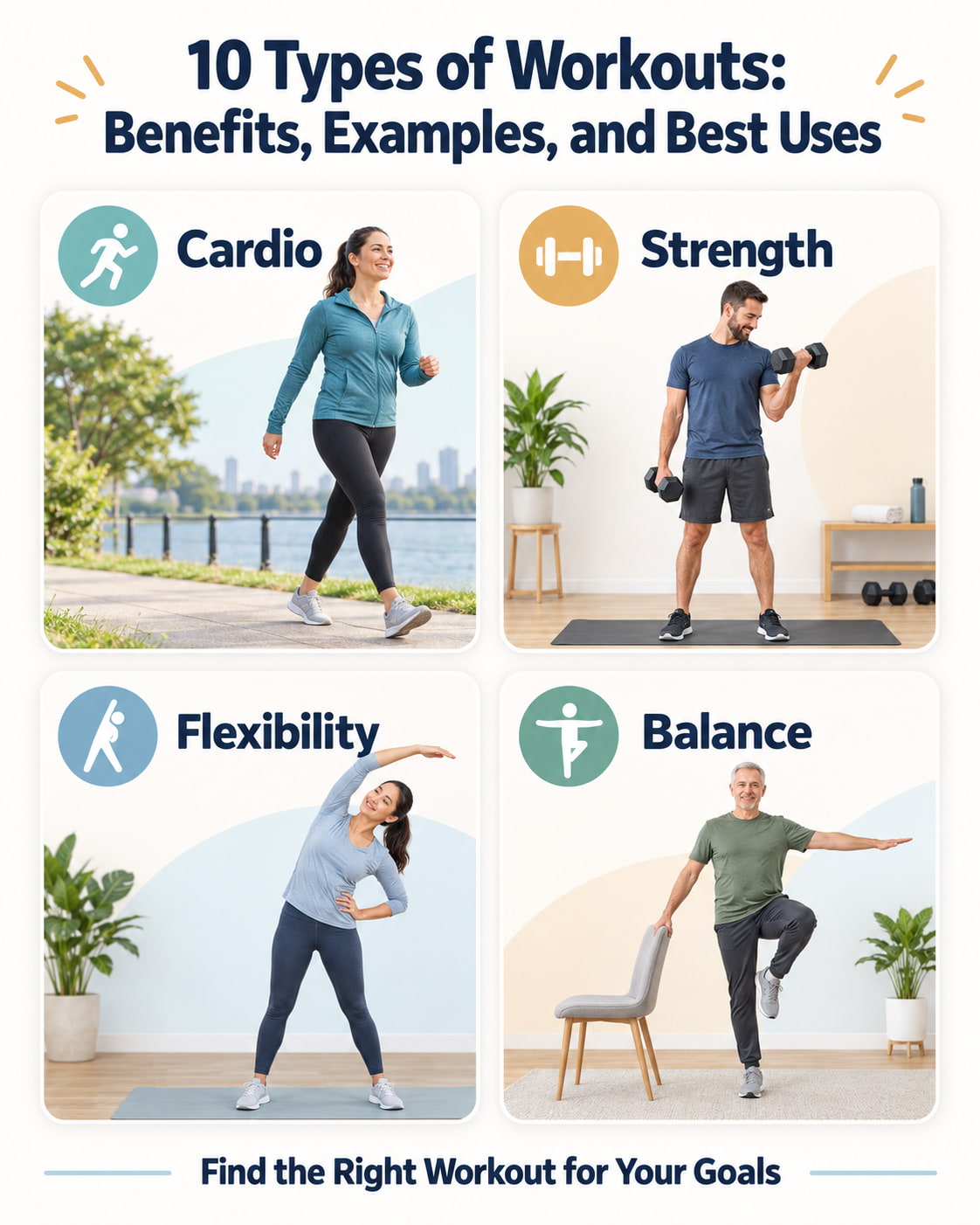
You do not need to fit all ten into your schedule. The CDC’s adult activity guidelines emphasize aerobic activity and muscle-strengthening exercise each week. Flexibility and balance work can complement that foundation.
This guide explains what each workout type offers, gives practical examples, and shows how to combine your options into a manageable routine.
Understanding the Different Types of Workouts
Workout names do not all describe the same thing. Cardio, strength, flexibility, and balance describe broad exercise purposes. HIIT and circuit training describe ways to organize exercise. These categories overlap rather than compete with one another.
For example, a stationary bike workout can be aerobic, low-impact, and interval-based at the same time. Think of the following options as a menu—not ten separate requirements for getting fit.
10 Types of Workouts and Their Best Uses
1. Cardio or Aerobic Workouts
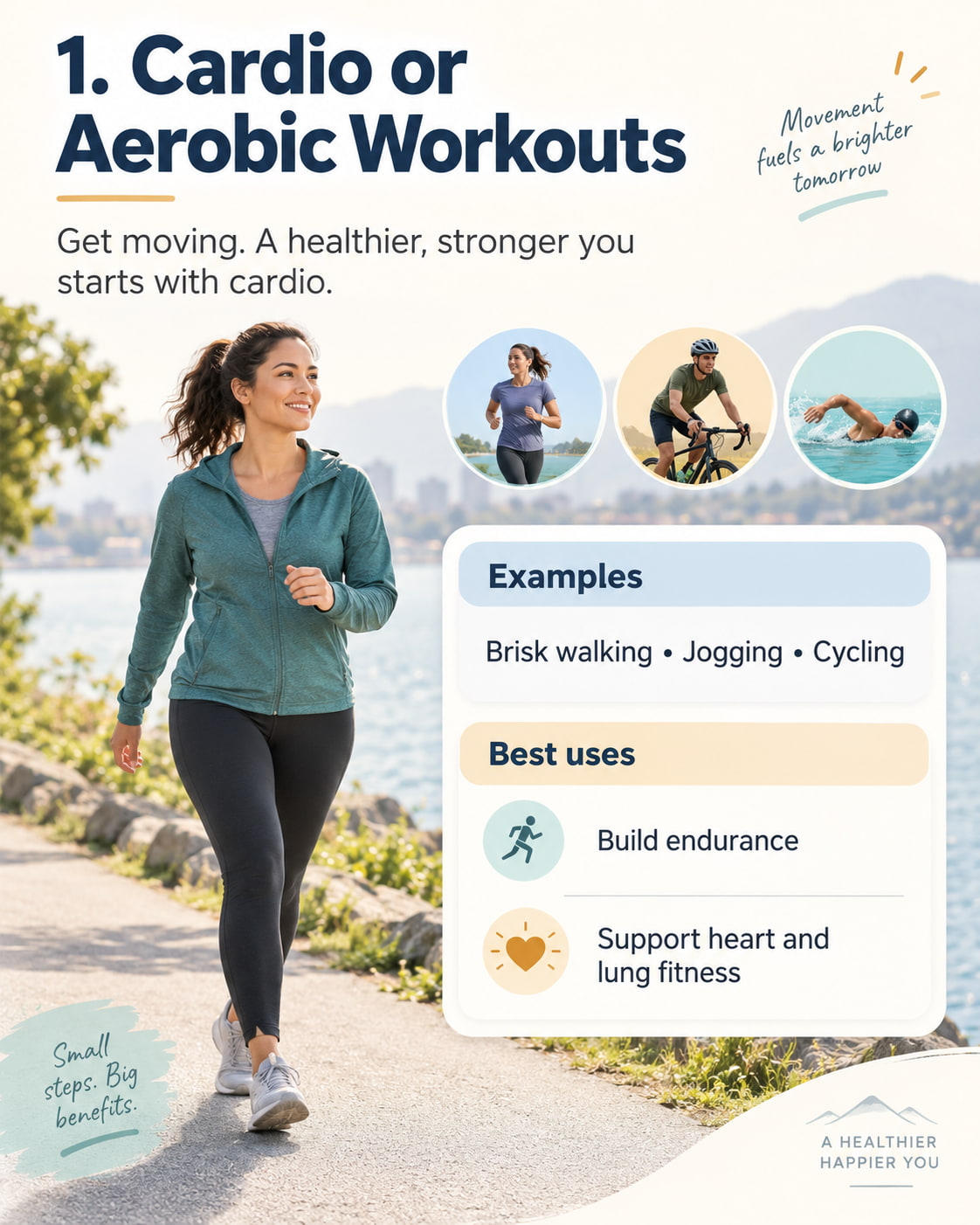
Cardio raises your heart rate and breathing through sustained movement. Regular aerobic activity supports heart and lung fitness and helps you develop stamina for activities such as walking farther or cycling longer.
Examples: Brisk walking, jogging, cycling, swimming, and dancing.
Best uses: Building endurance and contributing toward your weekly aerobic activity goal. Running is an option, not a requirement; brisk walking also counts.
The CDC’s talk test provides a practical way to judge your effort. At moderate intensity, you can carry on a conversation, but singing becomes difficult. At vigorous intensity, you need to pause for breath after saying only a few words. The same activity may feel different depending on your fitness.
2. Strength or Resistance Training
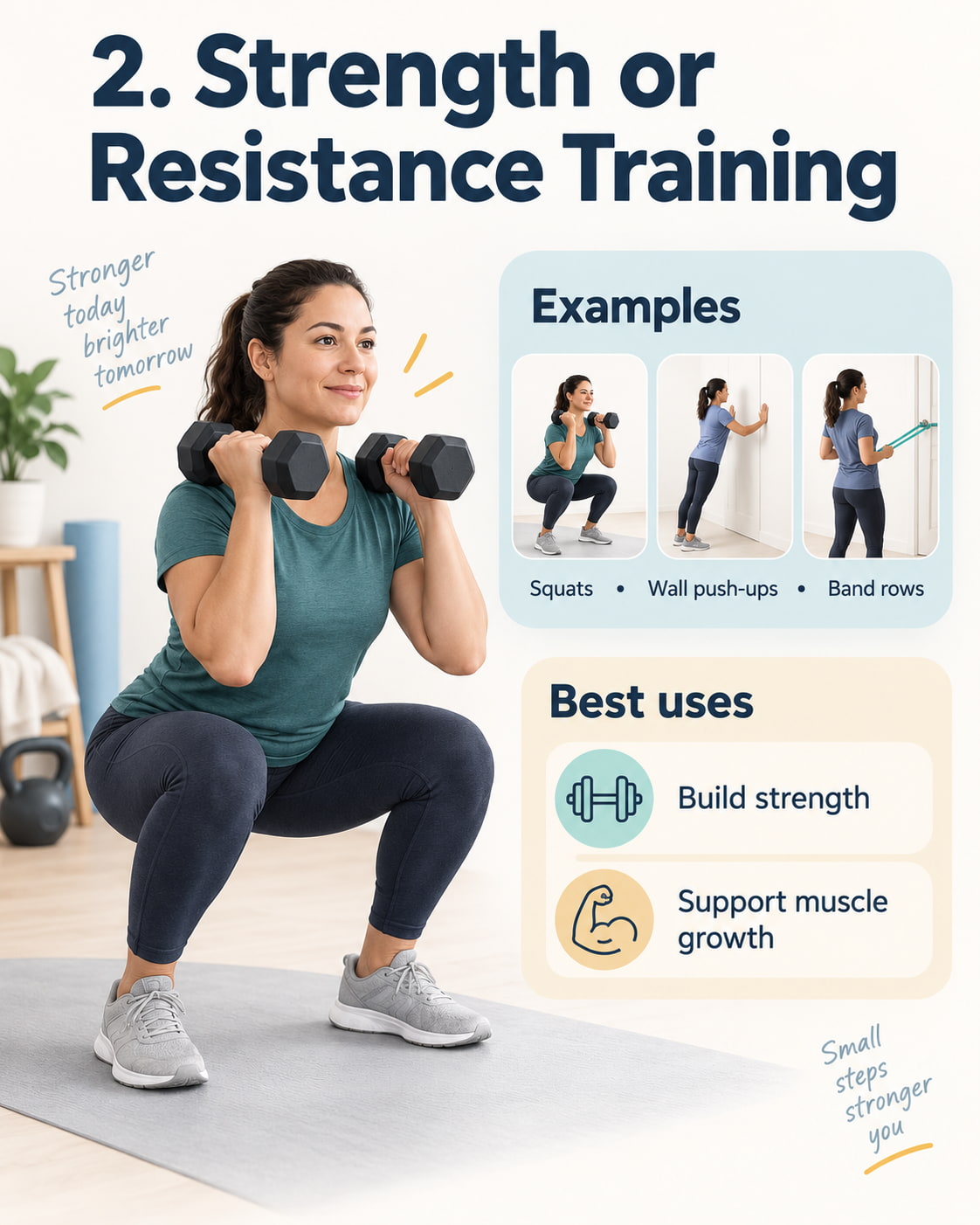
Strength training makes your muscles work against resistance. That resistance can come from your body weight, bands, dumbbells, barbells, or exercise machines.
Examples: Squats, wall push-ups, resistance-band rows, dumbbell exercises, and leg presses.
Best uses: Developing muscular strength, supporting muscle growth, and improving physical performance.
In its March, 2026, resistance-training update, the American College of Sports Medicine emphasized consistent participation and individualized programs. Bodyweight, band, and home-based training can be effective. For the average healthy adult, complex programming and taking every set to muscle failure are not necessary.
Start with exercises you can control, then make the routine appropriately more challenging as your ability improves. The goal is repeatable effort—not using the heaviest weight available.
3. Flexibility and Stretching Workouts
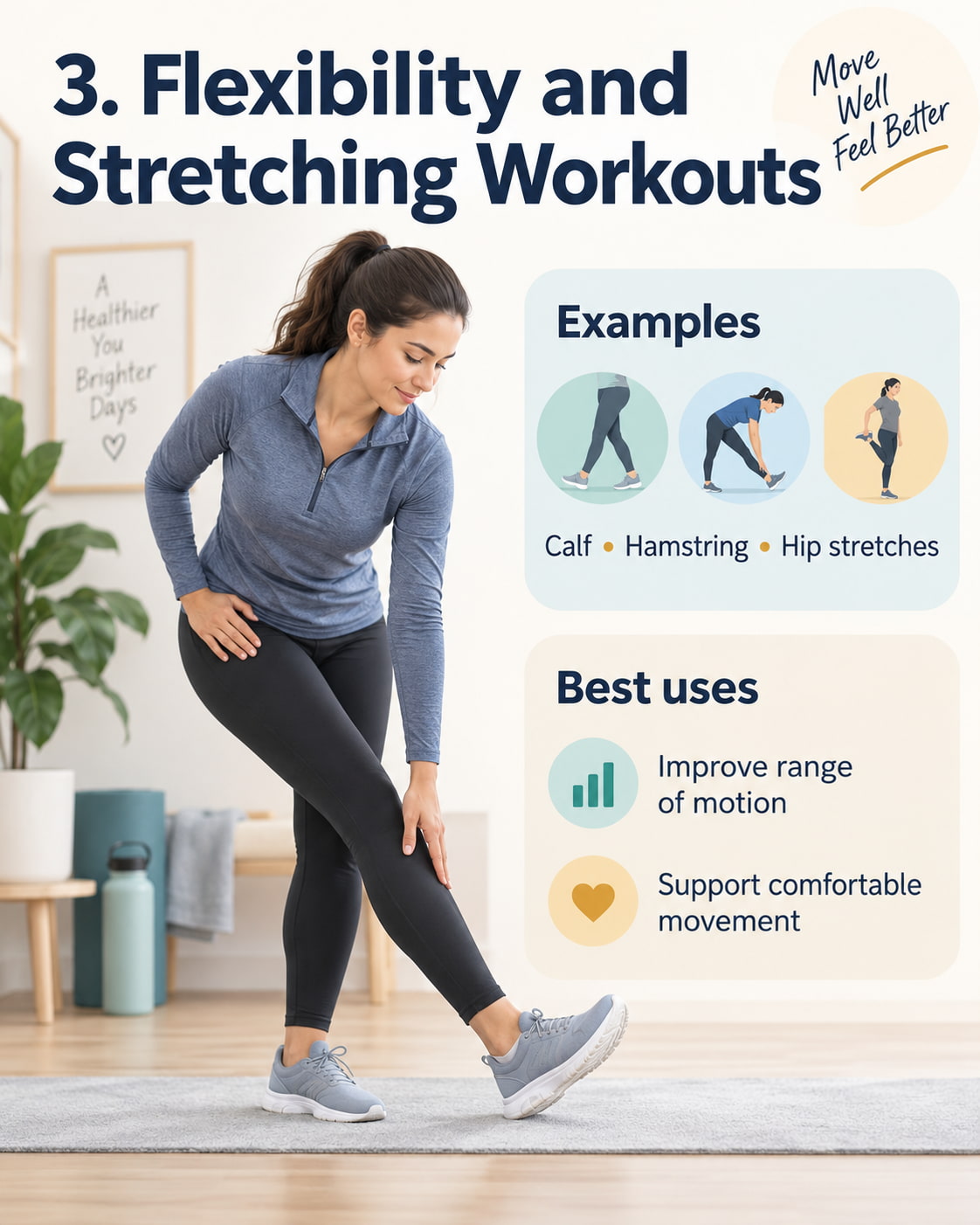
Flexibility work focuses on improving how far your joints can move comfortably. Stretching can help increase range of motion, but it should not be treated as a guarantee against injuries or post-workout soreness.
Examples: Calf stretches, hamstring stretches, hip stretches, and gentle chest stretches.
Best uses: Working on restricted flexibility and maintaining comfortable movement.
Follow Mayo Clinic’s stretching guidance: warm up with five to ten minutes of light activity, move smoothly without bouncing, and stretch to tension rather than pain.
For a warm-up before exercise, gradually rehearse the movements you are about to perform. Holding a few static stretches is not a complete warm-up by itself.
4. Balance Workouts
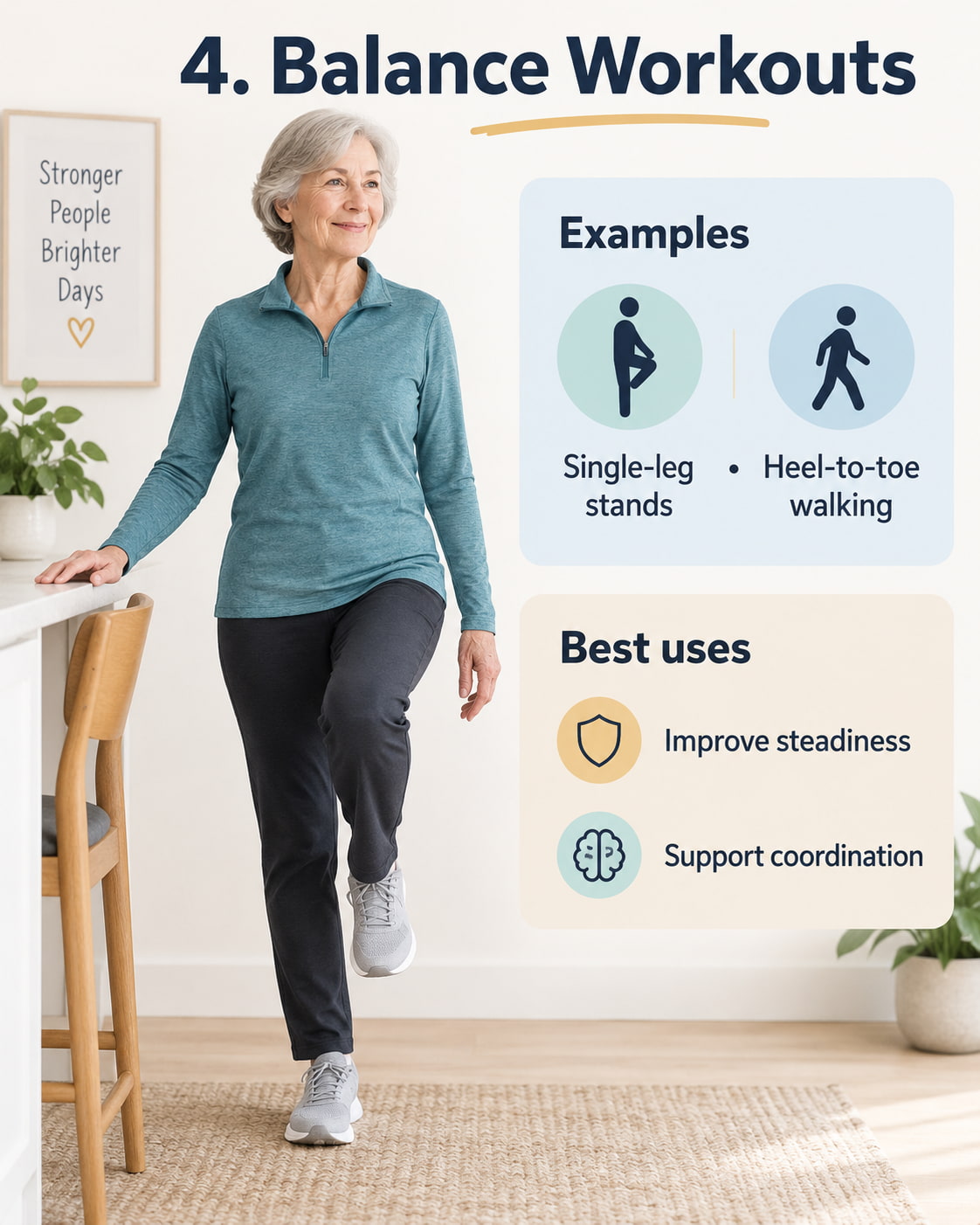
Balance exercises practice staying steady while standing or moving. They can support stability and coordination during activities such as changing direction or walking across uneven ground.
Examples: Supported single-leg stands, heel-to-toe walking, and tai chi.
Best uses: Improving steadiness and adding balance practice to an older adult’s routine.
The CDC recommends that adults 65 and older include balance activities each week, alongside aerobic and muscle-strengthening exercise.
Begin with support nearby rather than making the exercise unnecessarily difficult. A sturdy counter can provide a handhold. Trouble balancing or concerns about falling are reasons to seek individualized guidance before progressing.
5. High-Intensity Interval Training, or HIIT
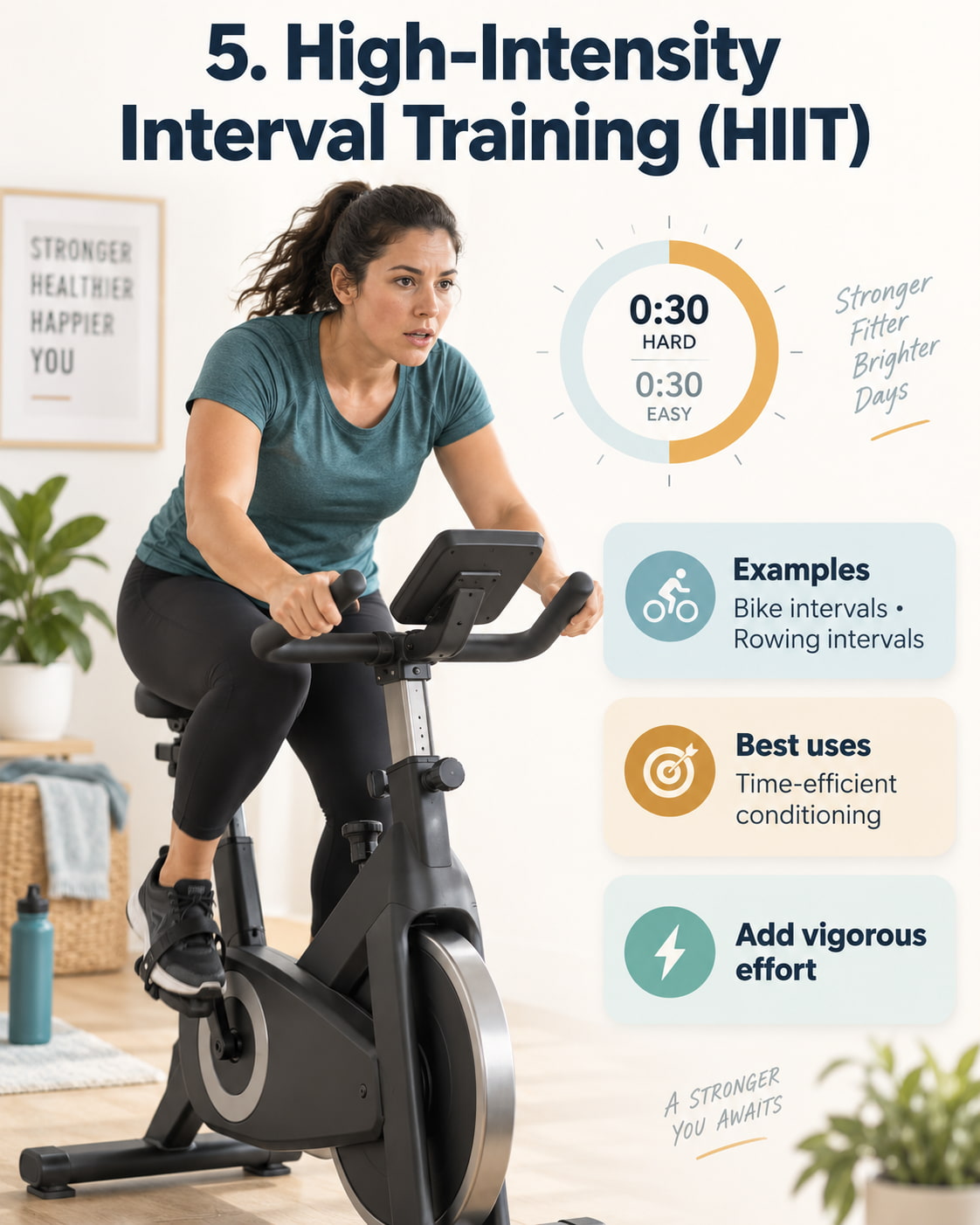
HIIT alternates vigorous efforts with periods of easier movement or rest. It can develop cardiovascular fitness in a time-efficient format, but it is not essential for good fitness or automatically better than steady-paced cardio.
Examples: Challenging cycling intervals followed by easy pedaling, or faster rowing intervals separated by gentler rowing.
Best uses: Adding vigorous conditioning when it suits your fitness, health, and preferences.
HIIT does not require jumping. A stationary bike can provide challenging intervals without repeated landings.
However, not every interval workout is HIIT. Alternating comfortable and moderately challenging efforts is still interval training. People who are inactive, recovering from injury, or managing medical conditions may need professional guidance before attempting high-intensity sessions.
6. Circuit Training
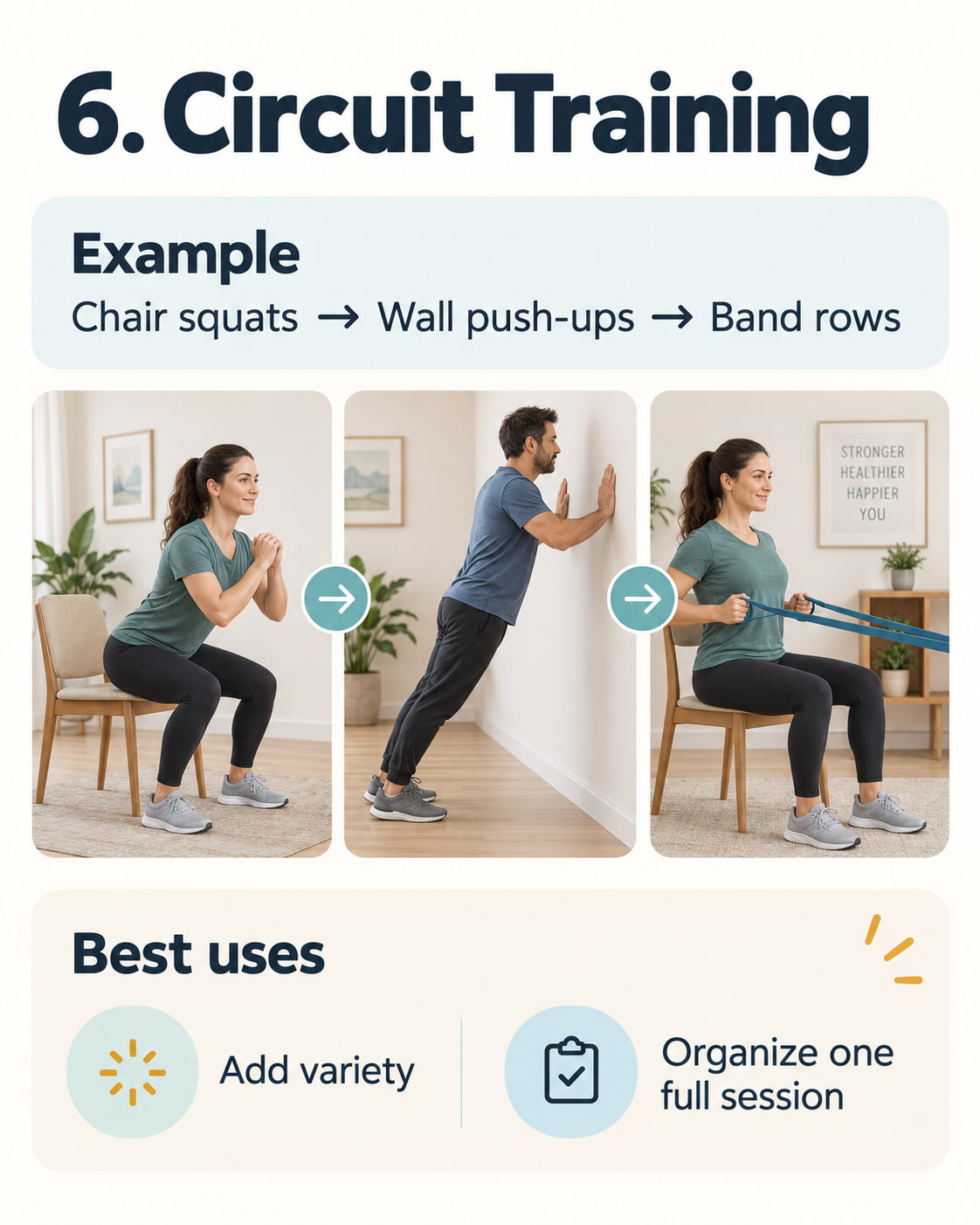
Circuit training organizes several exercises into a sequence. You complete one exercise, move to the next, and may repeat the sequence after finishing the round.
Example: Chair squats → wall push-ups → resistance-band rows → marching in place.
Best uses: Adding variety and organizing several exercises into one session.
Depending on the exercises, resistance, effort, and rest periods, a circuit can develop muscular fitness, cardiovascular fitness, or both. It can also be adapted for beginners.
A circuit is not automatically HIIT. Moving between stations describes the structure, not the intensity. Choose rest periods that let you maintain good technique rather than rushing to keep up with a timer.
7. Functional Training
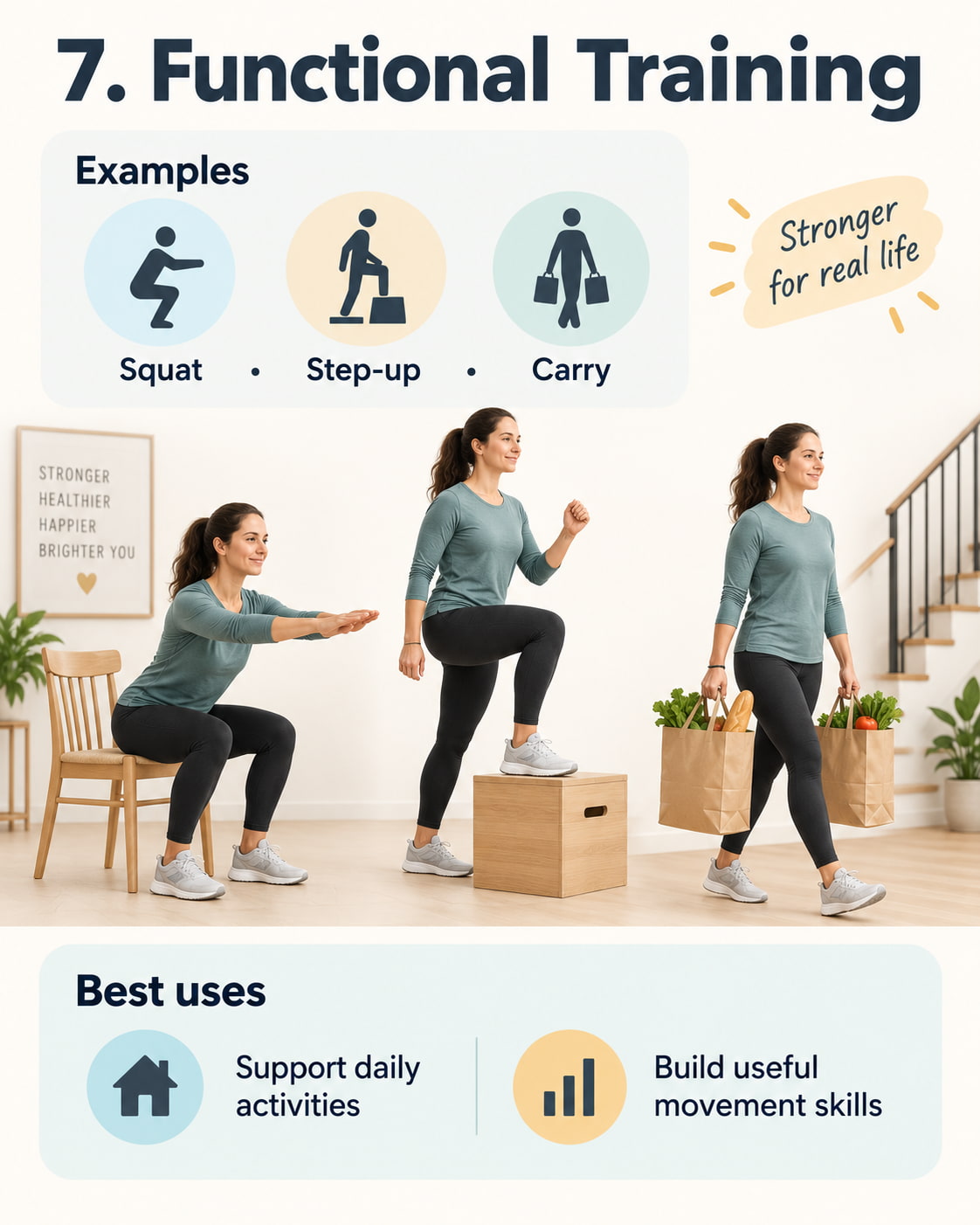
Functional training selects exercises based on the movements and tasks you need to perform. It often includes patterns such as squatting, hinging at the hips, lunging, pushing, pulling, and rotating.
Examples: Practicing a squat to support getting out of a chair, step-ups for stair climbing, or carrying weights to develop the capacity needed for moving loaded bags.
Best uses: Building strength and movement skills that relate to everyday activities, work, or recreational goals.
“Functional” is not a special property that only certain exercises possess. An exercise is useful when it matches your needs and abilities. A machine-based or single-joint exercise may also serve a practical purpose.
Focus on relevant movements and appropriate difficulty—not making an exercise look complicated.
8. Low-Impact Workouts
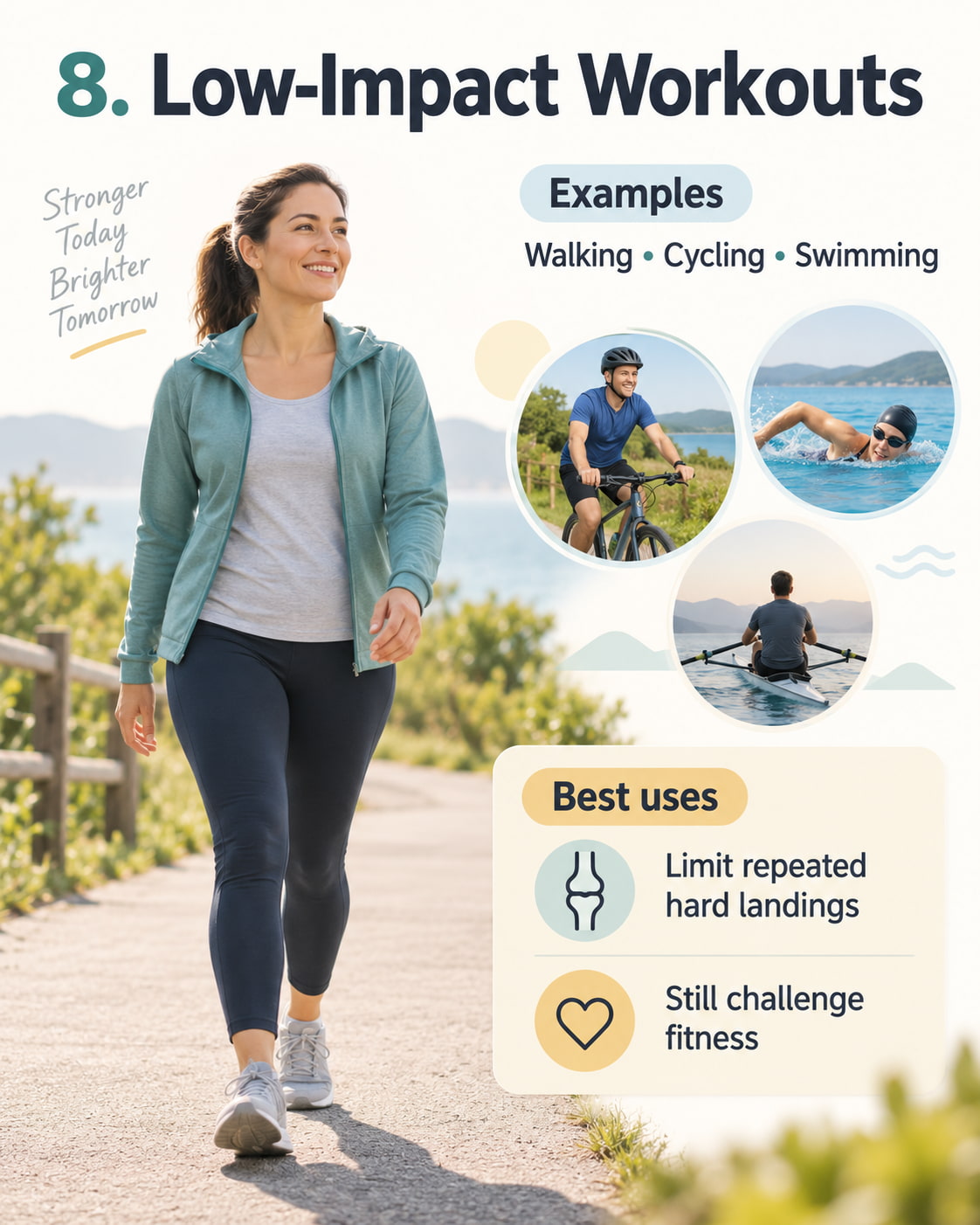
Low-impact exercise limits the repeated pounding associated with activities such as running and jumping. It can still challenge your heart, lungs, and muscles.
Examples: Walking, cycling, swimming, water aerobics, rowing, and many strength exercises.
Best uses: Choosing activities without repeated hard landings, including when you prefer alternatives to running or jumping.
Low-impact does not mean low-intensity. A demanding cycling session can feel much harder than a relaxed walk, even though both are low-impact options.
It also does not mean every exercise is suitable for every injury. Technique, resistance, range of motion, and your health still matter. Choose movements that feel appropriate, and get guidance when an injury, ongoing condition, or balance concern affects your options.
9. Yoga
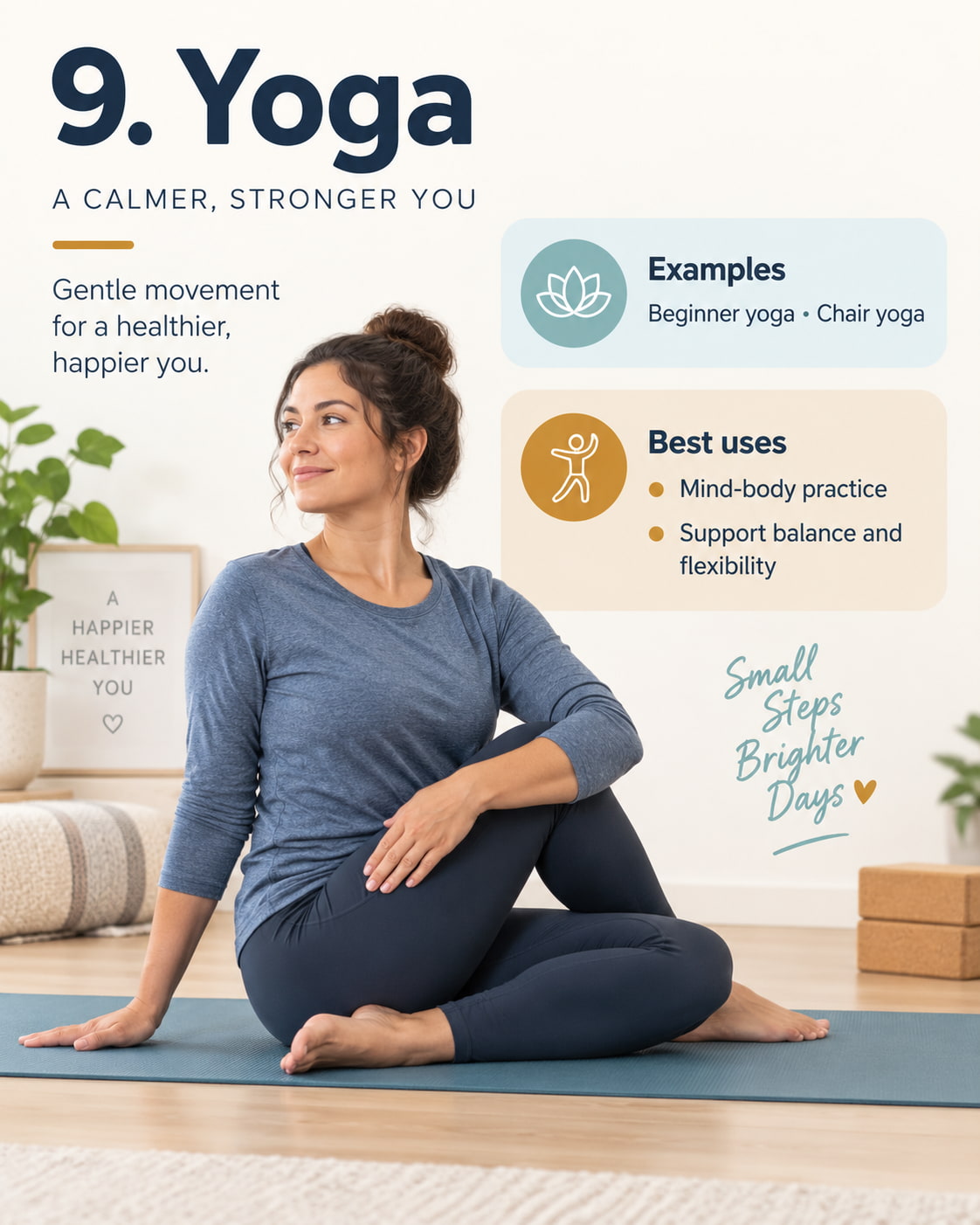
Yoga combines physical postures with breathing and other practices. Research suggests that it may support stress management, sleep, balance, and general well-being.
Examples: Beginner yoga classes, chair-based yoga, and gentle sessions using modified poses.
Best uses: Combining movement with a mind-body practice and working on balance and flexibility.
The National Center for Complementary and Integrative Health’s yoga guidance notes that injuries can occur and that qualified instruction matters. Beginners should avoid extreme practices such as headstands and forceful breathing.
Pregnancy, existing injuries, and certain health conditions may require modifications. Choose a class that matches your needs rather than assuming every yoga session is gentle or suitable for everyone.
10. Pilates
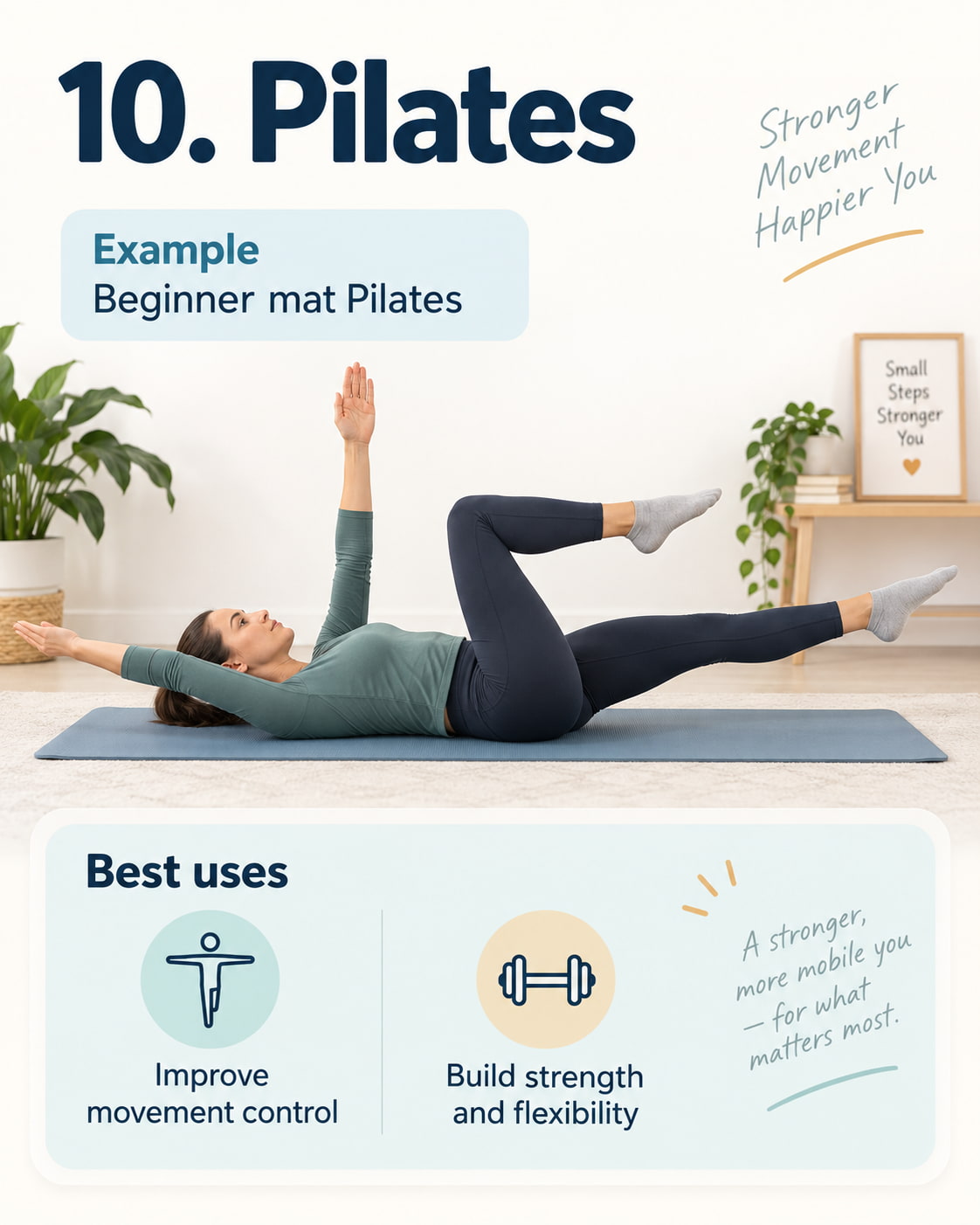
Pilates focuses on posture, balance, strength, and flexibility. Sessions commonly emphasize careful movement rather than completing repetitions as quickly as possible.
Example: An instructor-led beginner mat Pilates session.
Best uses: Practicing movement control and developing strength and flexibility within a structured class or routine.
The NHS offers beginner Pilates instruction and describes these areas as central to the practice. A mat-based session can be an accessible way to explore Pilates without committing to specialized equipment.
Choose instruction labeled for your experience level. General Pilates classes are not automatically appropriate for an injury or medical condition, and floor-based exercises are not necessarily easy simply because they use little equipment.
How to Choose the Right Types of Workouts
Start with a task-based goal rather than a workout trend. For example, you might aim to walk longer without stopping, lift your usual groceries more comfortably, or practice getting up from a chair with better control.
Then choose activities that directly support that goal. Aerobic exercise develops endurance, while resistance training develops strength. Balance and flexibility work address additional movement needs.
Next, consider the practical details: available time, equipment, location, and whether you enjoy the activity enough to repeat it. A routine you can maintain is more useful than an ambitious plan you regularly skip. You can adjust the challenge as your fitness improves.
How to Combine Different Types of Workouts
Use Weekly Activity Guidelines as Your Foundation
For substantial health benefits, federal activity guidance recommends that adults work toward:
- 150–300 minutes of moderate-intensity aerobic activity, or 75–150 minutes of vigorous activity, or an equivalent combination.
- Muscle-strengthening activity on at least two days each week, covering all major muscle groups.
The major muscle groups include your legs, hips, back, abdomen, chest, shoulders, and arms. These are weekly targets—not a requirement to exercise for a particular length of time each day.
Short sessions count. Federal guidelines do not require activity to last at least ten minutes to contribute toward the recommendations. Starting with smaller amounts and gradually building up is appropriate when the full target is currently out of reach.
Example of a Balanced Workout Week
The following is an illustrative schedule for someone who can already tolerate this amount of activity. It is not a starting prescription for every beginner.
| Day | Example activity |
|---|---|
| Monday | 30-minute brisk walk and a full-body strength session |
| Tuesday | 30 minutes of moderate-intensity cycling |
| Wednesday | Gentle flexibility and supported balance practice |
| Thursday | 30-minute brisk walk and a full-body strength session |
| Friday | Rest or comfortable, easy movement |
| Saturday | 30 minutes of moderate-intensity swimming or water aerobics |
| Sunday | 30-minute brisk walk |
This example provides 150 minutes of moderate aerobic activity and two strength sessions. The flexibility and balance practice adds variety without requiring another demanding workout.
You can adapt the format around your preferences. For instance, a strength session could use a circuit, and a suitable gentle yoga class could provide part of your flexibility and balance practice. The important question is what the session actually involves—not simply what it is called.
Workout Safety Tips
Increase your activity gradually rather than raising duration, intensity, and resistance all at once. Learn unfamiliar movements before making them harder, and adjust the plan when something does not feel right.
Seek individualized advice when health concerns, recent surgery, an injury, pregnancy, or significant balance difficulties make you uncertain about an activity’s suitability.
According to MedlinePlus’s exercise safety guidance, pain, dizziness, or extreme shortness of breath are reasons to stop exercising and seek help. Do not push through concerning symptoms to finish a workout.
Chest pressure or discomfort with possible heart-attack symptoms requires emergency attention. Call 911 in the United States when a heart attack may be occurring, even when you are unsure.
Frequently Asked Questions About Types of Workouts
What Are the Four Main Types of Exercise?
Four broad categories are aerobic exercise, strength training, balance exercise, and flexibility work. Popular workout styles often combine these purposes rather than fitting into only one category.
Which Types of Workouts Are Suitable for Beginners?
Walking, basic resistance training, and appropriately modified beginner classes are practical options. Start with a manageable amount, choose movements suited to your abilities, and build gradually. A “beginner” label does not replace checking whether a session suits you.
What Is the Difference Between HIIT and Circuit Training?
HIIT describes alternating high-effort periods with recovery. Circuit training describes moving through a sequence of exercises. A circuit can use a HIIT format, but it can also be performed at lower intensities.
Can Low-Impact Workouts Still Be Challenging?
Yes. Impact refers to pounding or landing forces, not how hard your cardiovascular system works. Cycling, swimming, and rowing can provide challenging sessions without repeated jumping or hard landings.
Which Types of Workouts Can You Do at Home?
Bodyweight or band-based strength training and beginner mat Pilates are home-based options. You do not need a gym for effective resistance training; suitable exercises and consistent effort matter more than the setting.
Do Yoga and Pilates Count as Cardio?
Not automatically. Some active yoga styles can reach moderate intensity, but a workout’s name does not establish its aerobic contribution. Judge the effort involved; a gentle session should not automatically replace your moderate- or vigorous-intensity activity.
Conclusion
Different types of workouts serve different purposes, and you do not need to master all of them. Use aerobic activity and strength training as your foundation, then choose additional formats that fit your goals, abilities, and preferences.
For your next step, choose one aerobic activity you enjoy and a manageable strength routine. Put them into your week, start at a realistic level, and build a pattern you can repeat.
References
- CDC: Adult Activity: An Overview, Measuring Physical Activity Intensity, and Older Adult Activity: An Overview.
- MedlinePlus: Exercise and Physical Fitness.
- American College of Sports Medicine: Updated Resistance Training Guidelines.
- Mayo Clinic: Stretching: Focus on Flexibility.