
The exact cause of skin tags is not fully understood, but skin friction may contribute. Age, family history, pregnancy, obesity, and insulin resistance are associated with a greater likelihood of developing them.
Most skin tags are harmless. Understanding their risk factors can help you avoid unnecessary worry and recognize when a growth needs attention. Confirming what a bump is and checking changes matter more than guessing its cause.
What Are Skin Tags?
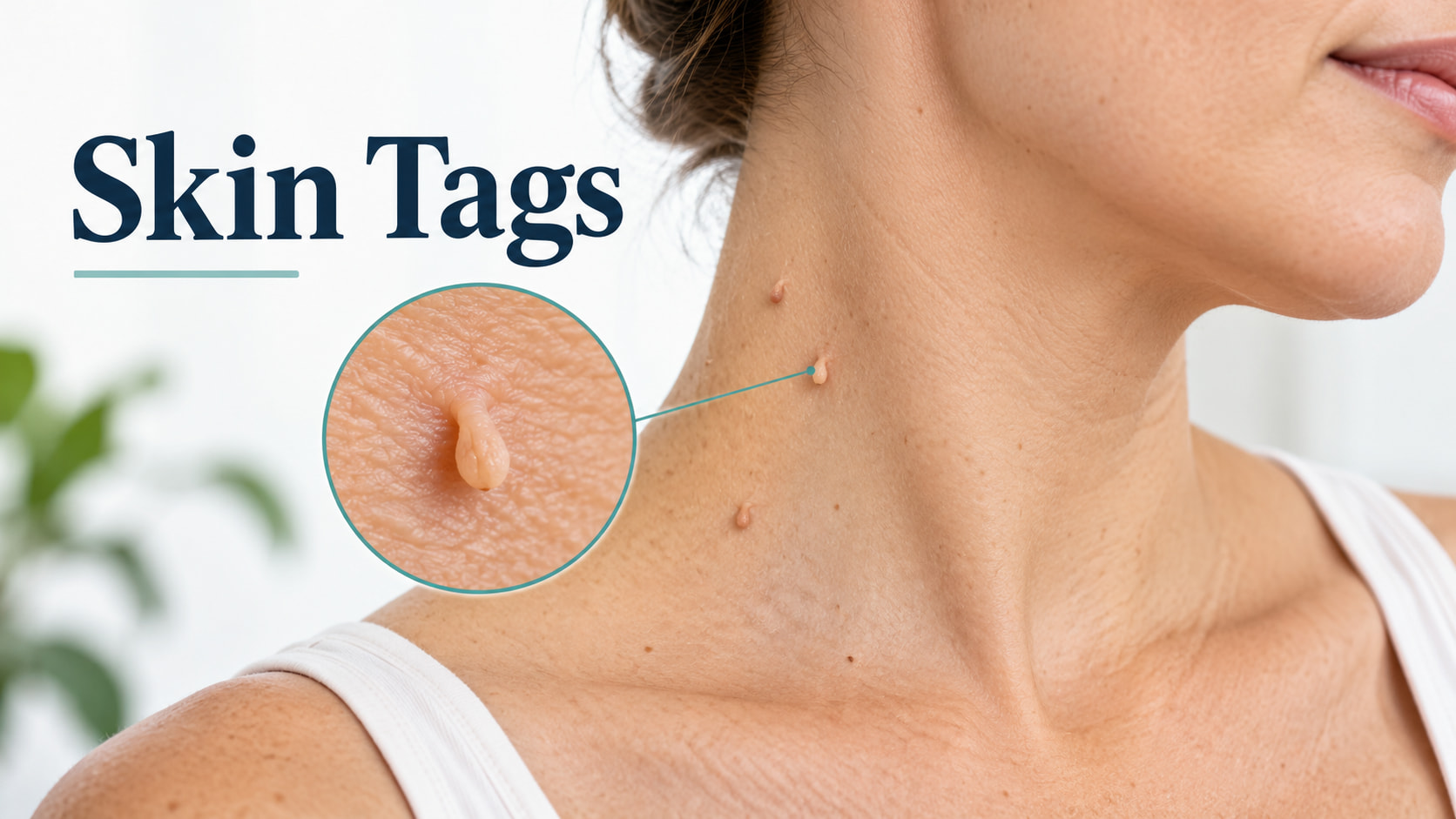
Skin tags, also called acrochordons, are soft growths that often hang from the skin by a small stalk. They may match your skin tone or look darker. Most are small and painless.
As DermNet explains, they contain collagen fibers and blood vessels covered by skin. Common locations include:
- Neck folds.
- Armpits.
- Eyelids.
- Groin folds.
- Under the breasts.
Their appearance can overlap with other skin growths. A description or photo cannot always confirm that a bump is a skin tag.
What Is the Cause of Skin Tags? Six Key Risk Factors
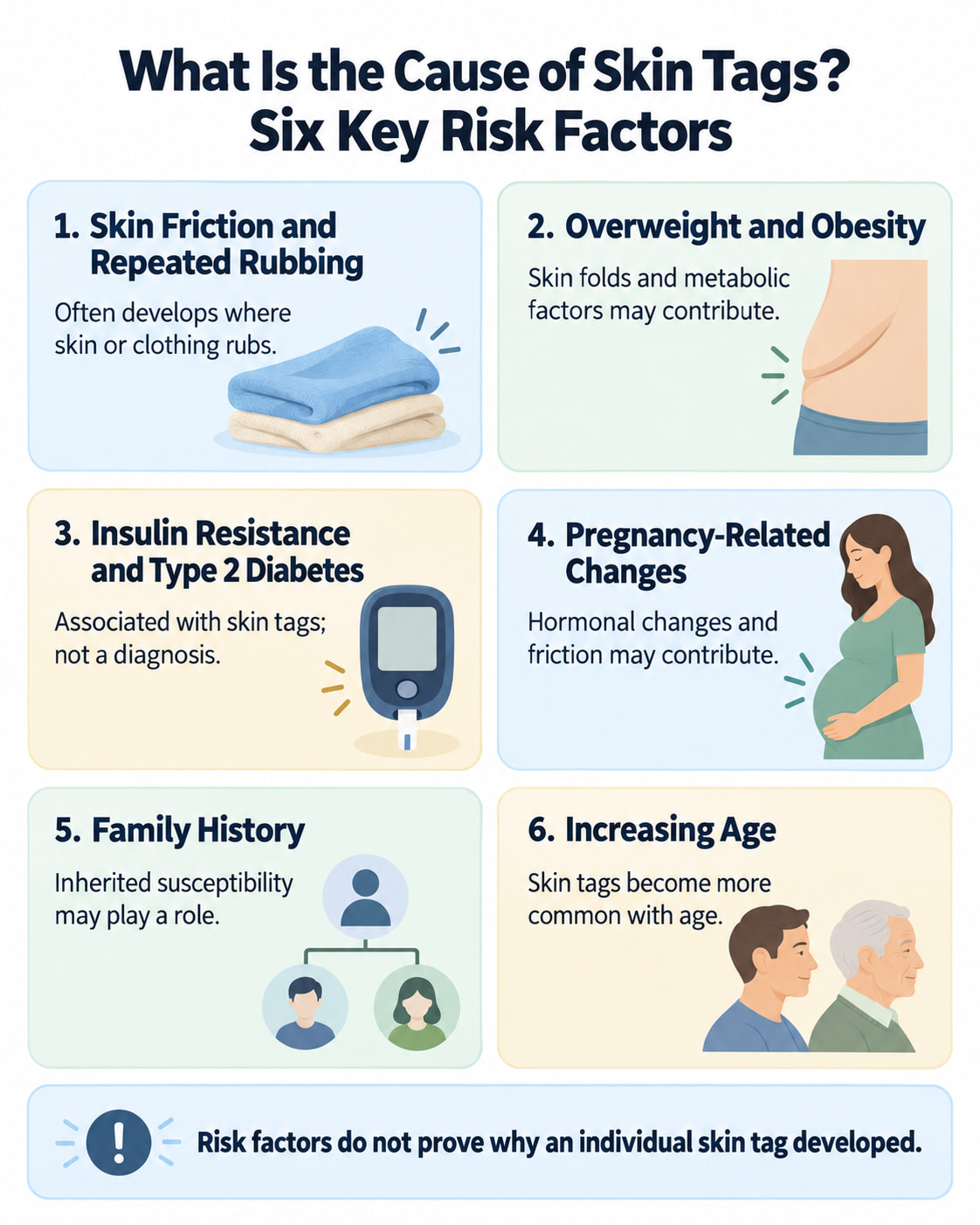
A risk factor makes a condition more likely; it does not prove why it developed in one person. The American Academy of Dermatology identifies several of the following factors.
1. Skin Friction and Repeated Rubbing
Skin tags often appear where skin surfaces touch or clothing and jewelry repeatedly rub. This pattern suggests that friction contributes to their development.
For example, a tag may appear in an armpit fold or near a collar. Rubbing can also irritate an existing tag.
2. Overweight and Obesity
People living with overweight or obesity are more likely to have skin tags. Additional skin folds can create more opportunities for rubbing, and metabolic factors may also contribute.
People at lower weights can develop skin tags, too.
3. Insulin Resistance and Type 2 Diabetes
Insulin resistance means the body responds less effectively to insulin, the hormone that helps regulate blood sugar. It has been associated with skin tags, particularly when several are present.
A 2025 comparative study reported that diabetes was more common among participants with skin tags than among those without them. The study compared 150 people in each group. It cannot establish cause and effect or predict an individual’s future diagnosis.
Skin tags alone do not diagnose insulin resistance or diabetes. If you have numerous tags, a clinician can consider your overall risk and whether blood sugar testing is appropriate.
4. Pregnancy-Related Changes
Skin tags may develop during pregnancy. Hormonal changes and growth signals are thought to contribute, alongside changes in skin folds and friction.
Some pregnancy-related tags may disappear after childbirth; others remain.
5. Family History
You may be more likely to develop skin tags if a parent, sibling, or another blood relative has them.
Inherited susceptibility may help explain their appearance when other obvious risk factors are absent.
6. Increasing Age
Skin tags become more common as people get older and occur in both men and women.
Younger people can develop them as well.
Can You Prevent Skin Tags?
There is no reliable way to prevent every skin tag. Changing one risk factor does not guarantee that new tags will stop appearing.
In guidance reviewed in March 2025, Healthdirect notes that maintaining a healthy weight may lower the likelihood of skin tags, while emphasizing that complete prevention is not possible.
For everyday comfort:
- Adjust clothing or jewelry that catches on an existing tag.
- Avoid picking at tags or nicking them while shaving.
- Discuss broader metabolic health concerns with your healthcare professional.
These measures do not remove existing growths.
When Should You Have a Skin Growth Checked?
Arrange an assessment if you are unsure what a growth is. Even a harmless-looking bump can resemble another condition.
The NHS advises seeking medical assessment for enlarging, painful, bleeding, or multiplying skin tags.
| What you notice | Practical next step |
|---|---|
| A growth that is getting larger, painful, or bleeding | Have a healthcare professional examine it. |
| Many new growths appearing over a short period | Ask for an assessment rather than assuming they are ordinary tags. |
| An eyelid growth affecting vision | Arrange an evaluation. |
| A bump you cannot confidently identify | Get it checked before considering removal. |
Skin tags usually do not need removal. If one causes problems, a clinician can explain options such as freezing, snipping, or an electrical procedure.
Avoid cutting, tying off, or burning a suspected tag yourself. Home removal can cause bleeding, infection, and scarring, and may remove a growth that needed proper identification first.
Frequently Asked Questions
Why Do Skin Tags Grow on the Neck and Armpits?
These areas contain skin folds and experience repeated rubbing. Friction may contribute, although age, inherited susceptibility, and metabolic factors can also be relevant.
Why Am I Suddenly Getting More Skin Tags?
There may be several explanations, including pregnancy or changes in weight. You cannot determine the reason from appearance alone. Have a sudden increase in growths checked to confirm what they are and whether further assessment is needed.
Do Skin Tags Always Mean You Have Diabetes?
No. Skin tags occur in people without diabetes. Although research links multiple tags with metabolic conditions, diagnosis requires an appropriate clinical assessment and testing.
Can Skin Tags Go Away on Their Own?
Sometimes. Some tags fall off, and some that develop during pregnancy may disappear afterward. Others persist. Do not pull or twist a tag to make it come off.
Are Skin Tags Cancerous?
Skin tags are benign growths. The concern is that another type of growth may be mistaken for one. Have an uncertain or changing lesion examined instead of relying on self-identification.
Do Skin Tags Come Back After Removal?
A completely removed tag usually does not return. However, other tags can develop because removing one growth does not eliminate the factors associated with forming new ones.
Conclusion
The cause of skin tags is usually not clear-cut. Friction and several personal or metabolic factors may contribute, but a tag alone cannot tell you why it appeared. If a growth changes, causes discomfort, or has not been identified, book an assessment before trying to remove it.
This content is for informational purposes only and not medical advice.