
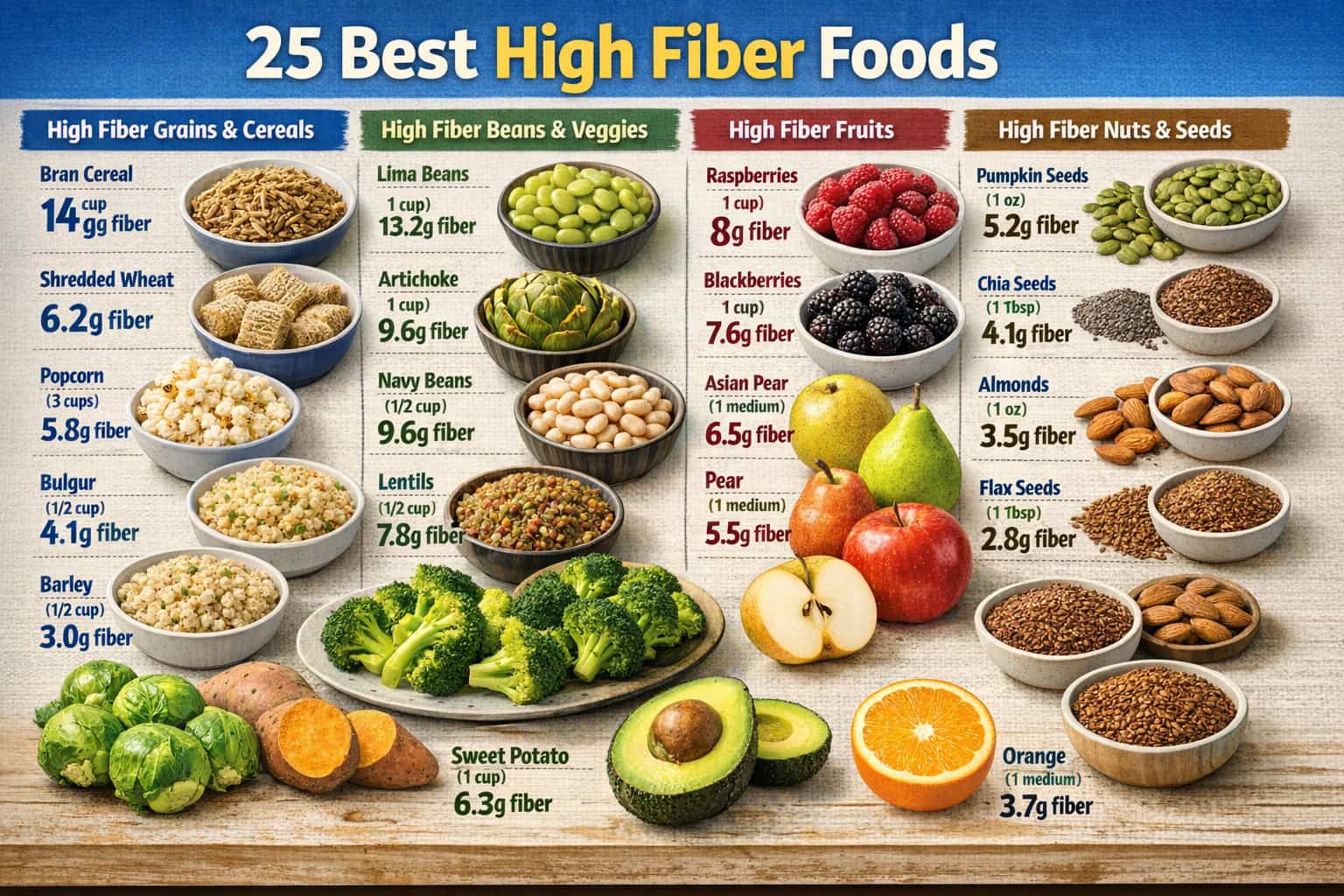
The best high fiber foods are beans, lentils, bran cereal, berries, pears, artichokes, popcorn, chia seeds, and whole grains because they deliver a lot of fiber in realistic portions. Adults generally need about 22 to 34 grams of fiber per day, and the Nutrition Facts label uses a Daily Value of 28 grams, so choosing fiber-rich foods consistently matters.
High fiber foods are worth understanding because fiber supports digestion, can help with regular bowel movements, may help you feel fuller for longer, and soluble fiber can help improve blood cholesterol levels as part of a heart-healthy eating pattern. This guide covers 25 of the best options, plus how to increase fiber without stomach discomfort.
Why high fiber foods matter
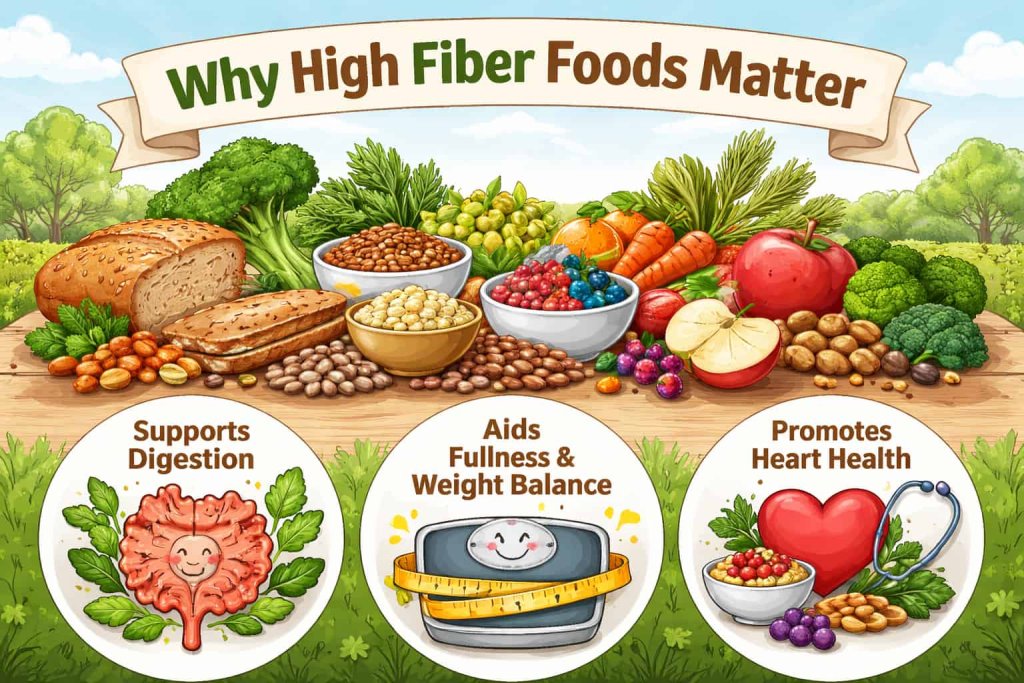
Fiber is the part of plant foods your body does not fully digest. There are two main types: soluble fiber, which attracts water and forms a gel-like texture during digestion, and insoluble fiber, which adds bulk and helps move food through the digestive tract. Soluble fiber is found in foods like barley, beans, lentils, nuts, seeds, and some fruits and vegetables, while insoluble fiber is common in whole grains, wheat bran, and many vegetables.
From a practical standpoint, fiber can help in three ways many readers care about most. It can support digestion and regularity, help with fullness and weight balance, and contribute to heart-healthy eating, especially when your fiber comes from minimally processed foods like beans, fruits, vegetables, nuts, seeds, and whole grains. According to NIH MedlinePlus guidance on dietary fiber, getting fiber from a variety of plant foods is a smart way to support overall health.
How much fiber do you need each day?
NIDDK says adults generally need about 22 to 34 grams of fiber a day, depending on age and sex. On packaged foods, the FDA Daily Value for dietary fiber is 28 grams on the Nutrition Facts label.
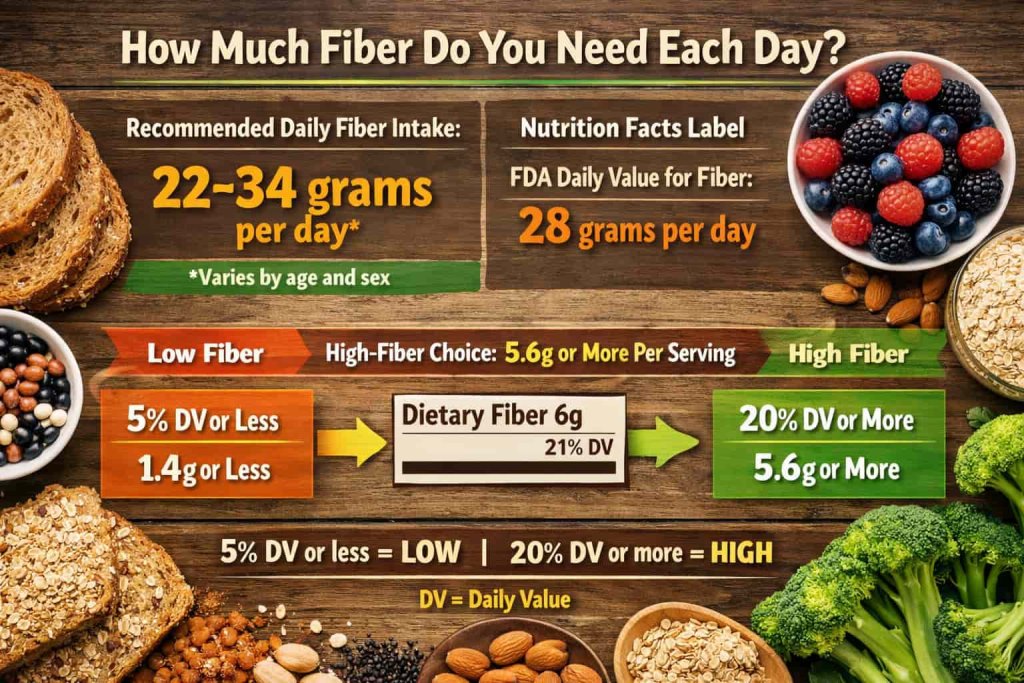
That label is useful when you shop. The FDA explains that 5% Daily Value or less is low and 20% Daily Value or more is high for a nutrient. For fiber, that means a packaged food with about 5.6 grams or more per serving counts as a high-fiber choice, based on the current 28-gram Daily Value.
One more label tip makes this easier in real life: check the serving size before you compare products. A cereal or snack can look high in fiber until you notice the serving is very small. When choosing between similar packaged foods, look for more fiber with less added sugar, sodium, and saturated fat.
25 best high fiber foods
The USDA Food Sources of Fiber handout lists fiber amounts using standard portions, which are reference amounts and not necessarily recommended serving sizes.
| Category | Food | Serving Size | Fiber |
|---|---|---|---|
| High fiber grains and cereals | High-fiber unsweetened bran cereal | 1/2 cup | 14.0 g |
| High fiber grains and cereals | Shredded wheat cereal | 1 cup | 6.2 g |
| High fiber grains and cereals | Popcorn | 3 cups | 5.8 g |
| High fiber grains and cereals | Bulgur, cooked | 1/2 cup | 4.1 g |
| High fiber grains and cereals | Barley, cooked | 1/2 cup | 3.0 g |
| High fiber beans and vegetables | Lima beans, cooked | 1 cup | 13.2 g |
| High fiber beans and vegetables | Artichoke, cooked | 1 cup | 9.6 g |
| High fiber beans and vegetables | Navy beans, cooked | 1/2 cup | 9.6 g |
| High fiber beans and vegetables | Lentils, cooked | 1/2 cup | 7.8 g |
| High fiber beans and vegetables | Black beans, cooked | 1/2 cup | 7.5 g |
| High fiber beans and vegetables | Brussels sprouts, cooked | 1 cup | 6.4 g |
| High fiber beans and vegetables | Chickpeas, cooked | 1/2 cup | 6.3 g |
| High fiber beans and vegetables | Sweet potato, cooked | 1 cup | 6.3 g |
| High fiber beans and vegetables | Broccoli, cooked | 1 cup | 5.2 g |
| High fiber beans and vegetables | Avocado | 1 cup | 5.0 g |
| High fiber fruits | Raspberries | 1 cup | 8.0 g |
| High fiber fruits | Blackberries | 1 cup | 7.6 g |
| High fiber fruits | Asian pear | 1 medium | 6.5 g |
| High fiber fruits | Pear | 1 medium | 5.5 g |
| High fiber fruits | Apple with skin | 1 medium | 4.8 g |
| High fiber fruits | Orange | 1 medium | 3.7 g |
| High fiber nuts and seeds | Pumpkin seeds | 1 ounce | 5.2 g |
| High fiber nuts and seeds | Chia seeds | 1 tablespoon | 4.1 g |
| High fiber nuts and seeds | Almonds | 1 ounce | 3.5 g |
| High fiber nuts and seeds | Flax seeds | 1 tablespoon | 2.8 g |
What 28 grams of fiber can look like in a day
You do not need huge portions or a perfect diet to hit the daily target. One simple example is 1 cup of shredded wheat at breakfast (6.2 grams) with 1 cup of raspberries (8 grams), 1/2 cup of lentils at lunch (7.8 grams), and 1 medium pear as a snack (5.5 grams). That adds up to about 27.5 grams of fiber, which is essentially a full day’s worth on the current Nutrition Facts label.
Best high fiber foods for digestion
For regularity, some of the most helpful choices are bran cereal, beans, lentils, berries, pears, broccoli, and sweet potatoes because they bring substantial fiber per serving. NIDDK also notes that drinking water and other liquids helps fiber work better, which is an easy point many people miss.
If constipation is your main concern, the best approach is usually not one “superfood.” It is a steady pattern of more beans, fruits, vegetables, and whole grains, plus enough fluids.
Best high fiber foods for fullness and weight balance
Foods that combine fiber with volume or slower digestion can make meals feel more satisfying. Good examples from this list include lentils, black beans, chickpeas, raspberries, pears, popcorn, chia seeds, and avocado. MedlinePlus notes that fiber adds bulk and can help you feel full faster, while the American Heart Association says fiber may promote fullness and support healthy weight management.
A simple rule works well here: build meals around fiber first. Try a bean-based lunch, fruit with skin as a snack, or popcorn instead of lower-fiber snack foods. That tends to be more practical than chasing one expensive “health food.”
Best high fiber foods for heart health
When heart health is the goal, focus especially on foods that provide soluble fiber, such as barley, beans, lentils, chickpeas, chia seeds, almonds, apples, pears, and oranges. MedlinePlus explains that some types of soluble fiber may help lower heart disease risk, and the American Heart Association notes that dietary fiber can help improve blood cholesterol levels.
That does not mean you need a perfect diet overnight. A more realistic strategy is to eat more meals built around whole grains, beans, fruits, vegetables, nuts, and seeds and fewer heavily refined foods with little fiber.
How to increase fiber without bloating
The biggest mistake is adding too much fiber too fast. NIDDK advises that for people prone to IBS symptoms, adding fiber slowly, by about 2 to 3 grams a day, may help prevent gas and bloating. MedlinePlus also notes that increasing fiber too quickly can cause gas, bloating, and cramps.
A better approach looks like this:
- Start with one higher-fiber swap a day, such as bran cereal instead of a low-fiber cereal.
- Add beans or lentils to one meal a few times a week.
- Keep fruit with skin and berries around for snacks.
- Drink more water and other liquids as your fiber intake rises.
Safety note: Check with a clinician before sharply increasing fiber if you have been told to follow a low-fiber diet, or if you have ongoing digestive symptoms. Seek medical care for constipation with blood in the stool, rectal bleeding, constant abdominal pain, vomiting, fever, inability to pass gas, or unexplained weight loss.
Who should be careful with more fiber
Some people should not increase fiber quickly without medical advice. That includes anyone who has been told to follow a low-fiber diet and people with conditions in which lower-fiber foods may be easier to tolerate, such as gastroparesis. People with IBS may also need a more individualized approach, because different diet changes help different people.
Easy ways to eat more high fiber foods
A practical shopping note
Fresh is not the only way to eat more fiber. Frozen, canned, and dried foods can all help. For beans and vegetables, choose no-salt-added or low-sodium versions when possible, and drain and rinse canned products to lower sodium.
At breakfast
Choose bran cereal or shredded wheat, then add berries or chia seeds.
At lunch
Add lentils, chickpeas, or black beans to soups, salads, wraps, or grain bowls.
At dinner
Swap a lower-fiber side for barley, bulgur, Brussels sprouts, broccoli, or sweet potato.
For snacks
Keep popcorn, pears, apples, oranges, almonds, or pumpkin seeds ready to go.
These small changes are usually easier to sustain than trying to overhaul everything at once.
FAQ about high fiber foods
What food is highest in fiber?
In the USDA standard-portion list, high-fiber unsweetened bran cereal is one of the highest options at 14 grams per 1/2 cup. Among produce and legumes, lima beans provide 13.2 grams per cup, while artichokes and navy beans each provide 9.6 grams in the listed portions.
How can I tell if a packaged food is high in fiber?
Use the % Daily Value on the Nutrition Facts label. The FDA says 20% Daily Value or more is high, and because the current Daily Value for fiber is 28 grams, that works out to about 5.6 grams of fiber per serving.
How do I add more fiber without stomach discomfort?
Increase it gradually, spread fiber across the day, and drink more fluids. NIDDK advises adding fiber slowly, and MedlinePlus notes that increasing it too quickly can lead to gas, bloating, and cramps.
Conclusion
High fiber foods do not have to be complicated. Start with a few proven basics like beans, berries, pears, bran cereal, popcorn, chia seeds, and whole grains, then build from there. Done consistently, those small upgrades can support digestion, make meals more satisfying, and strengthen an overall heart-healthy eating pattern.
References
- FDA — Daily Value on the Nutrition and Supplement Facts Labels
- FDA — The Lows and Highs of Percent Daily Value on the Label
- USDA / DietaryGuidelines.gov — Food Sources of Fiber: Standard Portions
- NIDDK — Treatment for Constipation
- NIDDK — Eating, Diet, & Nutrition for Constipation
- NIH MedlinePlus — Dietary Fiber
- NIH MedlinePlus — Soluble and Insoluble Fiber
- American Heart Association — Fiber Up