
Quad stretches for seniors can safely improve front-of-thigh flexibility and make everyday moves like standing up, climbing stairs, and walking feel easier when done gently and consistently. The key is using stable support, keeping the stretch pain-free, and holding it long enough to be effective.
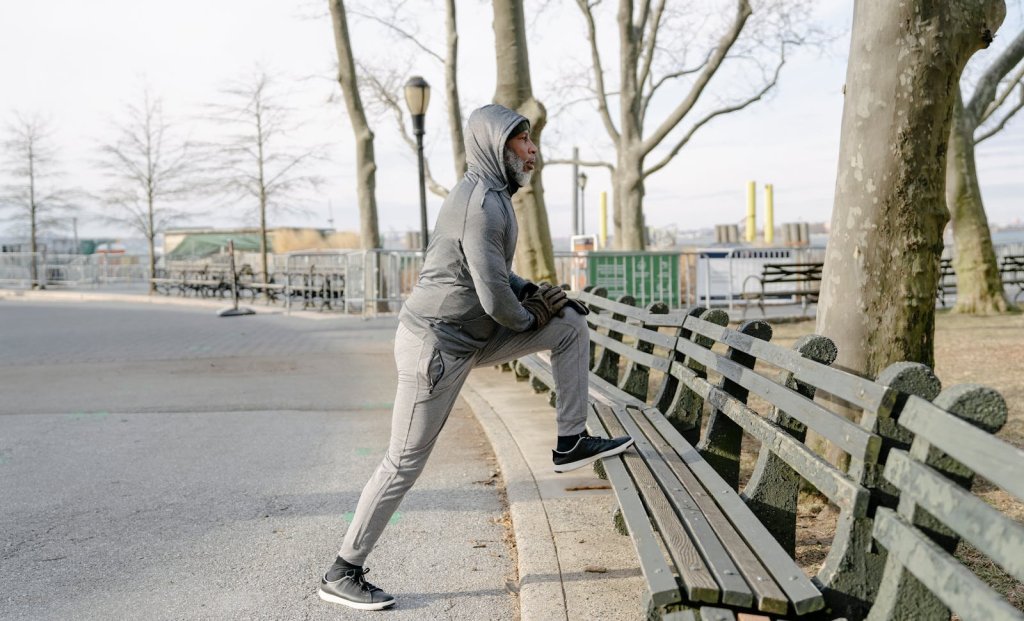
Most seniors do best with a simple routine: warm up for a few minutes, hold each stretch about 30 seconds, repeat 2–4 times per side, and avoid bouncing. That approach matches stretching guidance from the Mayo Clinic.
What Are Quad Stretches for Seniors?
Quad stretches for seniors are gentle flexibility exercises designed to lengthen the quadriceps muscles — the large muscles on the front of the thigh — in a safe, controlled way. These stretches help maintain comfortable knee movement and upright posture, both of which are essential for walking, standing up from a chair, and climbing stairs.
For older adults, quad stretches are typically:
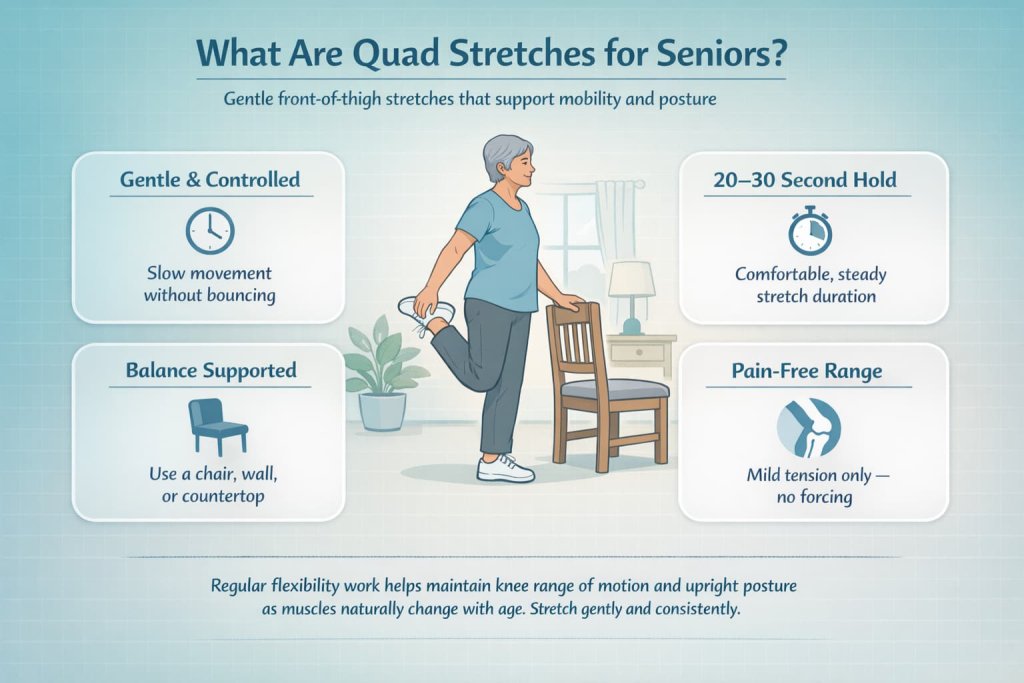
- Performed slowly without bouncing
- Held for about 20–30 seconds
- Done with balance support (chair, wall, or countertop) when standing
- Kept within a pain-free range
Because muscle elasticity naturally changes with age, flexibility work becomes more important over time. According to the Mayo Clinic, stretching helps maintain range of motion and supports overall movement quality when performed regularly and safely.
Why Quad Flexibility Matters for Mobility and Stiffness
Tight quadriceps can limit how comfortably the knee bends and straightens. When flexibility decreases, everyday movements may feel more effortful — especially standing from a seated position, stepping up stairs, or walking for longer periods.
Improving quad flexibility may help:
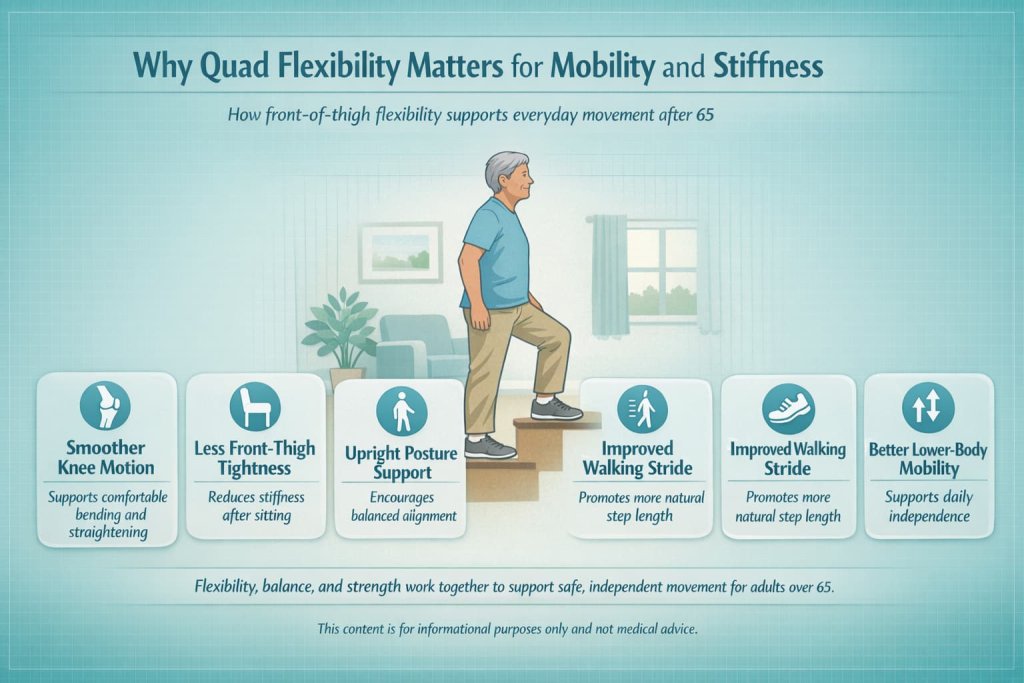
- Support smoother knee motion
- Reduce feelings of front-thigh tightness after sitting
- Promote more upright posture
- Improve stride length during walking
- Support overall lower-body mobility
Maintaining flexibility is particularly important for adults over 65. The Centers for Disease Control and Prevention (CDC) recommends that older adults include flexibility, balance, and strength activities in their weekly routine to support safe and independent movement.
Gentle quad stretching does not replace strengthening exercises, but when combined with strength and balance work, it can contribute to improved movement confidence and reduced stiffness over time.
5 best quad stretches for seniors
Use these in the order shown (easier to harder). Do them 2–3 days per week, or more often if they feel good and stay pain-free.
1) Chair-Supported Standing Quad Stretch
This is the classic quad stretch, made safer with balance support.
How to do it:
- Stand next to a sturdy chair or countertop and hold it with one hand
- Bend one knee and bring your heel toward your glutes
- Hold your ankle with your free hand (or loop a towel/strap around your ankle if reaching is difficult)
- Keep your knees close together and point the bent knee down toward the floor
- Gently tuck your pelvis (think “zip up” your lower belly”) to increase the stretch
- Hold for 20–30 seconds, then switch sides
Why it works:
This stretch directly lengthens the quadriceps while maintaining an upright posture. The added chair support improves stability and reduces fall risk, making it especially appropriate for seniors who want balance assistance.
Muscles worked:
Primarily the quadriceps (rectus femoris, vastus lateralis, vastus medialis, vastus intermedius). With a slight pelvic tuck, you may also feel a stretch in the hip flexors.
Trainer Tip:
Keep your standing knee softly bent rather than locked, and avoid arching your lower back. Focus on keeping your ribs stacked over your hips and your bent knee pointing toward the floor for better alignment and a more effective stretch.
2) Side-Lying Quad Stretch (Bed-Friendly)
Great if standing balance is limited.
How to do it:
- Lie on your side on a bed or firm couch
- Bend your top knee and bring your heel toward your glutes
- Hold your ankle, or use a strap/towel around your ankle to assist
- Keep your hips stacked and avoid rolling backward
- Gently move the thigh slightly behind you to deepen the stretch
- Hold for 20–30 seconds, then switch sides
Why it works:
Side-lying removes balance demands and allows you to focus fully on controlled knee bending. It also reduces strain on the lower back compared to unsupported standing versions.
Muscles worked:
Quadriceps, especially rectus femoris (the portion that crosses both the hip and knee).
Trainer Tip:
If your lower back begins to arch, reduce how far you pull your heel in and gently brace your abdominal muscles to maintain a neutral spine.
3) Prone Quad Stretch With Strap (Front-of-Hip Focus)
This adds a stronger stretch for the quad and hip area but should only be done if comfortable for your back and knees.
How to do it:
- Lie on your stomach on a bed or mat
- Loop a strap or towel around one ankle
- Bend that knee and gently pull the strap to bring your heel toward your glutes
- Keep your hips level and pressed into the surface
- Hold for 20–30 seconds, then switch sides
Why it works:
Lying face down limits compensation through the lower back and increases stretch intensity along the front of the thigh and hip, especially when the pelvis stays neutral.
Muscles worked:
Quadriceps and hip flexors, depending on pelvic position and how far the knee bends.
Trainer Tip:
If you feel pressure in the knee joint, slightly reduce the bend angle and focus on a gentle, steady pull rather than forcing range.
4) Supported Step-Back Lunge Stretch (Quad and Hip Flexor)
This is a functional stretch that reinforces posture and balance.
How to do it:
- Stand facing a chair or counter and hold it with both hands
- Step one foot back into a short split stance
- Bend the front knee slightly while keeping your torso upright
- Gently tuck your pelvis and shift your weight forward
- Keep the back heel lifted and the back knee softly bent or straight based on comfort
- Hold for 20–30 seconds, then switch sides
Why it works:
This stretch lengthens the front of the back leg while integrating balance and upright posture. It mimics functional movement patterns used in walking and stair climbing.
Muscles worked:
Rectus femoris (quadriceps), hip flexors, and possibly the calf depending on stance depth.
Trainer Tip:
Take a small step back rather than a long stride. If you feel the stretch in your lower back instead of your thigh, reset your posture and gently tuck your pelvis again.
5) Standing Quad Stretch With Strap (No Ankle Grab Needed)
Best if shoulder mobility limits reaching behind you.
How to do it:
- Stand beside a chair or countertop for support
- Loop a strap or towel around your ankle or the top of your foot
- Bend your knee and use the strap to guide your heel toward your glutes
- Keep your knees close and the bent knee pointing downward
- Hold for 20–30 seconds, then switch sides
Why it works:
This variation provides the same quadriceps stretch as the classic version while reducing strain on the shoulder and wrist. It allows better posture control and improved comfort for seniors with limited upper-body mobility.
Muscles worked:
Quadriceps primarily, with optional hip-flexor stretch when maintaining a gentle pelvic tuck.
Trainer Tip:
Use a longer strap or towel so your hand stays closer to waist height. This reduces shoulder stress and helps you maintain an upright, stable posture.
How often should seniors do quad stretches
A practical schedule that fits most seniors:
- 2–3 days per week as a minimum (after a warm-up or after walking)
- Daily is fine if the stretches remain easy and pain-free
For overall healthy aging, flexibility pairs best with regular aerobic activity, strength training, and balance work, as recommended by the Centers for Disease Control and Prevention (CDC).
What are the quadriceps and why do they get tight with age
Your quadriceps are the large muscles on the front of your thigh. They help straighten the knee and support walking, stair climbing, and getting up from a chair.
In older adults, quads may feel tighter due to:
- More time spent sitting
- Less frequent full knee bending
- Age-related changes in muscle elasticity
- Weak glutes and hip muscles, which can alter walking mechanics
Safety rules for quad stretches for seniors
Follow these guidelines to keep stretching comfortable and effective:
- Warm up 5–10 minutes (easy walking in place or gentle marching) before stretching, as recommended by the Mayo Clinic.
- Stretch slowly until you feel a mild pull, not pain, consistent with safety advice from the Mayo Clinic.
- Hold about 30 seconds (up to 60 seconds for very tight areas), and repeat 2–4 times per side.
- Use a chair, counter, or wall for balance on standing stretches.
- Stop and get medical guidance if you have sharp knee pain, recent surgery, or symptoms that worsen over time.
Common mistakes that make quad stretching less effective
- Bouncing into the stretch instead of holding steady, which the Mayo Clinic advises against
- Letting the knee flare outward on standing stretches (reduces the intended quad stretch)
- Arching the low back to “get more stretch”
- Pulling hard enough to create knee pain
When to seek professional guidance
Talk with a clinician or physical therapist before stretching if you have:
- Recent knee or hip surgery or joint replacement
- Severe osteoarthritis flare-ups
- Unexplained swelling, warmth, or giving-way sensations
- Pain that is sharp, worsening, or radiates down the leg
FAQs
What is the safest quad stretch for seniors?
The chair-supported standing quad stretch is often safest because you can hold stable support while controlling the stretch intensity.
How long should seniors hold a quad stretch?
About 30 seconds per stretch, repeated 2–4 times per side, is consistent with general stretching recommendations from the Mayo Clinic.
Should quad stretches hurt?
No. You should feel mild tension, not pain. If it hurts, ease off.
Can tight quads affect the knees?
Tightness in the thigh muscles can influence how forces move through the knee during daily activity. Gentle stretching may support comfort and mobility, but persistent knee pain should be evaluated.
Is it better to stretch before or after walking?
Stretching is generally most effective after a light warm-up or after activity, when muscles are already warm.
How many days a week should older adults stretch?
Many general guidelines suggest stretching major muscle groups 2–3 days per week or more if comfortable.
What if I can’t reach my ankle for the standing quad stretch?
Use a strap or towel to guide your heel toward your glutes without forcing your shoulder to reach behind you.
Conclusion
Quad stretches for seniors work best when they’re gentle, supported, and consistent. Pick 2–3 stretches from this list, do them after a short warm-up, and aim for steady progress instead of intensity. Over time, this simple habit can support easier movement and daily independence.
References
- World Health Organization (WHO) – Physical Activity and Sedentary Behaviour Guidelines (2020)
- National Institute on Aging – Exercise and Physical Activity
- NHS inform – Exercises for Thigh Problems
- My Health Alberta – Quadriceps Stretch (Standing)
- PubMed – Bandy et al. (1997): Time and Frequency of Static Stretching on Flexibility