
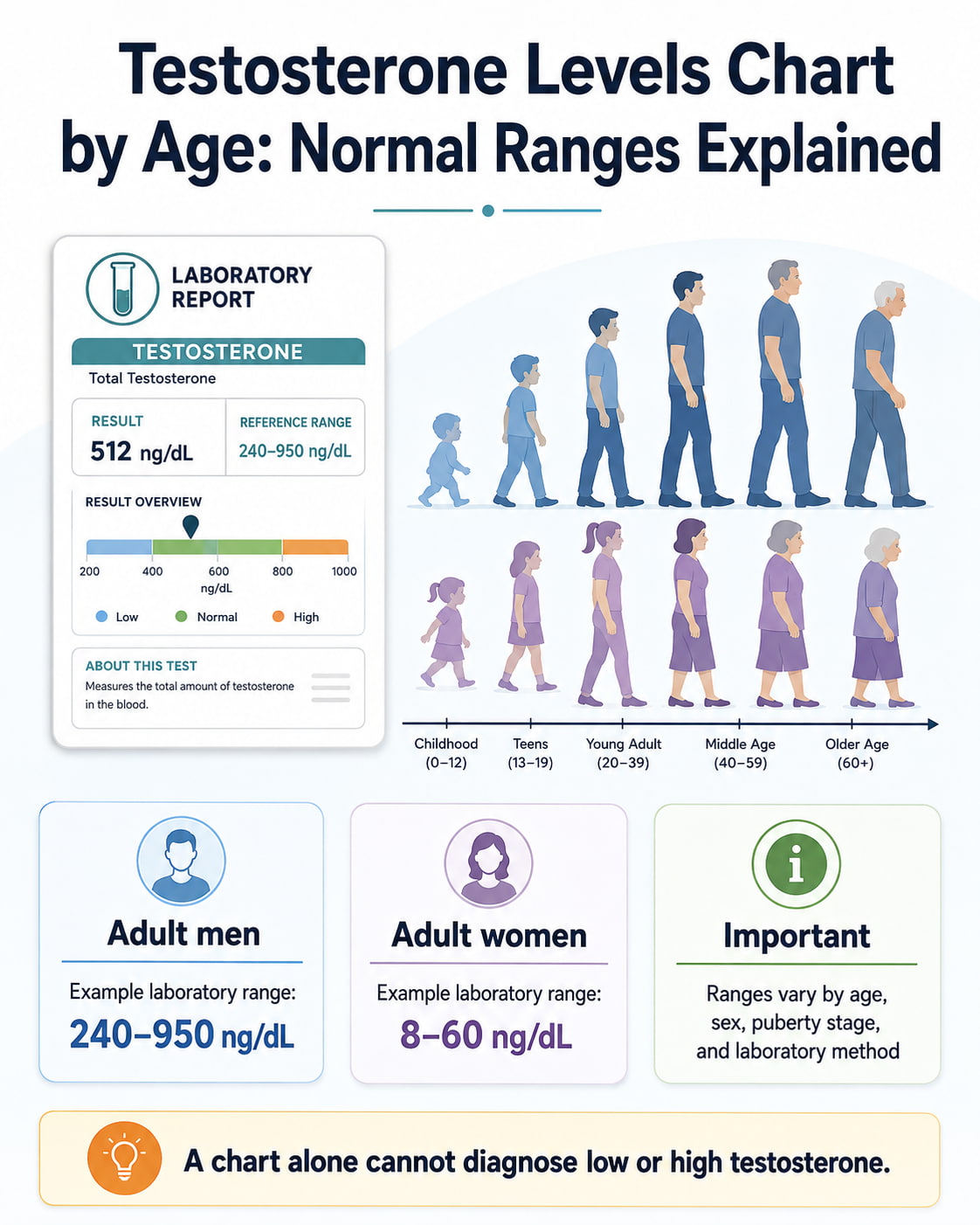
Normal testosterone levels vary by age, sex, puberty stage, testing time, and laboratory method. For adult men, many laboratories use a total testosterone range of approximately 240–950 ng/dL, but a result outside this range does not confirm a hormone disorder by itself.
A testosterone levels chart by age can help you understand your report. However, doctors also consider symptoms, repeat morning measurements, medications, health conditions, and the laboratory’s own reference range. Current guidance recommends diagnosing testosterone deficiency only when compatible symptoms occur with consistently low results.
Testosterone Levels Chart by Age
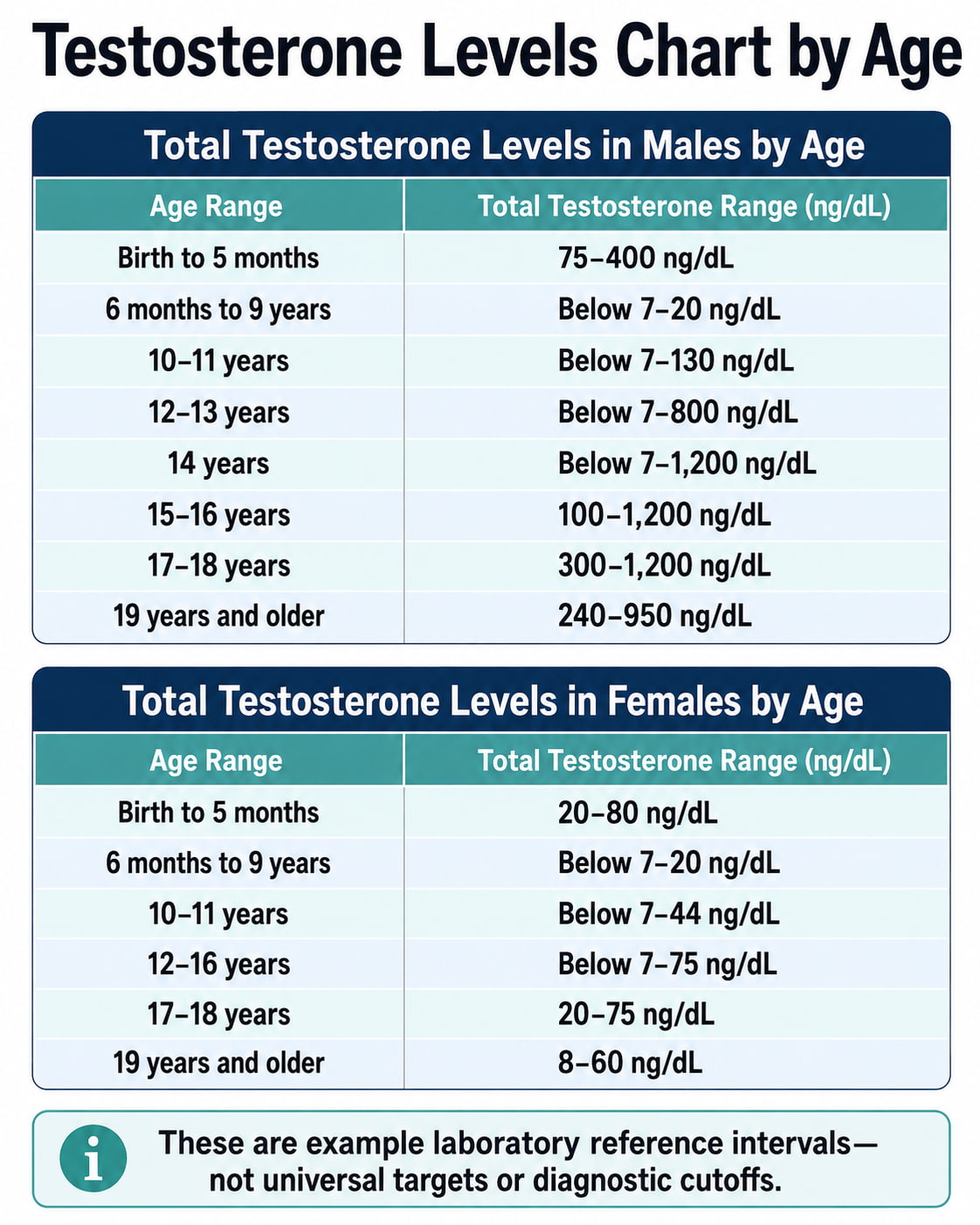
The following charts show example total testosterone reference intervals from Mayo Clinic Laboratories. Mayo uses liquid chromatography-tandem mass spectrometry, or LC-MS/MS, for this test.
These numbers are educational examples—not universal targets or diagnostic cutoffs. Always compare your result with the reference interval printed on your laboratory report.
Total Testosterone Levels in Males by Age
| Age | Example total testosterone range |
|---|---|
| Birth to 5 months | 75–400 ng/dL |
| 6 months to 9 years | Below 7–20 ng/dL |
| 10–11 years | Below 7–130 ng/dL |
| 12–13 years | Below 7–800 ng/dL |
| 14 years | Below 7–1,200 ng/dL |
| 15–16 years | 100–1,200 ng/dL |
| 17–18 years | 300–1,200 ng/dL |
| 19 years and older | 240–950 ng/dL |
The adult range of 240–950 ng/dL equals approximately 8.3–33.0 nmol/L.
The wide ranges during adolescence reflect differences in when puberty starts and how quickly it progresses. Two boys of the same age may have very different testosterone levels while both are developing normally.
Total Testosterone Levels in Females by Age
| Age | Example total testosterone range |
|---|---|
| Birth to 5 months | 20–80 ng/dL |
| 6 months to 9 years | Below 7–20 ng/dL |
| 10–11 years | Below 7–44 ng/dL |
| 12–16 years | Below 7–75 ng/dL |
| 17–18 years | 20–75 ng/dL |
| 19 years and older | 8–60 ng/dL |
The adult female range of 8–60 ng/dL equals approximately 0.28–2.08 nmol/L.
Women naturally have much lower testosterone concentrations than men. Hormonal contraception, menstrual status, menopause, pregnancy, ovarian or adrenal conditions, and the testing method can affect the result.
Testosterone Levels by Puberty Stage
For children and teenagers, puberty stage may provide better context than chronological age. Doctors commonly use Tanner stages to describe physical development during puberty.
Male Testosterone Levels by Tanner Stage
| Tanner stage | Example total testosterone range |
|---|---|
| Stage I: prepubertal | Below 7–20 ng/dL |
| Stage II | 8–66 ng/dL |
| Stage III | 26–800 ng/dL |
| Stage IV | 85–1,200 ng/dL |
| Stage V: young adult | 300–950 ng/dL |
Female Testosterone Levels by Tanner Stage
| Tanner stage | Example total testosterone range |
|---|---|
| Stage I: prepubertal | Below 7–20 ng/dL |
| Stage II | Below 7–47 ng/dL |
| Stage III | 17–75 ng/dL |
| Stage IV | 20–75 ng/dL |
| Stage V: young adult | 12–60 ng/dL |
Puberty does not begin at one exact age. Because Tanner stages can overlap substantially, a pediatric result should be interpreted with physical development, growth pattern, symptoms, and other hormone tests.
What Is a Normal Testosterone Level for Adult Men?
There is no single ideal testosterone number for every adult man.
One large harmonization study established a reference interval of 264–916 ng/dL, or approximately 9.2–31.8 nmol/L, among healthy, nonobese men ages 19–39. The researchers standardized results across several major studies to reduce differences caused by laboratory testing methods.
This research range does not mean that every man must stay within 264–916 ng/dL. It applies most directly when a laboratory uses an assay standardized against the same reference method.
Another laboratory may report an adult range such as 240–950 ng/dL, 250–1,000 ng/dL, or something similar. The correct comparison range is normally the one provided by the laboratory that analyzed your sample.
Is There a Normal Testosterone Range for Each Decade?
Average testosterone levels tend to be higher during early adulthood and may gradually decrease with age. However, there is substantial overlap between age groups.
A healthy man in his 60s may have a higher result than a man in his 30s who has obesity, severe sleep disruption, a chronic illness, significant calorie restriction, or medication-related hormone suppression.
For that reason, major US guidelines do not assign a separate diagnostic cutoff for every decade. A result should not automatically be dismissed as “normal for age” when a person has relevant symptoms, and an older adult should not receive testosterone therapy simply because his level is lower than that of an average young man.
When Is Testosterone Considered Low?
The American Urological Association considers a total testosterone level below 300 ng/dL, or approximately 10.4 nmol/L, a reasonable cutoff supporting a diagnosis of low testosterone.
However, the AUA Testosterone Deficiency Guideline does not recommend diagnosing testosterone deficiency from this number alone. The person must also have relevant symptoms or signs, and the low result should be confirmed with a second early-morning measurement on another day.
The Endocrine Society cites approximately 264 ng/dL as the lower limit from harmonized research involving healthy young men when testing uses an appropriately standardized assay. Its testosterone therapy guideline similarly requires symptoms plus consistently and unequivocally low testosterone.
Low Testosterone Thresholds at a Glance
| Source | Testosterone level | How to interpret it |
|---|---|---|
| AUA clinical cutoff | Below 300 ng/dL | Supports diagnosis when symptoms and repeat low testing are present |
| Harmonized research lower limit | Approximately 264 ng/dL | Lower reference limit for healthy, nonobese men ages 19–39 using standardized assays |
| Individual laboratory range | Varies | Primary range to use when reading a specific test report |
A result between approximately 264 and 300 ng/dL is often considered borderline. A clinician may review free testosterone, sex hormone-binding globulin, symptoms, body weight, medications, and other hormone tests before deciding what the result means.
What Is a Good Testosterone Level for Your Age?
A “good” testosterone level is not necessarily a particular number in the middle or upper end of a chart.
A useful result is one that:
- Was measured accurately
- Was collected at an appropriate time
- Falls within the laboratory’s validated range
- Matches the person’s symptoms and health history
- Remains reasonably consistent when repeated
For example, a total testosterone level of 350 ng/dL may be normal for one man but require further evaluation in another man with persistent sexual symptoms, reduced morning erections, unexplained anemia, infertility, or low bone density.
Conversely, fatigue alone does not prove low testosterone. Fatigue can also occur with sleep disorders, depression, anemia, thyroid disease, medication effects, calorie restriction, chronic illness, and many other conditions.
How Doctors Test for Low Testosterone
A single random testosterone test should not normally be used to diagnose testosterone deficiency.
1. Test Early in the Morning
Testosterone follows a daily rhythm. Levels are usually highest in the morning, especially in younger men.
The Endocrine Society’s patient guidance recommends testing between approximately 7 and 10 a.m. Mayo Clinic Laboratories notes that early-morning results in young men may average about 50% higher than afternoon results.
2. Repeat a Low Result
Testosterone can fluctuate from one day to another. Poor sleep, food intake, illness, strenuous exercise, stress, and medications may temporarily affect the measurement.
Current guidance generally requires at least two low early-morning results collected on separate days. The July, 2026 Endocrine Society statement reaffirmed the need for two early-morning fasting tests and accurate, standardized assays.
3. Consider Fasting Instructions
Your clinician or laboratory may request fasting. Follow the instructions provided with your test order rather than assuming that every testosterone test requires the same preparation.
4. Avoid Testing During Acute Illness When Possible
A significant infection, surgery, hospitalization, severe calorie restriction, or another acute health problem can temporarily suppress testosterone. Unless testing is urgent, a clinician may recommend waiting until recovery before evaluating long-term hormone status.
5. Investigate the Cause
When repeat testing confirms a low level, additional tests may include:
- Luteinizing hormone, or LH
- Follicle-stimulating hormone, or FSH
- Prolactin
- Sex hormone-binding globulin, or SHBG
- Free testosterone
- Thyroid tests
- Iron studies
- Other pituitary or testicular evaluations when indicated
LH and FSH can help distinguish a testicular problem from a condition involving the pituitary gland or hypothalamus.
Total Testosterone vs. Free Testosterone
Total Testosterone
Total testosterone measures testosterone in three forms:
- Testosterone strongly bound to SHBG
- Testosterone loosely bound to albumin
- Unbound, or free, testosterone
Doctors usually begin an evaluation with total testosterone because it is the most standardized and widely available measurement.
Free Testosterone
Free testosterone is the small portion not bound to proteins. It may offer additional information when:
- Total testosterone is close to the lower limit
- Symptoms do not match the total testosterone result
- SHBG is expected to be unusually high or low
- Obesity, aging, liver disease, thyroid disease, or certain medications may be affecting SHBG
The Endocrine Society recommends measuring free testosterone with an accurate method, such as equilibrium dialysis, or calculating it from reliable total testosterone, SHBG, and albumin measurements. Free-testosterone ranges vary by method, so the number on one laboratory’s report may not be comparable with a result from another laboratory.
Common Symptoms Associated With Low Testosterone in Men
Symptoms that may occur with testosterone deficiency include:
- Reduced sexual desire
- Fewer spontaneous or morning erections
- Erectile difficulties
- Reduced sperm production or infertility
- Loss of muscle mass or strength
- Increased body fat
- Reduced body or facial hair
- Low bone density
- Unexplained anemia
- Low energy
- Mood or concentration changes
These symptoms are not specific to testosterone deficiency. Many have other possible causes, so laboratory confirmation and a broader medical evaluation remain important. MedlinePlus testosterone testing guidance explains that a testosterone result cannot identify the cause of an abnormal level by itself.
What Can Cause Low Testosterone?
Testicular Causes
The testicles may produce too little testosterone because of:
- Genetic or developmental conditions
- Testicular injury
- Certain infections
- Chemotherapy or radiation
- Testicular surgery
- Some autoimmune or metabolic diseases
Pituitary or Hypothalamic Causes
Testosterone can also decrease when the brain does not send the correct hormonal signals. Possible causes include:
- Pituitary or hypothalamic disorders
- High prolactin
- Head injury
- Brain radiation
- Severe malnutrition
- Excessive physical stress
- Certain medications or substances
Potentially Reversible Contributors
Other factors may suppress testosterone or alter how it appears on a blood test:
- Obesity
- Poor or insufficient sleep
- Untreated sleep apnea
- Acute illness
- Significant calorie restriction
- Opioid medications
- Glucocorticoids
- Prior anabolic steroid use
- Poorly controlled chronic disease
Obesity may lower both testosterone and SHBG. This can produce a low total testosterone result while free testosterone remains adequate. The 2026 Endocrine Society statement identifies weight loss as the usual first-line approach when properly evaluated functional hypogonadism is associated with overweight or obesity and no other cause is found.
What Can Cause High Testosterone?
High testosterone may result from:
- Testosterone medication
- Anabolic steroid use
- Laboratory interference
- Certain adrenal or testicular conditions
- Early puberty in children
- Ovarian or adrenal androgen excess in women
In women, symptoms that may prompt testing include irregular or absent menstrual periods, increased facial or body hair, acne, scalp hair thinning, voice changes, or fertility problems.
A high result should be confirmed and evaluated rather than interpreted from symptoms or a chart alone.
How to Read Your Testosterone Test Result
Use this practical sequence:
Check the Type of Test
Confirm whether the report measures total, free, or bioavailable testosterone. These results have different units and reference intervals.
Check the Units
Total testosterone is commonly reported in:
- Nanograms per deciliter: ng/dL
- Nanomoles per liter: nmol/L
To convert:
- ng/dL × 0.0347 = nmol/L
- nmol/L × 28.84 = ng/dL
Examples:
| ng/dL | Approximate nmol/L |
|---|---|
| 240 | 8.3 |
| 264 | 9.2 |
| 300 | 10.4 |
| 500 | 17.4 |
| 950 | 33.0 |
Use the Laboratory’s Reference Range
Do not compare a result from one laboratory with a range taken from an unrelated website or another testing method.
Check the Collection Time
A low afternoon result may not be directly comparable with a morning reference interval.
Review Symptoms and Health Factors
Consider recent illness, sleep, body weight changes, medications, supplements, and previous hormone use.
Confirm Unexpected Results
Repeat testing is especially important when the result is low, borderline, unusually high, or inconsistent with symptoms.
Are Home Testosterone Tests Accurate?
Home collection kits may provide useful screening information, but they do not replace a complete clinical evaluation.
Accuracy depends on:
- The sample type
- Collection timing
- Sample handling
- The laboratory method
- Whether the assay is appropriately standardized
- Whether an abnormal result is confirmed
The CDC’s Hormone Standardization Program evaluates the accuracy and reliability of testosterone testing methods. A clinician may prefer testing through a laboratory that uses a validated or CDC-certified method when results are borderline or unexpected.
Should You Try to Raise Testosterone Naturally?
Healthy habits may support normal hormone function, particularly when low levels are related to obesity, inadequate sleep, severe calorie restriction, or poor overall health.
Practical priorities include:
- Getting adequate, consistent sleep
- Managing sleep apnea when present
- Maintaining a sustainable body weight
- Eating enough calories and nutrients
- Performing regular resistance and aerobic exercise
- Managing chronic health conditions
- Reviewing hormone-affecting medications with a clinician
- Avoiding anabolic steroids and unregulated hormone products
These steps do not correct every cause of low testosterone. Structural, genetic, pituitary, or testicular conditions may require specialist care.
Important Testosterone Therapy Considerations
Do not begin testosterone medication solely because a result falls near the bottom of a chart.
Testosterone therapy can reduce sperm production and may impair fertility. The Endocrine Society recommends against starting therapy in men who plan to pursue fertility in the near term. Treatment also requires individualized screening and monitoring.
In June 2026, the FDA requested several testosterone-labeling updates after reviewing newer evidence, including cardiovascular findings from the TRAVERSE trial. However, a labeling change does not make testosterone appropriate for every age-related decline or nonspecific symptom. The FDA still advises patients to use prescription testosterone under qualified medical supervision. Current FDA testosterone information provides the latest regulatory details.
When to Speak With a Healthcare Professional
Consider requesting an evaluation when symptoms are persistent or significantly affect daily life, especially when they include:
- Reduced sexual desire or morning erections
- Fertility concerns
- Delayed or unusually early puberty
- Unexplained muscle or bone loss
- Unexplained anemia
- Menstrual irregularity with signs of androgen excess
- A repeatedly low or high testosterone result
- Symptoms suggesting a pituitary, testicular, ovarian, or adrenal condition
Seek prompt medical care for sudden severe headache with vision changes, acute testicular pain, rapid virilization, or other sudden and concerning symptoms.
Frequently Asked Questions
What is a normal testosterone level for my age?
The normal range depends on sex, age, puberty stage, laboratory method, and the type of testosterone measured. Mayo Clinic Laboratories lists an example adult male total testosterone range of 240–950 ng/dL and an adult female range of 8–60 ng/dL. Use the interval printed on your own report.
Is a testosterone level of 300 ng/dL low?
The AUA considers below 300 ng/dL a reasonable cutoff supporting a diagnosis of testosterone deficiency in men. However, diagnosis also requires relevant symptoms and a second low early-morning measurement.
Is 500 ng/dL a good testosterone level for a 50-year-old man?
A total testosterone level of 500 ng/dL falls within many adult male laboratory ranges. Whether it is appropriate for a particular person depends on symptoms, collection time, SHBG, free testosterone when indicated, and the laboratory’s reference interval.
What time should testosterone be tested?
For men being evaluated for low testosterone, testing is generally performed early in the morning, often between 7 and 10 a.m. A low result should usually be repeated on another morning.
Can one low result diagnose low testosterone?
No. Testosterone changes throughout the day and can vary between days. Major guidelines recommend compatible symptoms plus at least two consistently low early-morning results.
Why is my total testosterone low but free testosterone normal?
Low SHBG can lower total testosterone while leaving the free portion within range. Obesity, insulin resistance, hypothyroidism, some medications, and other health factors can affect SHBG. A clinician should interpret both measurements in context.
Do women need testosterone testing?
Testing may be appropriate when a woman has signs of androgen excess, such as increased facial hair, irregular periods, significant acne, voice changes, or fertility problems. A low value alone does not establish a universal female testosterone-deficiency syndrome.
Conclusion
A testosterone levels chart by age provides helpful context, but it cannot diagnose low or high testosterone on its own. Laboratory methods vary, puberty causes wide age-related differences, and adult results can change with collection time, health, medications, and SHBG.
Start with the reference range on your report. When a result is low, borderline, unusually high, or inconsistent with your symptoms, discuss repeat morning testing and appropriate follow-up with a qualified healthcare professional.
This content is for informational purposes only and not medical advice.
References
- Mayo Clinic Laboratories: Testosterone, Total, Mass Spectrometry, Serum
- Endocrine Society: Testosterone Therapy for Hypogonadism Guideline
- Endocrine Society: 2026 Statement on Testosterone Replacement Therapy
- American Urological Association: Testosterone Deficiency Guideline
- MedlinePlus: Testosterone Levels Test
- US Food and Drug Administration: Testosterone Information