
Heart shaped butt exercises are glute-focused strength moves that may help build stronger, fuller-looking glutes by training the butt muscles from several angles. They cannot guarantee one exact body shape, because genetics, hip structure, muscle size, and body-fat distribution all affect how your glutes look.
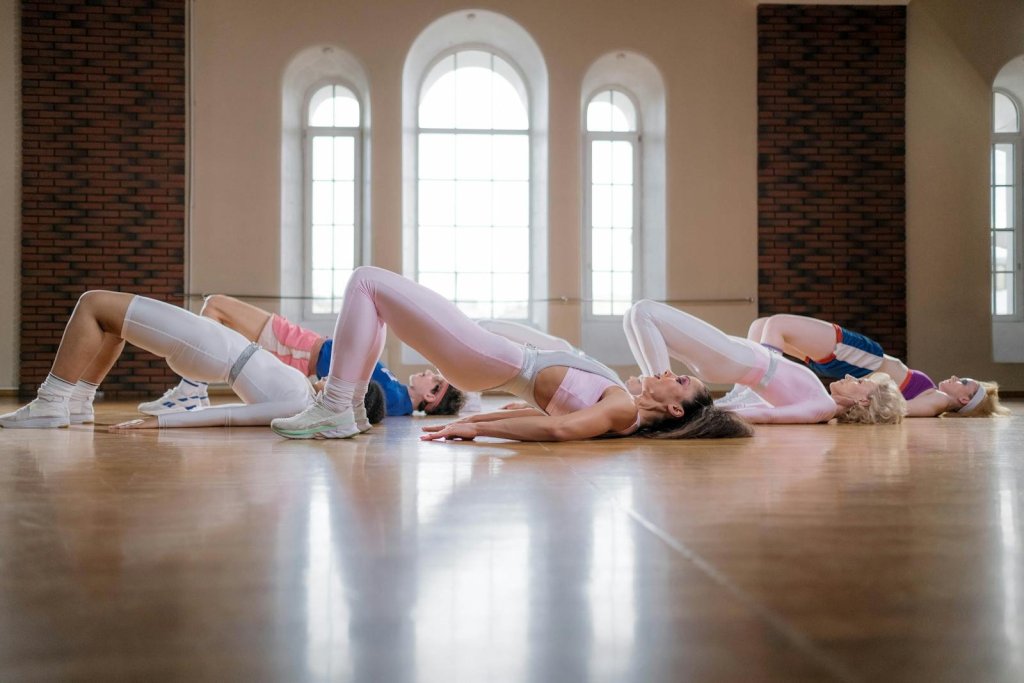
A smart glute routine should target the gluteus maximus, gluteus medius, and gluteus minimus. Cleveland Clinic explains that these three glute muscles help stabilize, balance, and control lower-body movement and posture, which is why glute training is about more than appearance.
The best approach is simple: train hip extension, single-leg strength, squats, hinges, and side-glute stability. Use controlled form, progress gradually, and focus on building strength instead of chasing a “perfect” body shape.
What Are Heart Shaped Butt Exercises?
Heart shaped butt exercises are lower-body exercises that focus on building the glutes, especially the lower and outer glute area. The goal is usually a stronger, fuller, more balanced glute appearance.
But it is important to be realistic. Exercise can help you build muscle and improve strength, but it cannot completely change your natural bone structure or where your body stores fat.
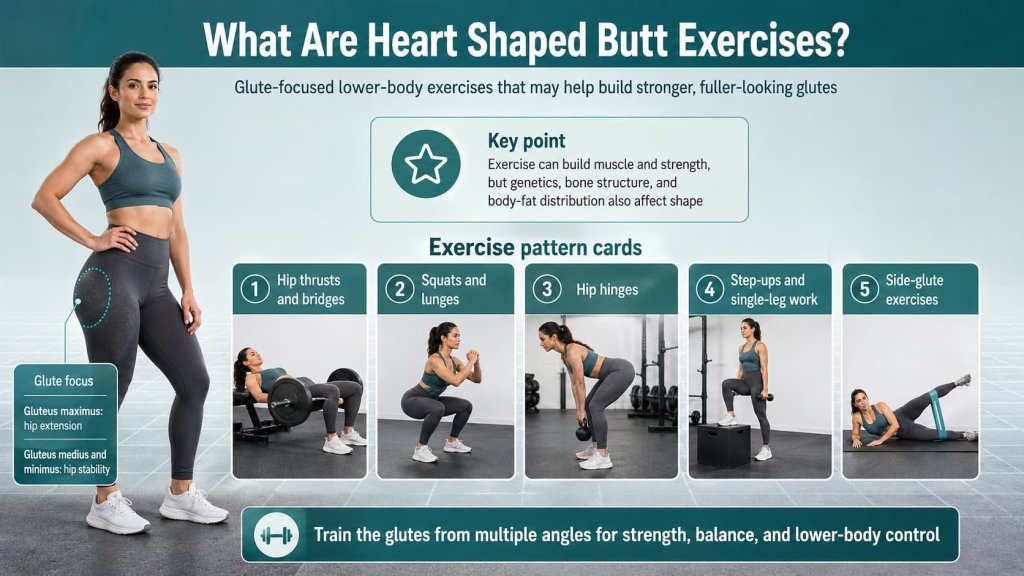
A good heart shaped butt workout usually includes:
- Hip thrust or bridge movements
- Squat and lunge patterns
- Hip hinge exercises
- Step-up or single-leg work
- Side-glute exercises like abductions and band walks
This mix matters because the gluteus maximus helps power big hip-extension movements, while the gluteus medius and minimus help stabilize the pelvis and support hip control. Cleveland Clinic describes the gluteus maximus as important for standing, walking, and running, while the gluteus medius and minimus help with stability and hip movement.
Can Exercises Really Build a Heart Shaped Butt?
Yes, exercises can build stronger and fuller-looking glutes, but they cannot promise one exact “heart shaped” result for everyone.
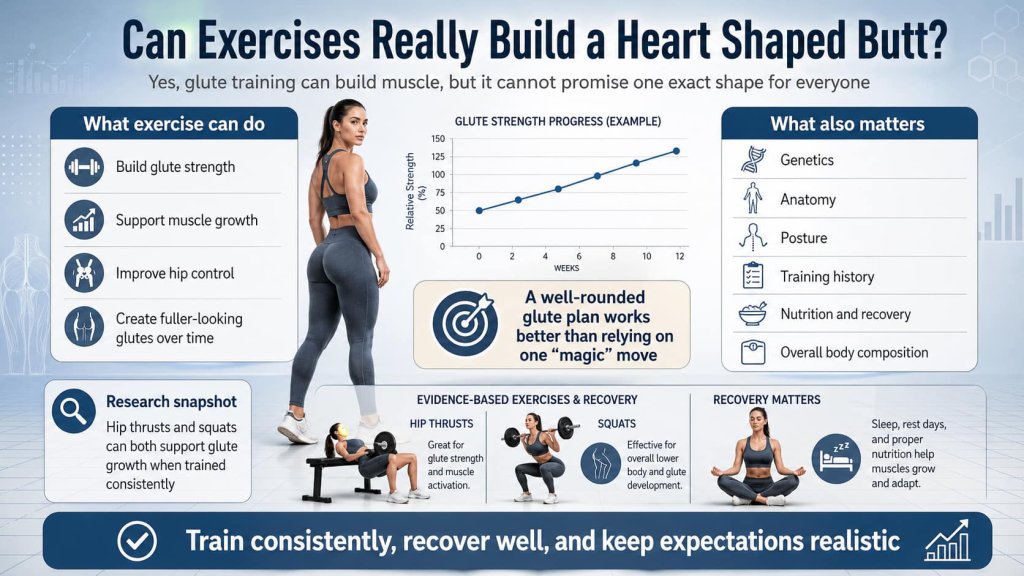
Strength training works by challenging the muscles over time. If you train consistently, eat enough to support your goal, and recover well, your glutes can become stronger and more developed. However, your final shape depends on your anatomy, genetics, posture, training history, and overall body composition.
Research supports using more than one glute exercise. PubMed includes a 2023 study showing that hip thrust training and squat training produced similar gluteal hypertrophy over nine weeks, while squats produced greater thigh hypertrophy. That means both hip-thrust patterns and squat/lunge patterns can have a place in a well-rounded glute plan.
How Often Should You Do Heart Shaped Butt Exercises?
Most people can train glutes 2 to 3 days per week, depending on recovery and total workout volume.
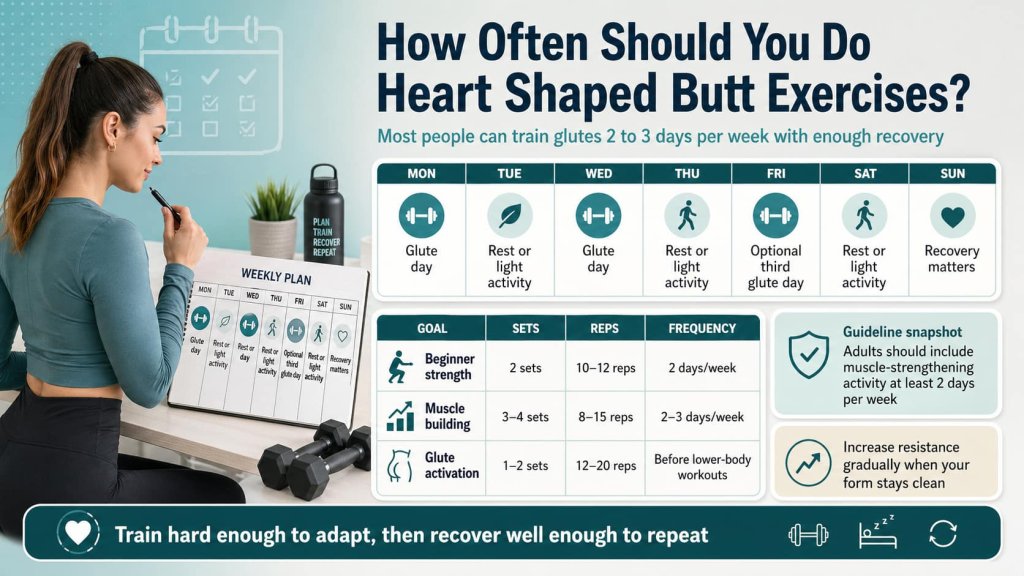
The CDC says adults need at least 2 days of muscle-strengthening activity each week, along with regular aerobic activity for general health. For glute growth, you can use that as a baseline and gradually increase your training as your body adapts.
A simple starting plan:
| Goal | Sets | Reps | Frequency |
|---|---|---|---|
| Beginner strength | 2 sets | 10–12 reps | 2 days/week |
| Muscle building | 3–4 sets | 8–15 reps | 2–3 days/week |
| Glute activation or warm-up | 1–2 sets | 12–20 reps | Before lower-body workouts |
Mayo Clinic notes that a weight that fatigues the muscles around 12 to 15 repetitions can build strength efficiently for many people, and that resistance should increase gradually as strength improves.
Before You Start: Form and Safety Tips
Warm up for 5 to 10 minutes before training your glutes. Use light cardio, bodyweight squats, hip circles, glute bridges, or band walks to prepare your hips and knees.
Keep these safety tips in mind:
- Start with bodyweight or light resistance.
- Keep your core braced and spine neutral.
- Move slowly enough to control each rep.
- Stop if you feel sharp, worsening, or unusual pain.
- Rest at least one day between hard glute workouts.
- Increase weight only when your form stays clean.
If you have a current hip, knee, ankle, or back injury, get guidance from a qualified professional before doing heavy lower-body exercises.
9 Best Heart Shaped Butt Exercises for Stronger, Fuller Glutes
These heart shaped butt exercises train the glutes from different directions. You do not need to do all nine in one workout. Pick 4 to 6 exercises, focus on form, and progress over time.
1. Hip Thrust
The hip thrust is one of the best exercises for directly loading the glutes. ACE describes the barbell hip thrust as a bridge-style exercise with external resistance that focuses on the hip extensor muscles of the gluteal complex.
How to do it
- Sit on the floor with your upper back against a sturdy bench.
- Place your feet flat on the floor about hip-width apart.
- Rest a dumbbell, barbell, or pad across your hips if using weight.
- Brace your core and keep your chin slightly tucked.
- Drive through your heels and lift your hips.
- Squeeze your glutes at the top without arching your lower back.
- Lower slowly and repeat.
Why it works
The hip thrust trains powerful hip extension, which is one of the gluteus maximus’ main jobs. It is especially useful when your goal is glute strength and muscle development without relying only on squats.
Muscles worked
Hip thrusts mainly work the gluteus maximus. They also involve the hamstrings, adductors, core, and smaller hip stabilizers.
Trainer Tip
Pause for one second at the top of each rep. If you feel your lower back more than your glutes, reduce the weight and focus on keeping your ribs down.
2. Glute Bridge
The glute bridge is a beginner-friendly version of the hip thrust. It is done from the floor, which makes it easier to control.
How to do it
- Lie on your back with knees bent and feet flat.
- Keep your feet about hip-width apart.
- Place your arms by your sides.
- Brace your core gently.
- Press through your heels and lift your hips.
- Squeeze your glutes at the top.
- Lower slowly until your hips return to the floor.
Why it works
The glute bridge teaches you how to extend your hips without overusing your lower back. It is a great starting move before progressing to loaded hip thrusts.
Muscles worked
Glute bridges mainly work the gluteus maximus. They also involve the hamstrings, core, and hip stabilizers.
Trainer Tip
Do not push your hips so high that your lower back arches. Aim for a straight line from shoulders to knees at the top.
3. Bulgarian Split Squat
The Bulgarian split squat is a single-leg exercise that challenges glute strength, balance, and hip control.
How to do it
- Stand a few feet in front of a bench or sturdy step.
- Place the top of one foot behind you on the bench.
- Keep your front foot flat on the floor.
- Brace your core and lower your body with control.
- Let your front knee track in line with your toes.
- Push through your front heel and midfoot to stand.
- Complete all reps on one side, then switch legs.
Why it works
This move loads one glute at a time. It also helps reduce side-to-side strength differences, which can improve balance and lower-body control.
Muscles worked
Bulgarian split squats work the glutes, quads, hamstrings, adductors, and core stabilizers.
Trainer Tip
Take a slightly longer stance if you want more glute emphasis. Keep the movement controlled instead of bouncing at the bottom.
4. Romanian Deadlift
The Romanian deadlift is a hip-hinge exercise that trains the glutes and hamstrings through a deep stretch.
How to do it
- Stand tall with feet hip-width apart.
- Hold dumbbells, a barbell, or a kettlebell in front of your thighs.
- Soften your knees slightly.
- Push your hips back as your torso tilts forward.
- Keep your back neutral and the weight close to your legs.
- Lower until you feel a strong hamstring stretch.
- Drive your hips forward to stand tall.
Why it works
Romanian deadlifts train the glutes in a lengthened position. This makes them a strong choice for building the back side of the hips and thighs.
Muscles worked
Romanian deadlifts work the gluteus maximus, hamstrings, spinal erectors, adductors, and core.
Trainer Tip
Think “hips back,” not “hands down.” The weight should move because your hips hinge, not because you round your back.
5. Step-Up
The step-up builds glute strength in a practical way because it trains one leg at a time through a movement similar to stairs.
How to do it
- Stand in front of a sturdy box, bench, or step.
- Place one foot fully on the surface.
- Keep your chest tall and core braced.
- Push through the working leg to stand on the step.
- Avoid jumping off the back leg.
- Step down slowly with control.
- Repeat on one side or alternate legs.
Why it works
Step-ups train hip extension and single-leg stability. They can be especially useful if lunges bother your balance or knees.
Muscles worked
Step-ups work the glutes, quads, hamstrings, calves, and core stabilizers.
Trainer Tip
Choose a step height that lets you control the movement. If your hip shifts or your knee caves inward, use a lower step.
6. Reverse Lunge
The reverse lunge is often easier to control than the forward lunge because the front foot stays planted.
How to do it
- Stand tall with feet hip-width apart.
- Step one foot backward.
- Lower until both knees bend comfortably.
- Keep your front foot flat.
- Push through your front heel and midfoot to return to standing.
- Repeat on one side or alternate legs.
Why it works
Reverse lunges train the glutes, thighs, and hips while challenging balance. They are a strong option for building lower-body strength without needing a machine.
Muscles worked
Reverse lunges work the glutes, quads, hamstrings, calves, and core stabilizers.
Trainer Tip
Keep most of the effort in the front leg. The back leg should help with balance, not do most of the work.
7. Sumo Squat
The sumo squat uses a wider stance than a standard squat. This can increase the demand on the glutes and inner thighs.
How to do it
- Stand with feet wider than shoulder-width.
- Turn your toes slightly outward.
- Hold a dumbbell or kettlebell at your chest if adding weight.
- Brace your core and lower your hips.
- Keep your knees tracking in line with your toes.
- Push through your heels and midfoot to stand.
- Squeeze your glutes at the top without leaning back.
Why it works
The wider stance changes the angle of the hips and can help you feel more glute and adductor involvement. It also builds squat strength in a slightly different position.
Muscles worked
Sumo squats work the glutes, quads, adductors, hamstrings, and core.
Trainer Tip
Do not force an extreme toe angle. Use a stance that lets your knees and toes point in the same direction comfortably.
8. Cable or Band Hip Abduction
Hip abduction trains the side glutes, especially the gluteus medius and gluteus minimus.
How to do it
- Attach a cable ankle strap or loop a resistance band around your ankles.
- Stand tall and hold a stable surface for balance.
- Shift weight onto one leg.
- Move the working leg out to the side.
- Keep your toes pointing mostly forward.
- Pause briefly, then return with control.
- Complete all reps before switching sides.
Why it works
Side-glute training helps build hip stability and can improve the overall shape and balance of the glute area. It is also useful because many big lower-body lifts do not fully replace direct abduction work.
Muscles worked
Hip abductions mainly work the gluteus medius and gluteus minimus. They also involve the tensor fasciae latae and core stabilizers.
Trainer Tip
Use a smaller range of motion if you start leaning your torso. Clean reps are better than swinging your leg high.
9. Lateral Band Walk
The lateral band walk is a simple but effective side-glute exercise. It works well as a warm-up, finisher, or accessory move.
How to do it
- Place a mini band above your knees or around your ankles.
- Stand with feet about hip-width apart.
- Bend your knees slightly and hinge your hips back.
- Keep tension on the band.
- Step sideways with control.
- Bring the other foot in without letting the band go slack.
- Take several steps one way, then return.
Why it works
Lateral band walks train the gluteus medius and hip stabilizers. They can help improve control during squats, lunges, and step-ups.
Muscles worked
Lateral band walks work the gluteus medius, gluteus minimus, gluteus maximus, outer hips, and core stabilizers.
Trainer Tip
Keep your toes facing forward and avoid bouncing. If your knees cave inward, use a lighter band.
Best Heart Shaped Butt Workout Plan
Use this sample workout 2 to 3 times per week. Rest at least one day between hard lower-body sessions.
| Exercise | Sets | Reps |
|---|---|---|
| Hip Thrust | 3 | 8–12 |
| Romanian Deadlift | 3 | 8–12 |
| Bulgarian Split Squat | 2–3 | 8–10 per leg |
| Step-Up or Reverse Lunge | 2–3 | 10–12 per leg |
| Cable or Band Hip Abduction | 2–3 | 12–20 per side |
| Lateral Band Walk | 2 | 10–15 steps each way |
Start with fewer sets if you are new. Add more volume only when soreness, energy, and form are manageable.
How to Progress for Stronger, Fuller Glutes
Progressive overload means gradually making your muscles work harder. You do not need to change exercises every week. You need to improve slowly and safely.
Good progression options include:
- Add 1 to 2 reps per set.
- Add a small amount of weight.
- Add one extra set.
- Slow down the lowering phase.
- Pause at the hardest point.
- Improve range of motion without losing form.
Avoid increasing everything at once. For example, do not add more weight, more sets, and more workout days in the same week.
Common Mistakes That Limit Glute Growth
Even the best heart shaped butt exercises will not work well if your form and recovery are poor.
Common mistakes include:
- Using momentum instead of control
- Arching the lower back during bridges or hip thrusts
- Letting knees cave inward during squats and lunges
- Choosing weights that are too heavy too soon
- Skipping side-glute exercises
- Training glutes hard every day without recovery
- Eating too little to support muscle growth
A better strategy is to train hard enough to challenge your muscles, then recover well enough to repeat quality workouts.
Nutrition and Recovery for Glute Growth
Exercise creates the training signal, but food and recovery help your body adapt.
For better results, focus on:
- Eating enough total calories for your goal
- Getting protein at meals and snacks
- Including carbohydrates for workout energy
- Sleeping consistently
- Drinking enough fluids
- Taking rest days seriously
You do not need extreme dieting or complicated supplement routines to build stronger glutes. Consistent training, enough food, and recovery are more important than quick-fix claims.
Who Should Be Careful With These Exercises?
Most healthy people can do glute exercises with proper form and appropriate resistance. Still, some people should modify or get guidance first.
Be careful if you have:
- Current hip, knee, ankle, or back pain
- Recent surgery or injury
- Balance problems
- Pain that worsens during exercise
- Numbness, tingling, or unusual weakness
- A medical condition that affects safe exercise
If an exercise hurts, stop and switch to a gentler variation. Pain is not a sign that an exercise is “working.”
FAQs About Heart Shaped Butt Exercises
What exercises give you a heart shaped butt?
The best exercises are hip thrusts, glute bridges, Bulgarian split squats, Romanian deadlifts, step-ups, reverse lunges, sumo squats, hip abductions, and lateral band walks. These train the glutes through hip extension, single-leg strength, squatting, hinging, and side-glute stability.
Can you change your butt shape with exercise?
You can build glute muscle and improve strength, which may change how your glutes look over time. However, your exact shape is also affected by genetics, pelvis structure, and body-fat distribution.
How long does it take to see glute results?
Many people notice strength improvements within a few weeks, but visible muscle changes often take several months of consistent training, nutrition, and recovery. Results vary from person to person.
Are squats enough for a heart shaped butt?
Squats can help, but they are usually not enough by themselves. A better plan includes hip thrusts or bridges, hinge exercises, lunges, step-ups, and side-glute movements.
Should I train glutes every day?
No. Hard glute workouts need recovery. Most people do better with 2 to 3 focused glute sessions per week, with rest days or lighter activity between sessions.
What is the best beginner exercise for glutes?
The glute bridge is one of the best beginner exercises because it is simple, low-impact, and easy to control. Once it feels easy, you can progress to hip thrusts, step-ups, and split squats.
Do I need weights to build glutes?
Weights help you progress, but beginners can start with bodyweight exercises and resistance bands. Over time, adding resistance usually makes it easier to keep challenging the glutes.
Conclusion
Heart shaped butt exercises can help you build stronger, fuller-looking glutes when you train consistently and use a balanced plan. Focus on hip thrusts, bridges, lunges, hinges, step-ups, and side-glute work instead of relying on one “magic” move.
Start with clean form, progress gradually, and give your body enough recovery. Strong glutes support better movement, better hip stability, and a more powerful lower body.
References
- Cleveland Clinic — Gluteal Muscles
- Cleveland Clinic — Best Glute Exercises
- CDC — Adult Physical Activity Guidelines
- Mayo Clinic — Strength Training: Get Stronger, Leaner, Healthier
- Mayo Clinic — Weight Training: Do’s and Don’ts of Proper Technique
- ACE Fitness — Understanding the Barbell Hip Thrust
- PubMed — Similar Gluteus Maximus Hypertrophy Responses Between Barbell Hip Thrust and Back Squat Training
- World Health Organization — Physical Activity