
A glycemic index chart ranks carbohydrate-containing foods from low to high based on how quickly they may raise blood sugar. Low glycemic index foods score 55 or below, medium GI foods score 56–69, and high GI foods score 70 or higher.
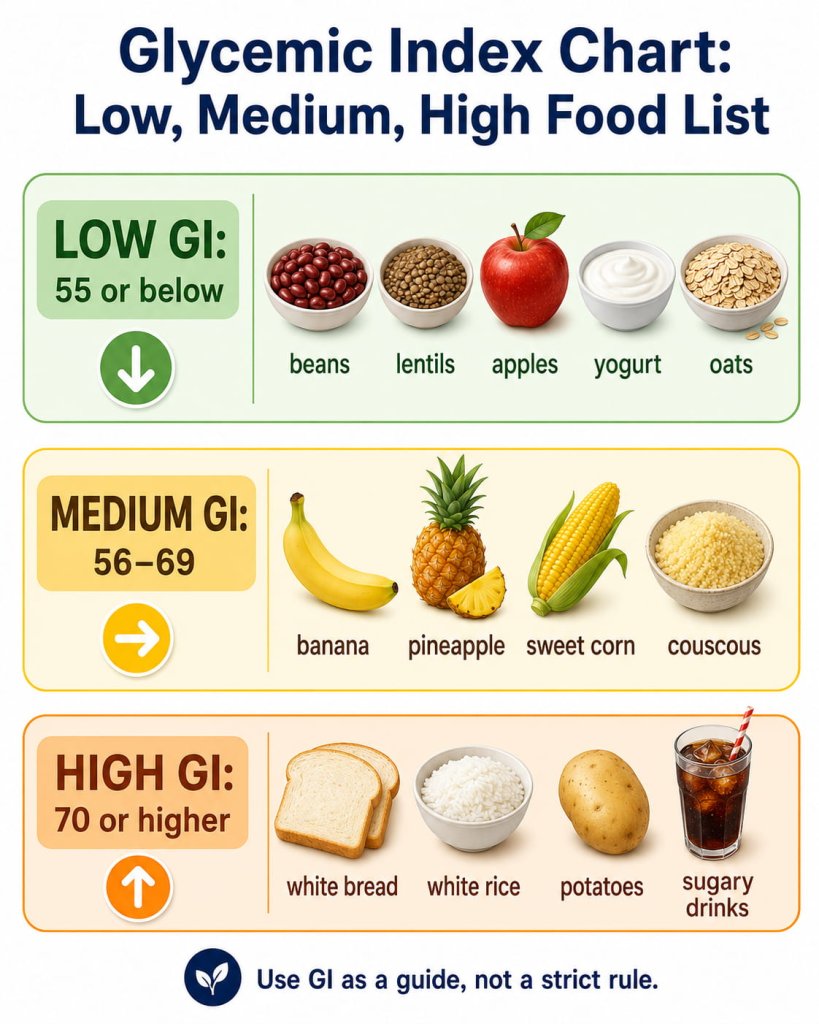
The glycemic index chart can help you choose carbohydrates more wisely, but it should not be the only tool you use. Portion size, total carbohydrates, fiber, protein, fat, cooking method, ripeness, and your personal glucose response all matter. The Mayo Clinic explains that GI can be one food-choice guide, while overall nutrition quality and healthy eating patterns still matter most.
This guide gives you a simple low, medium, and high GI food list, explains glycemic load, and shows how to use the chart safely for everyday meals.
Glycemic Index Chart: Low, Medium, and High GI Foods
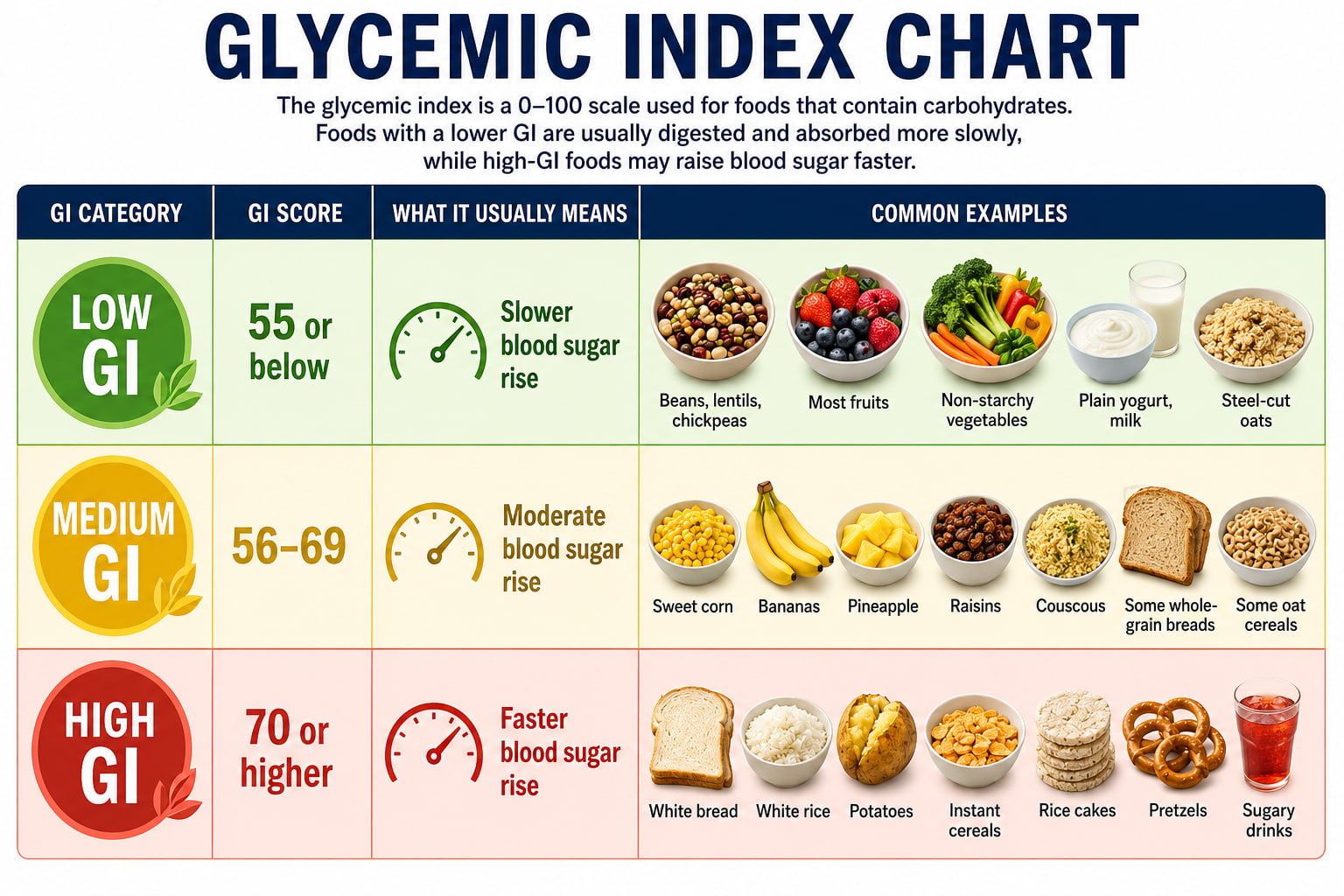
The glycemic index is a 0–100 scale used for foods that contain carbohydrates. Foods with a lower GI are usually digested and absorbed more slowly, while high-GI foods may raise blood sugar faster. The standard GI categories are low GI 1–55, medium GI 56–69, and high GI 70 or higher.
| GI Category | GI Score | What It Usually Means | Common Examples |
|---|---|---|---|
| Low GI | 55 or below | Slower blood sugar rise | Beans, lentils, chickpeas, most fruits, non-starchy vegetables, plain yogurt, milk, steel-cut oats |
| Medium GI | 56–69 | Moderate blood sugar rise | Sweet corn, bananas, pineapple, raisins, couscous, some whole-grain breads, some oat cereals |
| High GI | 70 or higher | Faster blood sugar rise | White bread, white rice, potatoes, instant cereals, rice cakes, pretzels, sugary drinks |
Use this chart as a starting point, not a strict rule. The exact GI of a food can vary by variety, brand, processing, cooking method, ripeness, and what you eat with it.
What Is the Glycemic Index?
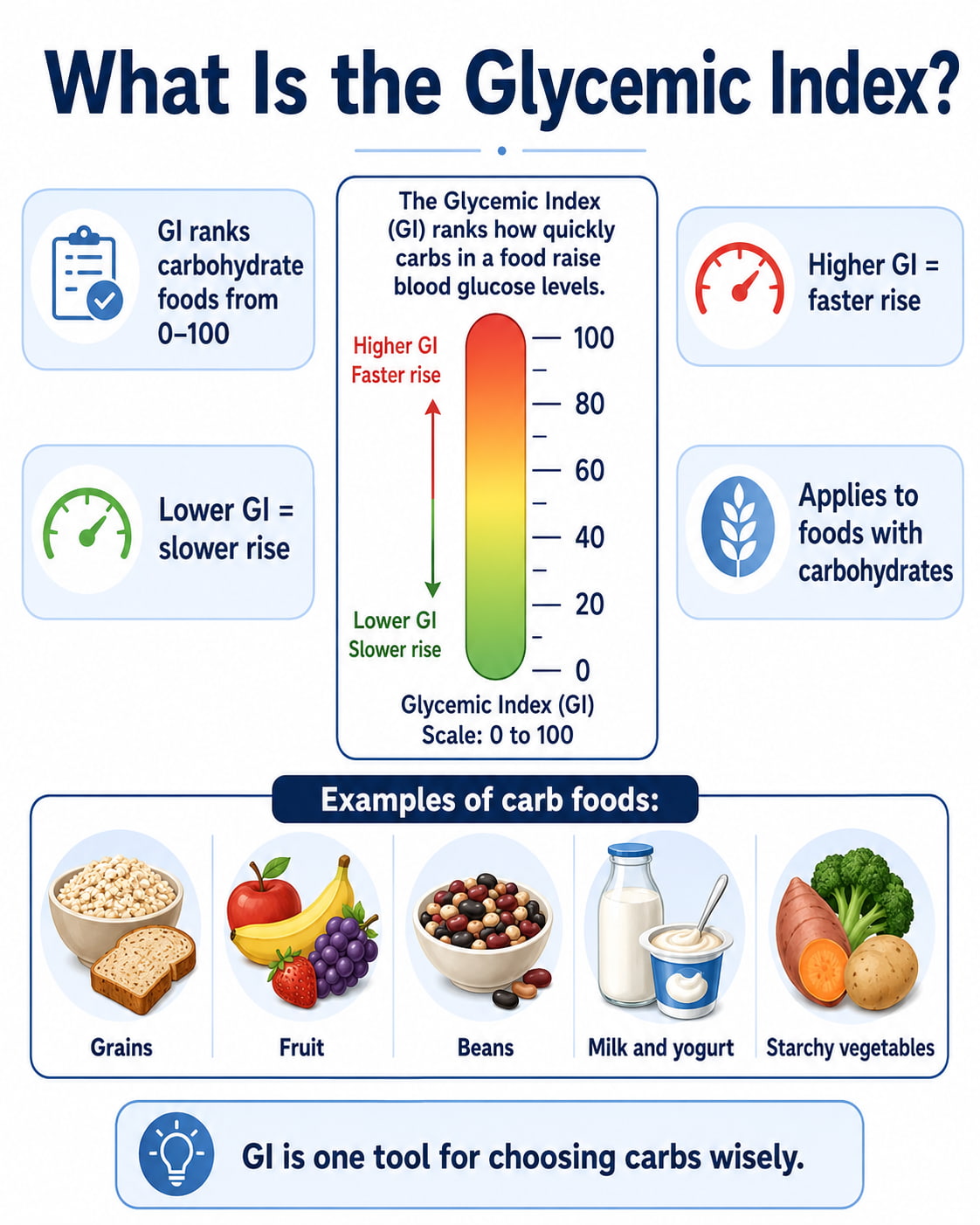
The glycemic index, often shortened to GI, measures how a carbohydrate-containing food affects blood glucose compared with a reference food such as glucose. In simple terms, it helps estimate whether a food is likely to raise blood sugar slowly, moderately, or quickly.
The University of Sydney Glycemic Index database is one of the most useful tools for checking tested GI and glycemic load values because it includes GI, GL, serving size, carbohydrate per serving, and study references for many foods.
GI mainly applies to foods that contain carbohydrates, such as:
- Grains
- Bread
- Rice
- Pasta
- Cereal
- Fruit
- Starchy vegetables
- Beans and lentils
- Milk and yogurt
- Sweets and sugary drinks
Foods with little or no carbohydrate, such as plain meat, fish, poultry, eggs, oils, and most cheeses, usually do not have a meaningful GI score.
Low Glycemic Index Food List
Low GI foods score 55 or below. These foods are often higher in fiber, less processed, or digested more slowly. They may help support steadier blood sugar when used as part of a balanced eating plan.
Low GI Fruits
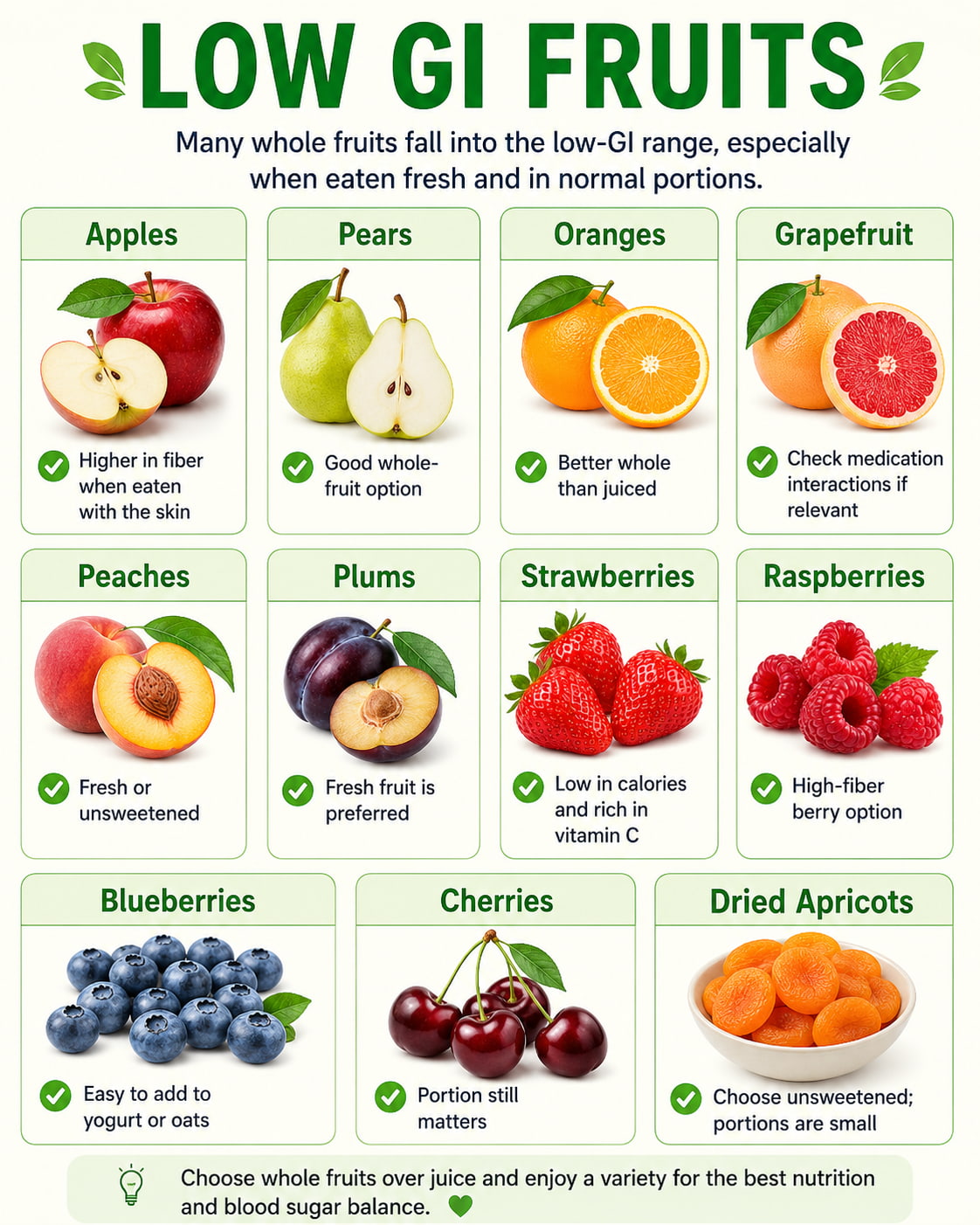
Many whole fruits fall into the low-GI range, especially when eaten fresh and in normal portions.
| Low GI Fruits | Notes |
|---|---|
| Apples | Higher in fiber when eaten with the skin |
| Pears | Good whole-fruit option |
| Oranges | Better whole than juiced |
| Grapefruit | Check medication interactions if relevant |
| Peaches | Fresh or unsweetened |
| Plums | Fresh fruit is preferred |
| Strawberries | Low in calories and rich in vitamin C |
| Raspberries | High-fiber berry option |
| Blueberries | Easy to add to yogurt or oats |
| Cherries | Portion still matters |
| Dried apricots | Choose unsweetened; portions are small |
Whole fruit is usually a better choice than fruit juice because whole fruit contains fiber and takes longer to eat.
Low GI Vegetables
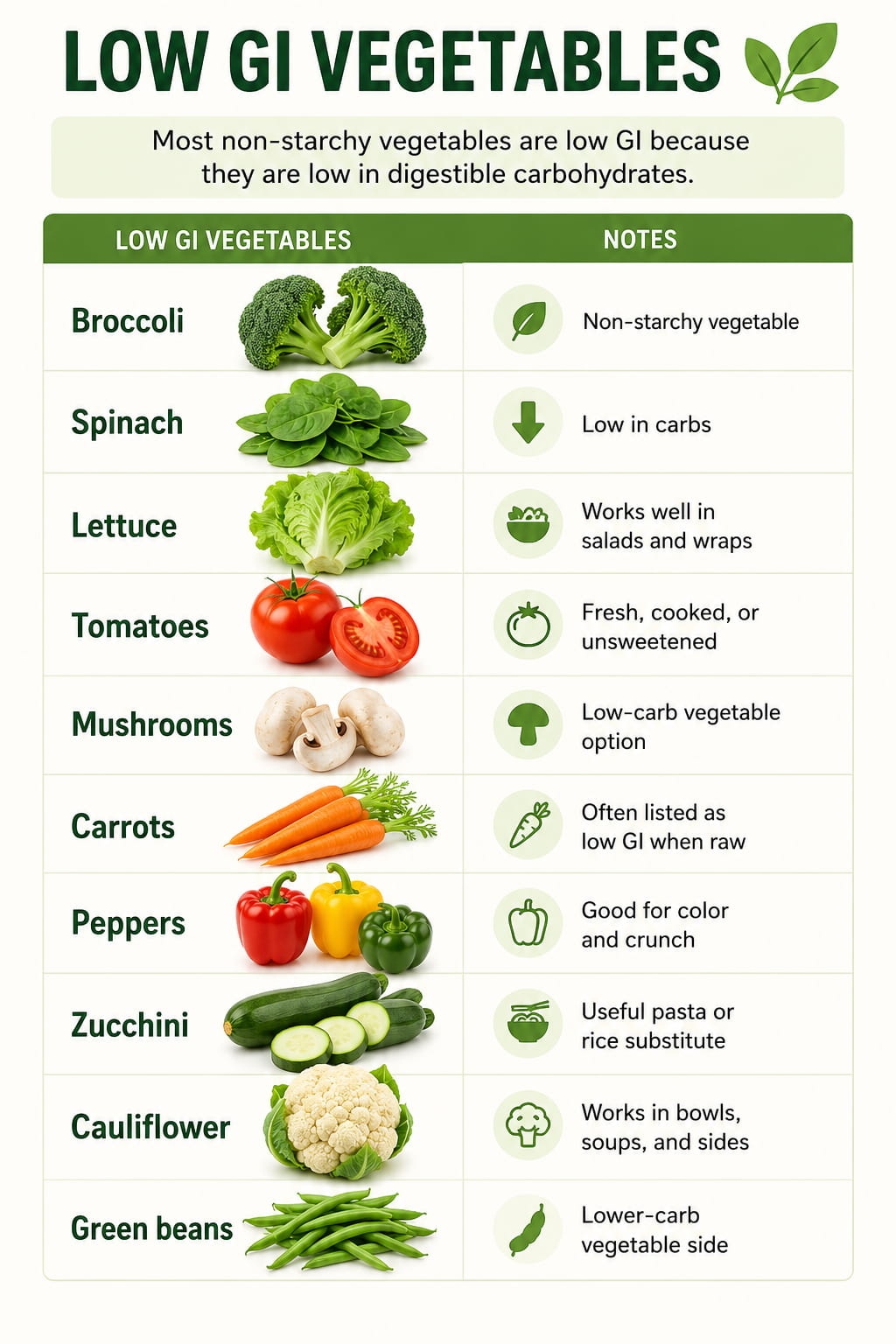
Most non-starchy vegetables are low GI because they are low in digestible carbohydrates.
| Low GI Vegetables | Notes |
|---|---|
| Broccoli | Non-starchy vegetable |
| Spinach | Low in carbs |
| Lettuce | Works well in salads and wraps |
| Tomatoes | Fresh, cooked, or unsweetened |
| Mushrooms | Low-carb vegetable option |
| Carrots | Often listed as low GI when raw |
| Peppers | Good for color and crunch |
| Zucchini | Useful pasta or rice substitute |
| Cauliflower | Works in bowls, soups, and sides |
| Green beans | Lower-carb vegetable side |
Non-starchy vegetables are a smart foundation for meals. The American Diabetes Association recommends using a 9-inch plate and filling half with non-starchy vegetables, one-quarter with lean protein, and one-quarter with quality carbohydrates.
Low GI Beans and Legumes
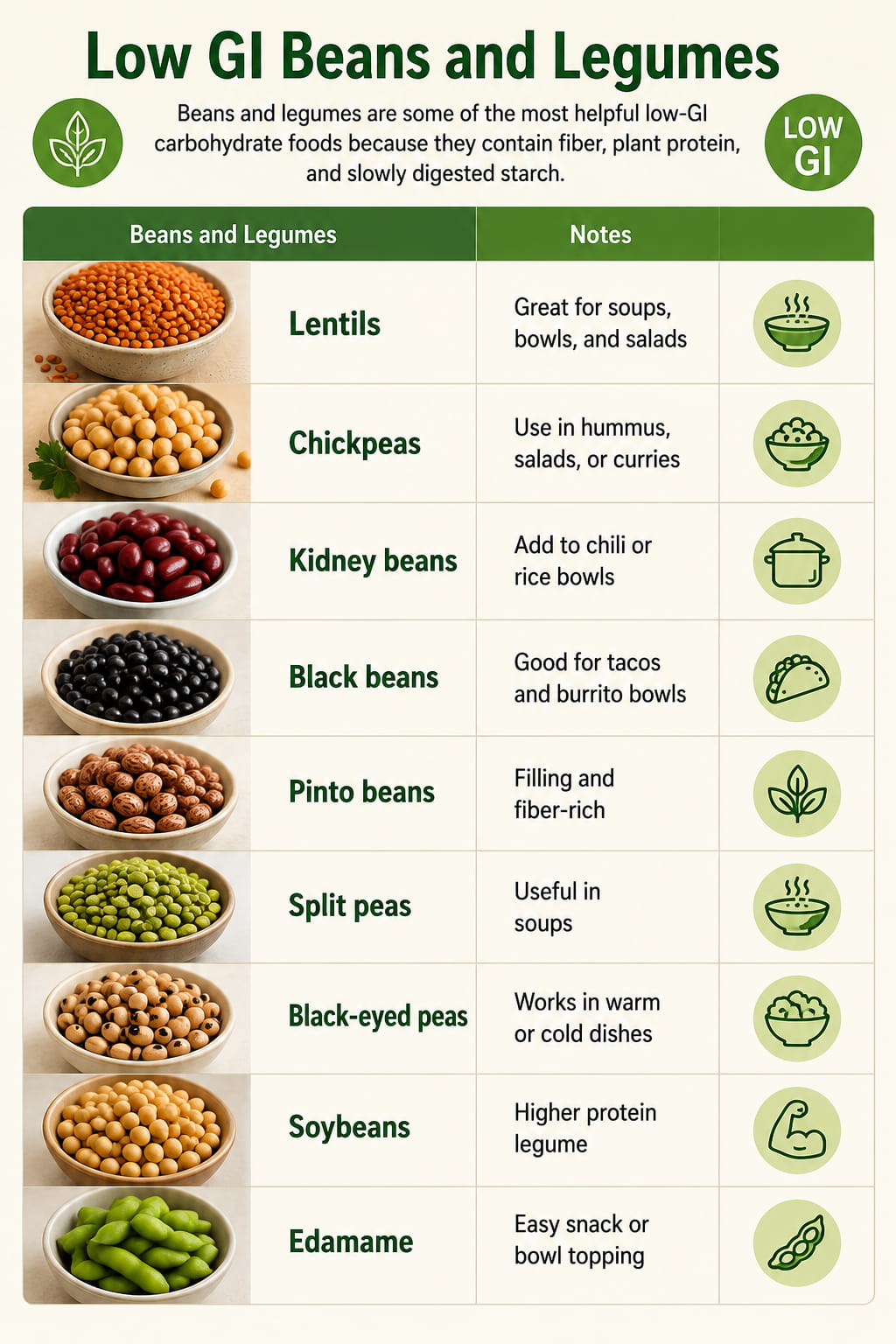
Beans and legumes are some of the most helpful low-GI carbohydrate foods because they contain fiber, plant protein, and slowly digested starch.
| Low GI Beans and Legumes | Notes |
|---|---|
| Lentils | Great for soups, bowls, and salads |
| Chickpeas | Use in hummus, salads, or curries |
| Kidney beans | Add to chili or rice bowls |
| Black beans | Good for tacos and burrito bowls |
| Pinto beans | Filling and fiber-rich |
| Split peas | Useful in soups |
| Black-eyed peas | Works in warm or cold dishes |
| Soybeans | Higher protein legume |
| Edamame | Easy snack or bowl topping |
Low GI Grains and Starches
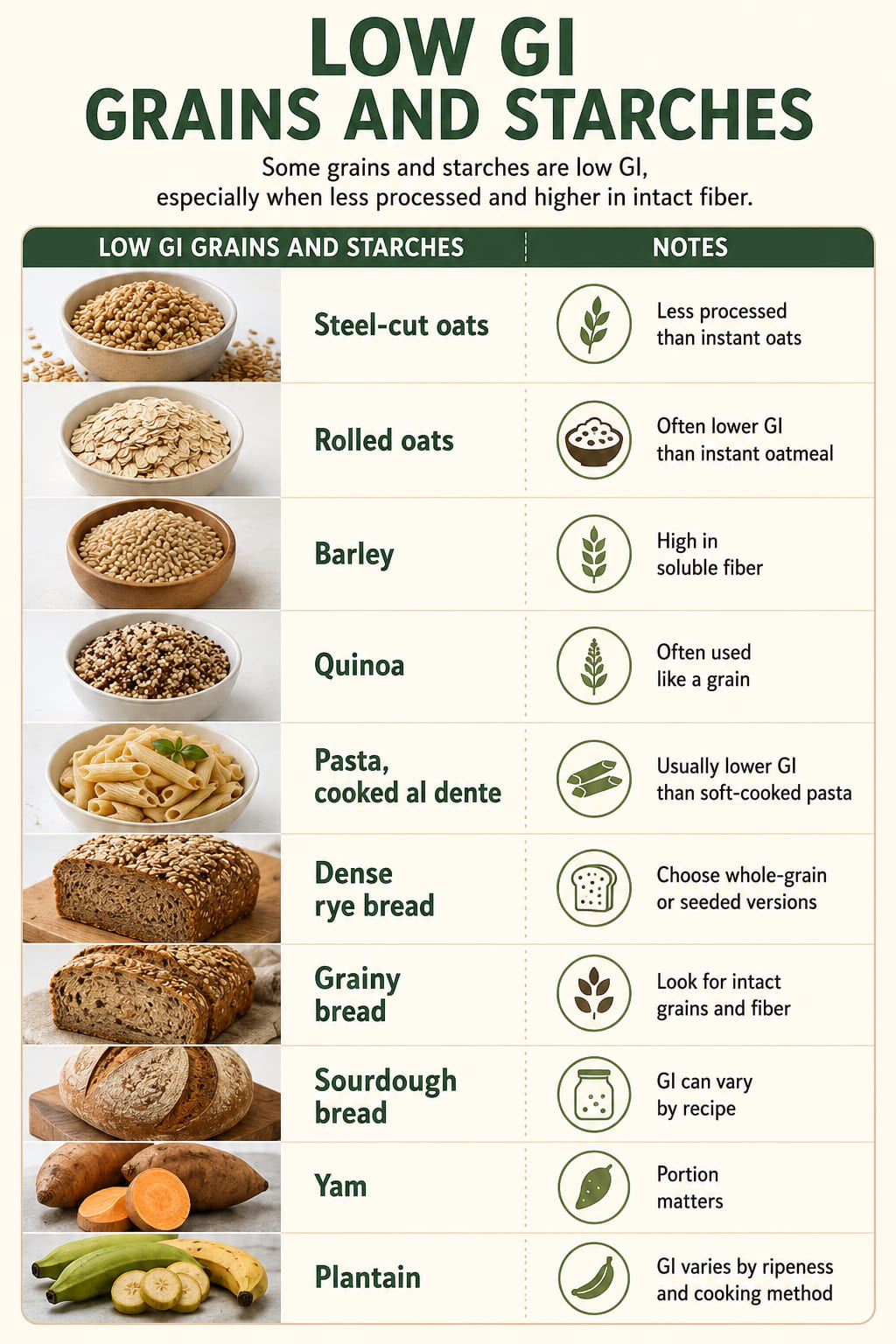
Some grains and starches are low GI, especially when less processed and higher in intact fiber.
| Low GI Grains and Starches | Notes |
|---|---|
| Steel-cut oats | Less processed than instant oats |
| Rolled oats | Often lower GI than instant oatmeal |
| Barley | High in soluble fiber |
| Quinoa | Often used like a grain |
| Pasta, cooked al dente | Usually lower GI than soft-cooked pasta |
| Dense rye bread | Choose whole-grain or seeded versions |
| Grainy bread | Look for intact grains and fiber |
| Sourdough bread | GI can vary by recipe |
| Yam | Portion matters |
| Plantain | GI varies by ripeness and cooking method |
Low GI Dairy and Alternatives
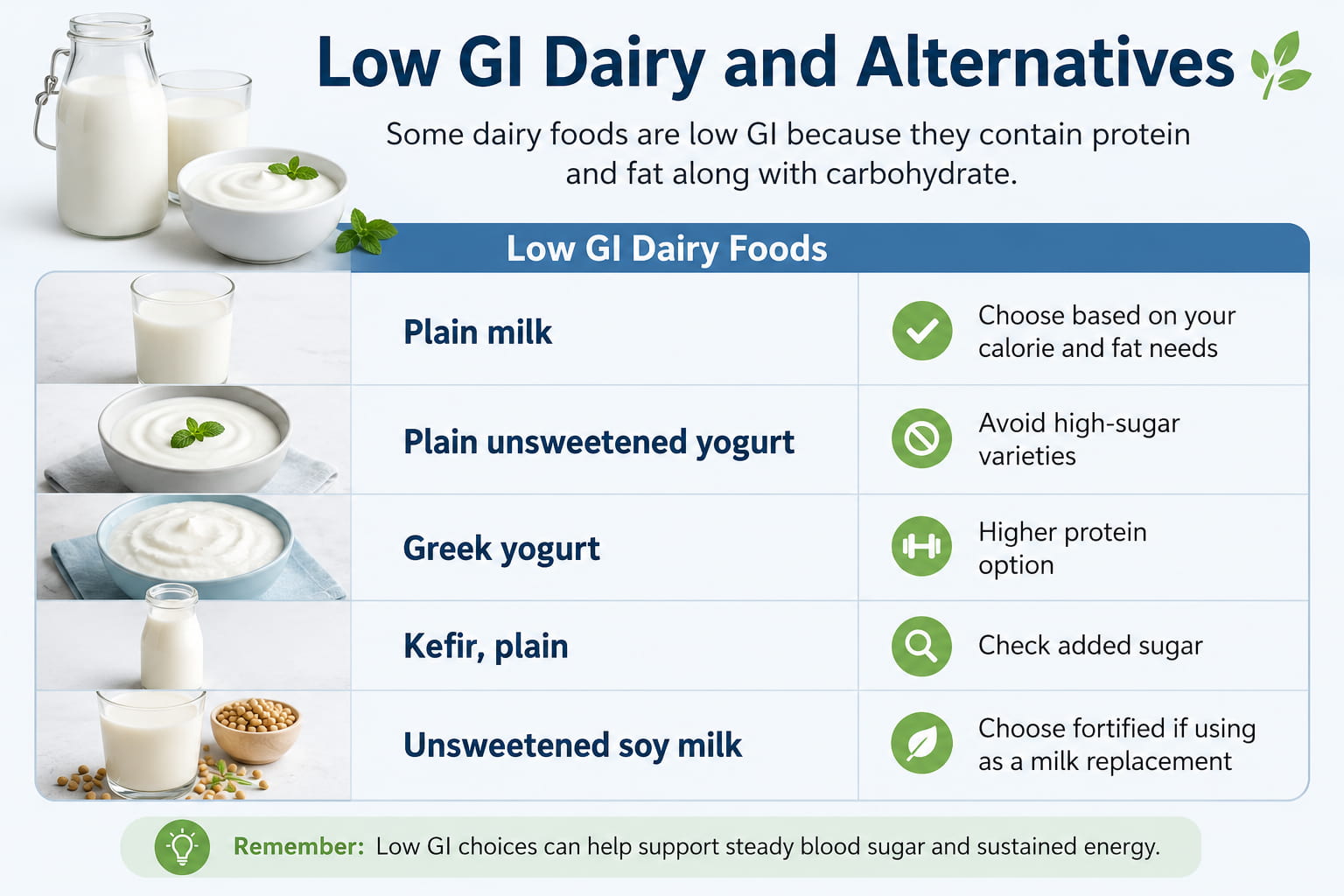
Some dairy foods are low GI because they contain protein and fat along with carbohydrate.
| Low GI Dairy Foods | Notes |
|---|---|
| Plain milk | Choose based on your calorie and fat needs |
| Plain unsweetened yogurt | Avoid high-sugar varieties |
| Greek yogurt | Higher protein option |
| Kefir, plain | Check added sugar |
| Unsweetened soy milk | Choose fortified if using as a milk replacement |
Flavored yogurts, sweetened milk drinks, and dessert-style dairy products may have more added sugar, so check the Nutrition Facts label.
Medium Glycemic Index Food List
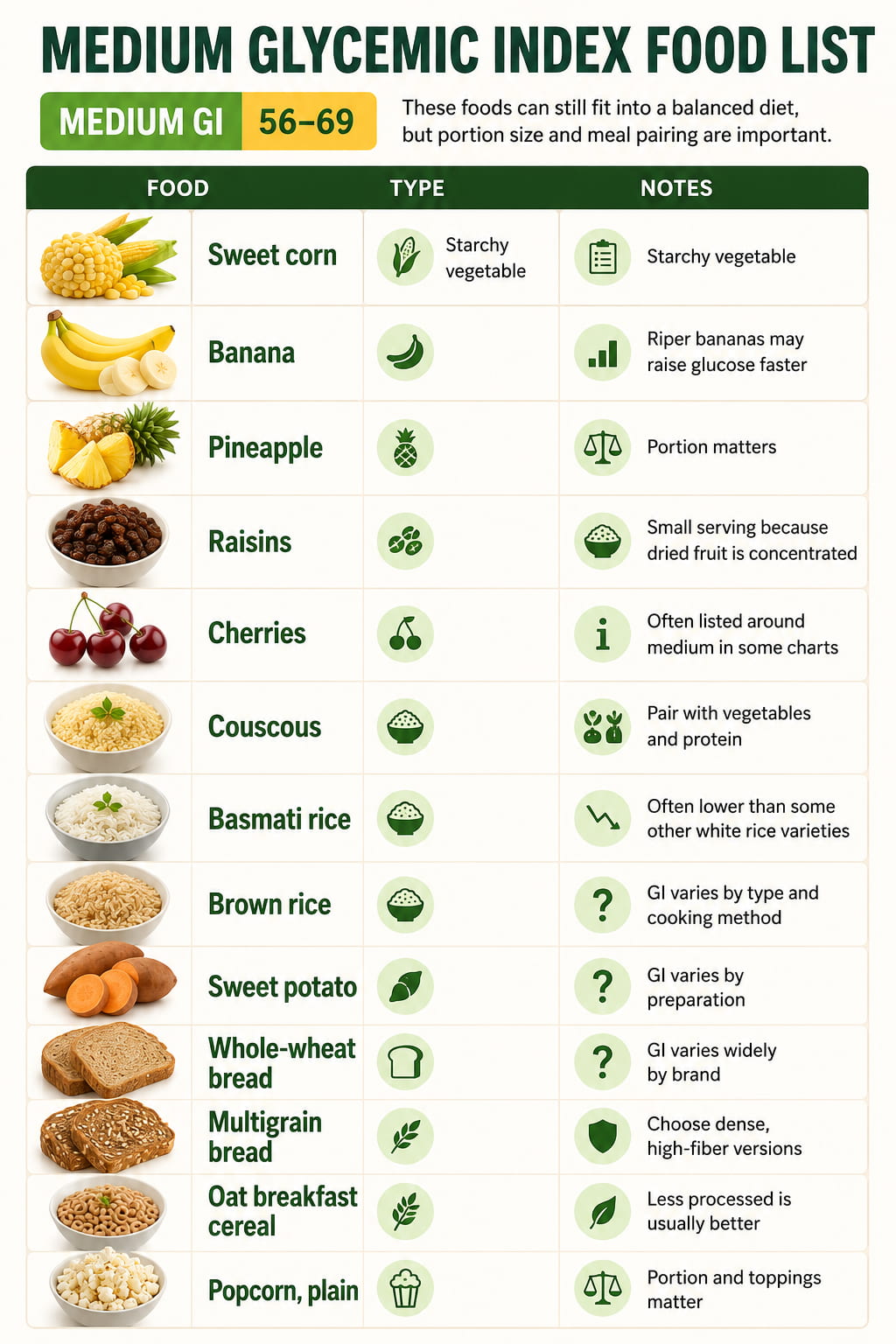
Medium GI foods score 56–69. These foods can still fit into a balanced diet, but portion size and meal pairing are important.
| Medium GI Foods | Notes |
|---|---|
| Sweet corn | Starchy vegetable |
| Banana | Riper Bananas may raise glucose faster |
| Pineapple | Portion matters |
| Raisins | Small serving because dried fruit is concentrated |
| Cherries | Often listed around medium in some charts |
| Couscous | Pair with vegetables and protein |
| Basmati rice | Often lower than some other white rice varieties |
| Brown rice | GI varies by type and cooking method |
| Sweet potato | GI varies by preparation |
| Whole-wheat bread | GI varies widely by brand |
| Multigrain bread | Choose dense, high-fiber versions |
| Oat breakfast cereal | Less processed is usually better |
| Popcorn, plain | Portion and toppings matter |
Medium GI does not automatically mean “bad.” For example, a banana or sweet potato can provide useful nutrients. The better question is: How much are you eating, and what are you eating it with?
High Glycemic Index Food List
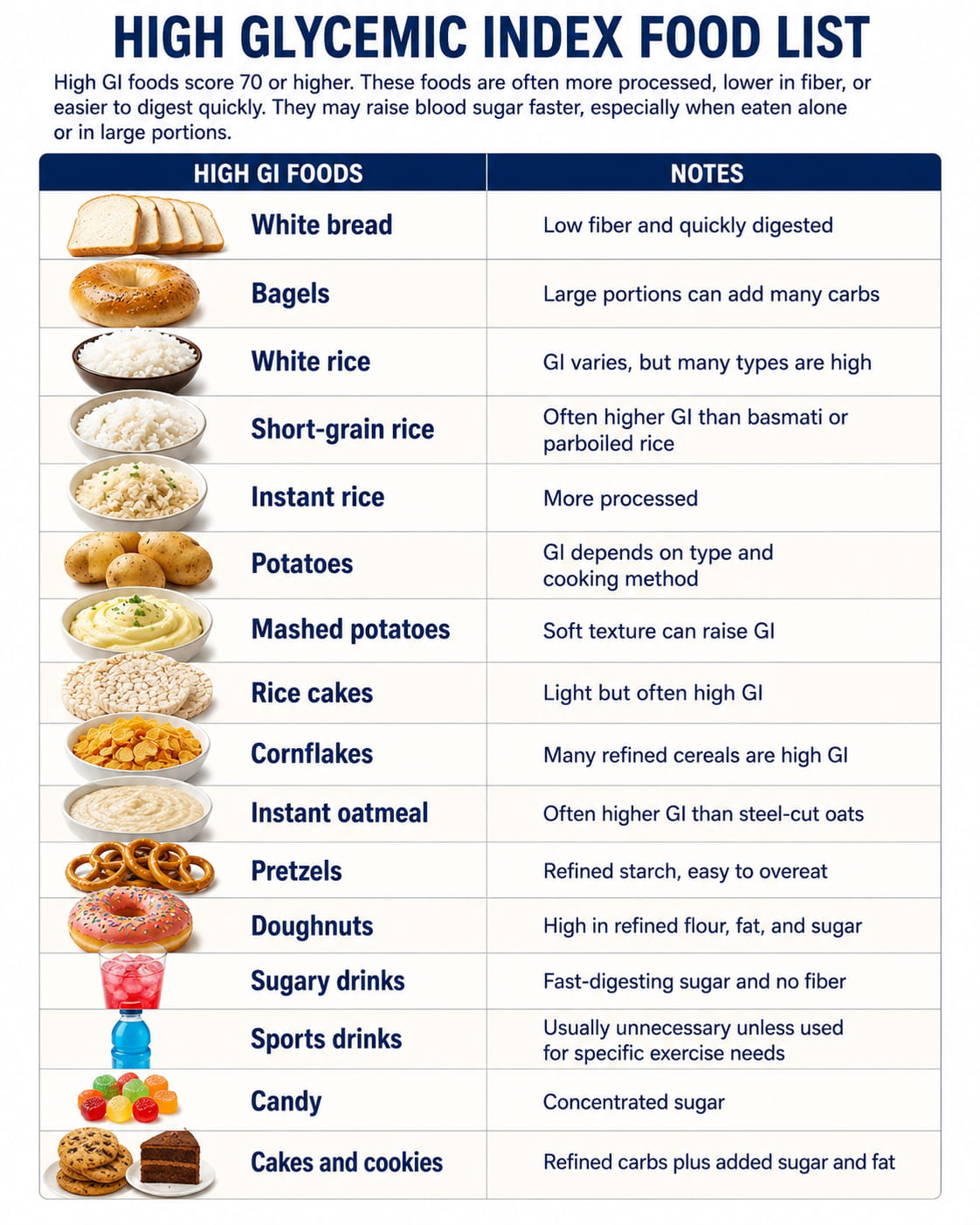
High GI foods score 70 or higher. These foods are often more processed, lower in fiber, or easier to digest quickly. They may raise blood sugar faster, especially when eaten alone or in large portions.
| High GI Foods | Notes |
|---|---|
| White bread | Low fiber and quickly digested |
| Bagels | Large portions can add many carbs |
| White rice | GI varies, but many types are high |
| Short-grain rice | Often higher GI than basmati or parboiled rice |
| Instant rice | More processed |
| Potatoes | GI depends on type and cooking method |
| Mashed potatoes | Soft texture can raise GI |
| Rice cakes | Light but often high GI |
| Cornflakes | Many refined cereals are high GI |
| Instant oatmeal | Often higher GI than steel-cut oats |
| Pretzels | Refined starch, easy to overeat |
| Doughnuts | High in refined flour, fat, and sugar |
| Sugary drinks | Fast-digesting sugar and no fiber |
| Sports drinks | Usually unnecessary unless used for specific exercise needs |
| Candy | Concentrated sugar |
| Cakes and cookies | Refined carbs plus added sugar and fat |
You do not have to avoid every high-GI food forever. But if blood sugar control is a concern, high-GI foods are usually better eaten less often, in smaller portions, or paired with protein, fiber, and healthy fat.
Glycemic Index vs. Glycemic Load
The glycemic index tells you how quickly a carbohydrate food may raise blood sugar, but it does not tell you how much carbohydrate you actually eat in a normal portion.
That is where glycemic load, or GL, helps.
Glycemic load considers both:
- The GI of the food
- The amount of carbohydrate in a typical serving
Mayo Clinic lists glycemic load categories as low GL 1–10, medium GL 11–19, and high GL 20 or more. This matters because a food can have a higher GI but a lower real-life blood sugar impact if a normal serving contains a smaller amount of carbohydrate.
Simple Example
Watermelon is often discussed in GI charts because some older lists show it as high GI. But a normal serving of watermelon contains a lot of water and a moderate amount of carbohydrate, so the glycemic load can be lower than people expect.
That is why GI should not be used alone. A small portion of a higher-GI food may have less impact than a large portion of a medium-GI food.
What Affects a Food’s Glycemic Index?
GI values are useful, but they are not perfect. The same food can act differently depending on how it is prepared, processed, and eaten.
1. Processing
More processed foods are often digested faster. For example, instant oats may raise blood sugar faster than steel-cut oats because the grain structure is more broken down.
2. Cooking Time
Longer cooking can soften starches and make them easier to digest. Pasta cooked al dente usually has a lower GI than pasta cooked very soft.
3. Ripeness
Fruit ripeness can change blood sugar response. A very ripe banana may raise blood sugar faster than a less ripe banana.
4. Fiber Content
Fiber can slow digestion. Beans, lentils, intact grains, vegetables, and whole fruits are often better choices than refined grains and juices.
5. Protein and Fat
Eating carbohydrates with protein or healthy fat can slow digestion. For example, toast with eggs or beans may have a different effect than plain toast alone.
6. Food Acidity
Vinegar, lemon juice, and fermented foods may reduce the glycemic response of a meal for some people, especially when used as part of a balanced meal.
7. Portion Size
A huge portion of a low-GI food can still provide a large amount of carbohydrate. A small portion of a higher-GI food may have a smaller total effect.
The ADA Nutrition & Wellness Team notes that individual blood glucose response can vary based on many factors, including fiber, ripeness, meal composition, eating speed, current glucose level, and medication timing. It also states that GI is not recommended as a stand-alone tool for people with diabetes.
How to Use a Glycemic Index Chart Safely
A glycemic index chart is most helpful when you use it with common sense and balanced meal planning.
Use GI as a Guide, Not a Rulebook
Choose more low-GI, high-fiber, nutrient-dense carbohydrates most of the time. But do not judge a food only by its GI number.
For example, whole fruit may have a higher GI than some processed low-carb snack foods, but fruit provides vitamins, minerals, fiber, and plant compounds.
Watch Total Carbohydrates
If you have diabetes or track blood sugar, total carbohydrates often matter more than GI alone. The American Diabetes Association recommends using total carbohydrates on the Nutrition Facts label rather than relying on “net carbs,” which does not have a legal FDA definition.
Build Balanced Plates
A simple blood sugar-friendly plate can include:
- ½ plate: non-starchy vegetables
- ¼ plate: lean protein
- ¼ plate: quality carbohydrate
- Small amount: healthy fat
- Drink: water or unsweetened beverage
This approach is easier than memorizing hundreds of GI numbers.
Pair Carbs With Protein, Fiber, and Healthy Fat
Instead of eating a carbohydrate by itself, pair it with foods that slow digestion.
Examples:
- Apple with peanut butter
- Oatmeal with Greek yogurt and chia seeds
- Brown rice with salmon and broccoli
- Whole-grain toast with eggs
- Lentil soup with salad
- Beans with avocado and vegetables
Check Your Own Response
If you monitor blood glucose, your personal response matters. Two people can eat the same food and have different glucose changes.
Helpful steps:
- Check your blood glucose before a meal if advised by your healthcare team.
- Eat a normal portion of the food.
- Check again as directed, often around two hours after eating.
- Look for patterns over time.
Talk with your healthcare professional if you notice frequent high or low readings.
Best Low-GI Swaps for Everyday Meals
Small swaps can make meals more balanced without making your diet feel strict.
| Instead of This | Try This |
|---|---|
| White bread | Dense whole-grain, rye, seeded, or sourdough bread |
| Sugary cereal | Steel-cut oats or plain rolled oats |
| White rice | Basmati rice, brown rice, barley, quinoa, or lentils |
| Large baked potato | Smaller potato with beans, vegetables, and protein |
| Fruit juice | Whole fruit |
| Sweetened yogurt | Plain Greek yogurt with berries |
| Crackers or pretzels | Nuts, hummus with vegetables, or roasted chickpeas |
| Sugary drink | Water, sparkling water, or unsweetened tea |
| Candy snack | Fruit with nuts or yogurt |
| Plain pasta bowl | Al dente pasta with vegetables and lean protein |
Sample Low-GI Meal Ideas
Here are simple meals that use low-GI or lower-GI choices while keeping the plate balanced.
Breakfast Ideas
- Steel-cut oats with Greek yogurt, berries, and chia seeds
- Egg and avocado on dense whole-grain toast
- Plain yogurt with berries, walnuts, and cinnamon
- Vegetable omelet with a small slice of rye toast
- Smoothie with plain yogurt, berries, spinach, and ground flaxseed
Lunch Ideas
- Lentil soup with a side salad
- Chickpea and vegetable bowl with quinoa
- Turkey and avocado wrap with a high-fiber tortilla
- Tuna salad over greens with whole-grain crackers
- Bean chili with vegetables
Dinner Ideas
- Salmon with barley and roasted broccoli
- Chicken stir-fry with vegetables and a smaller portion of basmati rice
- Tofu vegetable curry with lentils
- Turkey chili with beans
- Whole-wheat pasta cooked al dente with vegetables and lean protein
Snack Ideas
- Apple slices with peanut butter
- Carrots and hummus
- Plain Greek yogurt with berries
- Roasted chickpeas
- Pear with walnuts
- Cottage cheese with fruit
- Edamame
Foods Without a Glycemic Index
Not every food belongs on a GI chart. GI is mainly for carbohydrate-containing foods. Foods with little or no carbohydrate usually do not have a meaningful GI value.
Examples include:
- Eggs
- Fish
- Chicken
- Turkey
- Beef
- Olive oil
- Avocado oil
- Butter
- Most cheeses
- Plain tofu
- Nuts and seeds in small portions
These foods can still affect the overall meal. Protein and fat can slow digestion, while large portions of high-calorie foods may affect weight, cholesterol, or heart health goals.
Common Mistakes When Using a Glycemic Index Chart
Mistake 1: Thinking Low GI Always Means Healthy
Some low-GI foods may still be high in calories, saturated fat, added sugar, or low in nutrients. GI is only one number.
Mistake 2: Ignoring Portion Size
A large serving of low-GI pasta or rice can still contain many grams of carbohydrate. Portion size matters.
Mistake 3: Avoiding All High-GI Foods
Some higher-GI foods, such as potatoes or certain fruits, can still provide nutrients. The key is portion size, preparation, and meal balance.
Mistake 4: Forgetting About Drinks
Sugary drinks can raise blood sugar quickly because they contain fast-digesting sugar and little or no fiber.
Mistake 5: Using GI Instead of Medical Advice
If you take insulin or glucose-lowering medication, changing your carbohydrate intake can affect blood sugar and medication needs. Always follow your care plan.
Who Should Be Extra Careful With GI Charts?
A glycemic index chart can be useful, but some people need personalized guidance.
Speak with a healthcare professional or registered dietitian if you:
- Have type 1 diabetes
- Have type 2 diabetes
- Have prediabetes
- Have gestational diabetes
- Take insulin or sulfonylurea medication
- Have frequent low blood sugar
- Have kidney disease
- Have a history of eating disorders
- Are pregnant or breastfeeding
- Are making major diet changes
GI information should support your care plan, not replace it.
FAQs About Glycemic Index Chart
What is a glycemic index chart?
A glycemic index chart is a food list that ranks carbohydrate-containing foods by how quickly they may raise blood sugar. Low GI foods score 55 or below, medium GI foods score 56–69, and high GI foods score 70 or higher.
What foods are low on the glycemic index?
Low-GI foods include beans, lentils, chickpeas, most non-starchy vegetables, many whole fruits, plain yogurt, milk, steel-cut oats, barley, and some dense whole-grain breads.
Is rice low or high GI?
Rice varies by type. Some rice, such as basmati or certain brown rice varieties, may fall closer to medium GI, while short-grain white rice and instant rice are often higher GI. Portion size and what you eat with rice also matter.
Are potatoes high glycemic?
Many potatoes are medium to high GI, but the number can change based on the potato variety, cooking method, and whether the potato is eaten hot, cooled, mashed, roasted, or paired with protein and vegetables.
Is oatmeal low GI?
Steel-cut oats and less processed rolled oats are often lower GI than instant oatmeal. Choose plain oats and add protein, fiber, and healthy fat, such as Greek yogurt, chia seeds, nuts, or berries.
Is glycemic index the same as carbs?
No. Glycemic index measures how quickly a carbohydrate food may raise blood sugar. Total carbohydrates tell you how many grams of carbohydrate are in a serving. For blood sugar management, both can matter.
Should people with diabetes use a glycemic index chart?
People with diabetes may use GI as one tool, but it should not be used alone. The American Diabetes Association emphasizes that individual glucose response varies, and meal planning should also consider total carbohydrates, portion size, glucose monitoring, medication timing, and overall meal balance.
Conclusion
A glycemic index chart is a useful starting point for choosing carbohydrates that may support steadier blood sugar. Focus on low-GI, high-fiber, nutrient-rich foods such as beans, lentils, vegetables, whole fruits, plain yogurt, oats, barley, and less processed grains.
For best results, do not rely on GI alone. Pay attention to portion size, total carbohydrates, glycemic load, fiber, protein, healthy fats, and your own blood sugar response. Start with one simple change, such as swapping white bread for dense whole-grain bread or replacing juice with whole fruit, and build from there.
This content is for informational purposes only and not medical advice.
References
- Mayo Clinic: Low-glycemic index diet
- American Diabetes Association: Why the Glycemic Index Isn’t a Helpful Tool and What You Should Do Instead
- American Diabetes Association: Eating Well & Managing Diabetes
- University of Sydney: Glycemic Index Database
- Diabetes UK: Glycaemic Index and Diabetes
- PubMed: International Tables of Glycemic Index and Glycemic Load Values